
Hospitality Branding Agency vs Graphic Designer: Which Do You Actually Need?
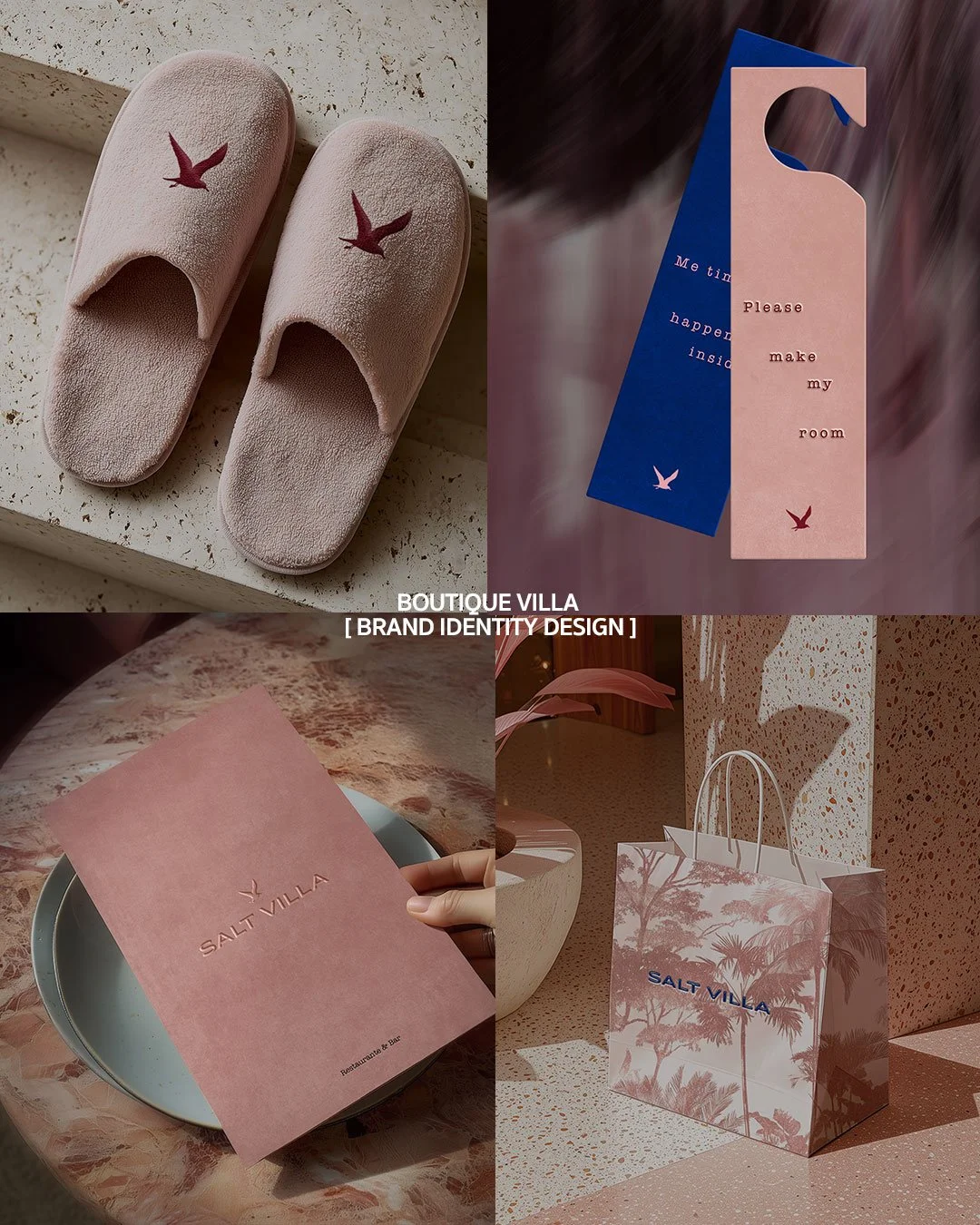
A hospitality branding agency and a graphic designer can both create visual work for your hotel. Both may design logos, brand identities, websites, menus, signage, and supporting assets that feel refined and professionally executed.
The difference lies in what that work is responsible for.
A hospitality branding agency works at a strategic level. It shapes how your property is positioned in the market, how potential guests understand it before they book, and how that perception influences pricing, occupancy, reviews, and long-term demand.
This article breaks down the difference in practical terms, so you can decide whether your property needs design execution, a complete hospitality brand strategy, or both.
Quick answer: hospitality branding agency vs graphic designer
A graphic designer is usually the right choice when your positioning, guest profile, brand story, and creative direction are already clear, and you mainly need visual assets executed well.
A hospitality branding agency is the better choice when the business problem is bigger than visuals: attracting the right guests, increasing perceived value, improving direct booking confidence, creating consistency across touchpoints, or repositioning a property so it can compete at a higher level.
In simple terms: design gives shape to the brand. Hospitality branding defines what the brand should mean to guests before anything is designed.
| Decision point | Graphic designer | Hospitality branding agency |
|---|---|---|
| Best for | Clear brief, defined brand direction, visual execution. | Undefined positioning, new concept, rebrand, premium repositioning, or inconsistent guest experience. |
| Main responsibility | Design individual brand assets. | Define what the property should stand for and how that should show up across every touchpoint. |
| Typical outputs | Logo, typography, color palette, layouts, print/digital assets, social media posts and brochures. | Positioning, guest persona, messaging, creative direction, identity system, website direction, guest touchpoint framework. |
| ROI impact | Fast turnaround for ongoing design work. | Supports stronger perception, clearer differentiation, better booking confidence and reduced price sensitivity. |
| When it falls short | When the brief itself is unclear or the brand has no distinct position. | When you only need a small asset refresh and strategy is already locked. |
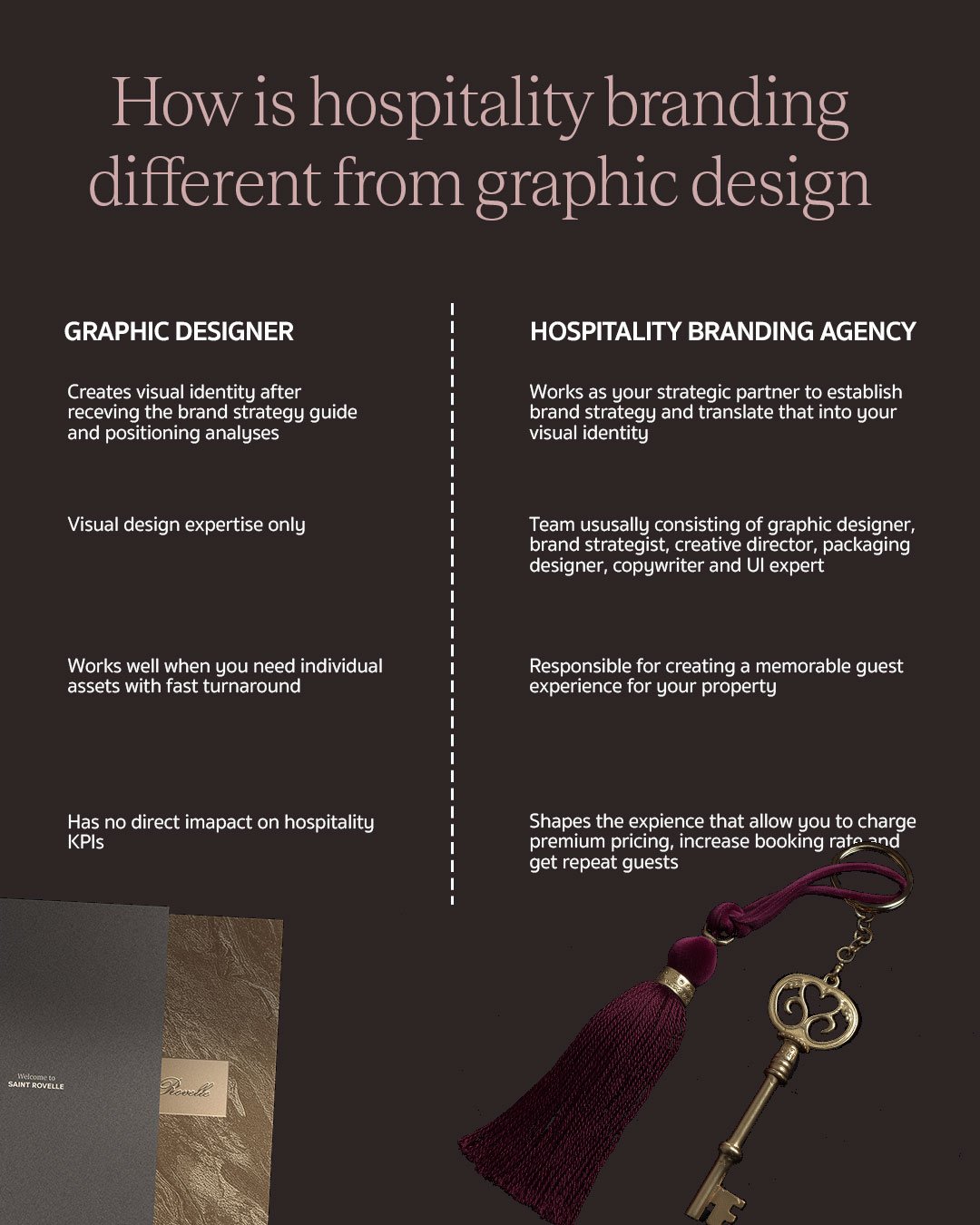
How is hospitality branding different from generic graphic design?
Where does hotel brand perception actually come from?
Some properties do not need to aggressively justify their price. They simply feel properly positioned at a different level the moment a guest encounters them.
It is not always about larger rooms, better amenities, or more expensive interiors. In many cases, the physical differences between properties are smaller than the pricing gap suggests.
What changes is how the hospitality brand is perceived before booking and how consistently that perception is reinforced throughout the experience.
From the first impression online, to the tone of communication, to the way the stay is experienced in small details, everything contributes to a sense of value that feels justified rather than questioned.
This is not accidental. It is the result of how the brand is defined and expressed.
And this is where the difference between strategic hospitality branding and visual design becomes important.
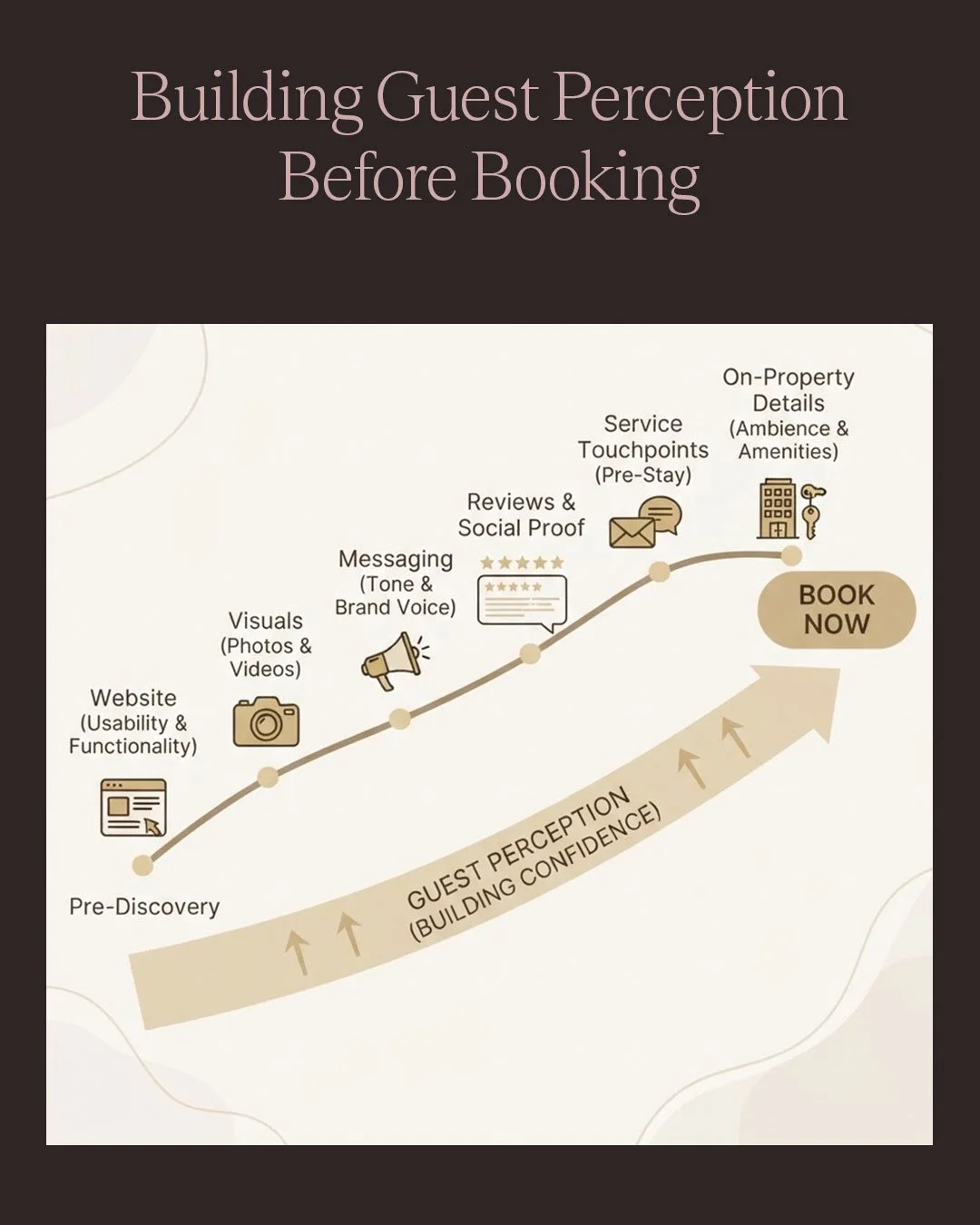
Hotel brand perception touchpoints before and during a guest stay.
Do you need a designer or a hospitality branding agency?
Most hospitality brand owners assume that feeling comes from nice visuals created by a designer. You hire a graphic designer, give them a direction, and expect the outcome to translate into a complete brand. A graphic designer usually works within a defined scope, with a clear task, a clear deliverable, and a clear end point.
But when you are trying to solve deeper problems like attracting the right guest, improving booking rates, increasing pricing power, or creating a more memorable stay, the approach has to change.
This is where a hospitality branding agency comes in. The focus is not just on execution, but on understanding what the property should stand for and who it is meant to attract. Every decision is informed by that clarity.
Sometimes the issue is that the property is attracting the wrong demographic. Sometimes it is that the experience does not justify a higher price. In other cases, guests leave satisfied but not impressed enough to talk about it.
These are not design problems in isolation. They are perception problems. And perception is shaped through a series of connected decisions that go far beyond visual design.
That is why a hospitality branding agency typically brings together specialists across strategy, creative direction, brand design, copywriting, digital experience, and marketing. Rather than focusing on a single deliverable, the team works together to shape how the property is positioned, experienced, and remembered.
The result is not just a better looking property. It is a brand that gives guests a clearer reason to choose you, pay more for the experience, and remember you long after their stay.
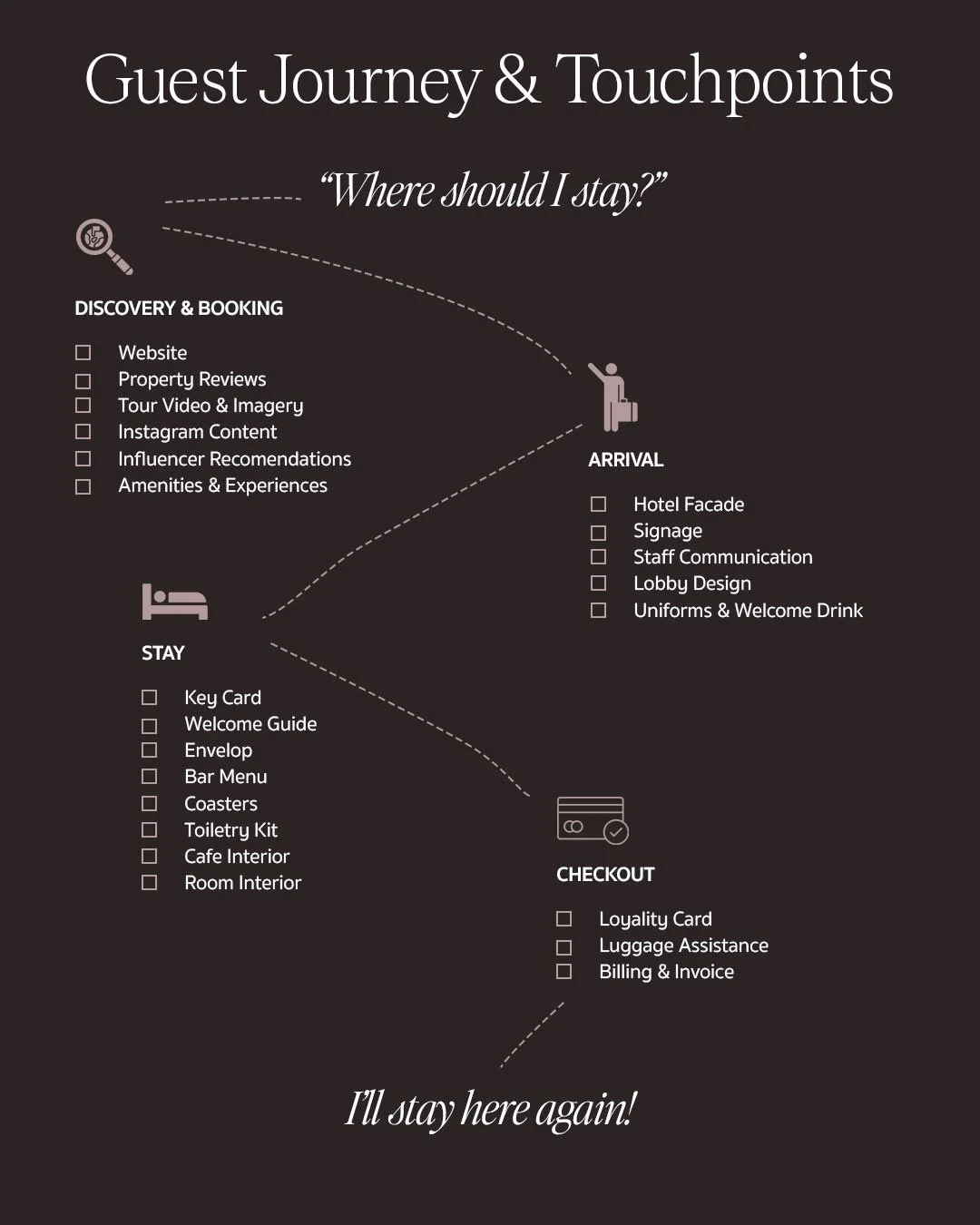
Hospitality brand identity touchpoints across the hotel guest journey.
Why does good design alone not create a memorable hospitality brand?
Good design can make a property appear polished. It can create a strong first impression and signal a certain level of quality. But that alone is rarely enough to make a property memorable.
What makes a property stay with you is not just how it looks, but what it stands for and how consistently that idea is expressed. It begins much earlier than design. It starts with how the property is positioned, who it is meant for, and what kind of experience it wants to be known for.
That thinking shows up in ways that are easy to overlook: the name of the property, the words a guest reads while exploring it, the tone of communication before arrival, how the space is introduced, what the signage says, how the staff communicates, what is written in the room guide, and what small rituals like a welcome drink are meant to signal.
When these elements are aligned, the property feels distinct. When they are not, even well designed spaces start to feel interchangeable. That is why some properties are remembered long after the stay, while others are forgotten despite looking just as good.
For hospitality owners exploring this in more depth before making any decisions, we’ve written about what to consider when choosing the right property branding partner.
Where do graphic designers work well, and where do they fall short?
A graphic designer is usually brought in too late in the thinking process.
They are strong at translating direction into visual output. If your brand positioning is already dialled in and you are clear on what you want to communicate, a designer will make that tangible.
In many cases, this alone is enough to make a property feel more polished and more premium, especially if the foundation is already clear. But here is the part most property owners only realise later.
A designer is not responsible for defining what the hospitality brand should mean in the mind of a guest. They are not deciding whether your property should feel like a wellness escape, a social luxury hub, a private retreat, or a culturally immersive stay. They are not shaping who you are competing against in the guest’s decision-making process, and they are not responsible for whether your positioning actually supports higher pricing in the market.
That layer sits before design.
And in many properties, that layer is either unclear, assumed, or completely missing. So when performance is not where it should be, the instinct is often to redesign. But if the underlying positioning is not defined, a rebrand or a different designer will not solve it.
Design can improve how a brand looks, but it cannot define what it is meant to mean in the mind of a guest.
When does design stop being enough for a hospitality brand?
When do you need a professional hospitality branding agency?
You might be asking yourself what those specialist hospitality branding agencies do that a graphic designer can’t. Design stops being enough at the point where visual identity is no longer the main question. This can happen at different stages of a hotel.
For some, it is before launch, when the property is being shaped for the first time and decisions are still open about what the hotel should stand for, who it should attract, and how it should be positioned in the market. For others, it happens later, when the property is already operating but the perception it is creating is not aligned with the level of experience it actually delivers.
In both cases, the issue is the same. Design is being asked to work without a fully defined positioning system behind it.
At that point, having a strong visual identity is not enough to create clarity in the guest’s mind.
You may still have a cohesive website, strong imagery, a well executed logo system, and a refined aesthetic across touchpoints. But the real question becomes whether all of that is expressing something specific enough to influence how the hotel is valued.
This is usually where the limitations become visible.
The hotel may be seen, understood, and even appreciated, but not clearly differentiated in a way that supports stronger pricing or preference.
And once that happens, improving visuals again does not change the outcome in a meaningful way. You need to go through a full branding process.
Quick decision framework for hotel owners
• Choose a graphic designer if you already have a defined brand strategy, audience, message, and creative direction.
• Choose a hospitality branding agency if the property needs to clarify what it stands for, who it should attract, and how it should justify a stronger rate.
• Choose a hospitality branding agency if the website, interiors, marketing, guest communication, and on-property experience feel disconnected.
• Choose a hospitality branding agency if guests like the stay but do not describe anything specific or memorable afterwards.
| If your situation is... | A Graphic Designer is Usually Enough |
You Need a Hospitality Branding Agency |
|---|---|---|
| You already know exactly how you want your hotel to be positioned. | ✓ | |
| You only need a logo refresh or visual updates. | ✓ | |
| Your brand strategy, target guest, and messaging are already defined. | ✓ | |
| You're launching a new hotel and need to define your concept before designing it. | ✓ | |
| You're attracting the wrong type of guests. | ✓ | |
| Guests like the property but don't remember it afterwards. | ✓ | |
| You're competing mainly on price instead of perceived value. | ✓ | |
| Your website, interiors, marketing and guest experience feel disconnected. | ✓ | |
| You're repositioning an existing hotel to charge premium rates. | ✓ | |
| You need consistency across every guest touchpoint, not just visual identity. | ✓ |
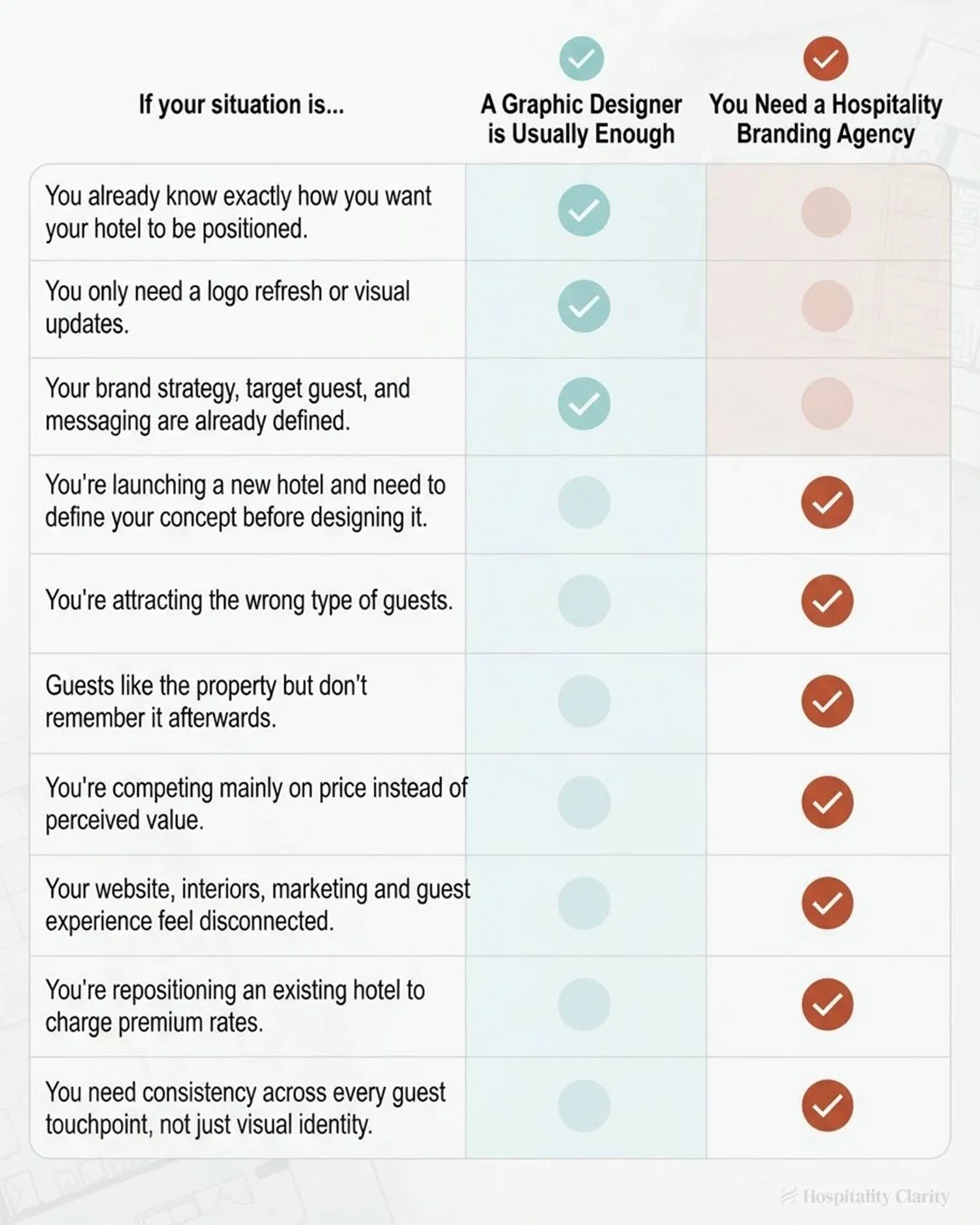
Is a graphic designer enough for your hospitality business branding?
How does a hospitality branding agency support ROI?
A hospitality branding agency supports ROI by making the property easier to understand, easier to choose, and easier to price at the right level. The work can influence revenue through stronger positioning, better website conversion, clearer guest expectations, stronger review language, and less dependence on discounts.
It does not replace revenue management, operations, or paid marketing. It gives those efforts a clearer brand system to work inside, so every touchpoint reinforces why the property deserves attention and a premium rate.
How does hospitality branding affect guest perception, bookings, and ROI?
When branding is done right, the biggest shift is not only visual. It affects guest perception, booking confidence, and the way people judge the value of the stay. Guests begin to see the property as a destination in itself, not just another option in the category. They stop evaluating the property piece by piece and start experiencing it as a cohesive whole. They may not consciously analyse it, but they feel it immediately. The property makes sense.
The tone, the visuals, the service, and the small details all reinforce the same idea, creating a sense of clarity rather than fragmentation. This changes how the property is judged. Instead of being compared feature by feature, it is understood as a distinct type of experience. That distinction reduces direct comparison with nearby properties and, over time, lowers price sensitivity.
Another shift happens before the guest even arrives. The expectation being created is clearer and more specific. Guests are no longer simply booking a room. They are choosing a particular kind of stay. That clarity naturally filters who decides to book, improving the quality of demand.
As a result, the stay itself feels more aligned. Guests arrive with the right expectations, experience what they anticipated, and leave with a clearer understanding of what the hotel stands for. This is where perception begins to compound.
Reviews become more specific. Instead of general comments about comfort or service, guests describe what felt distinct about the experience. That language becomes significantly more influential in future bookings than generic positive feedback.
Over time, this creates a stronger position in the market. The property is no longer just another option in the area. It becomes known for something specific. Once that association is established, pricing becomes easier to justify, not because it is discounted, but because it feels consistent with the experience being delivered.
This is the difference branding creates when it is done properly: not just a better-looking property, but a clearer position in the mind of the guest that continues to influence decisions long after the first impression.
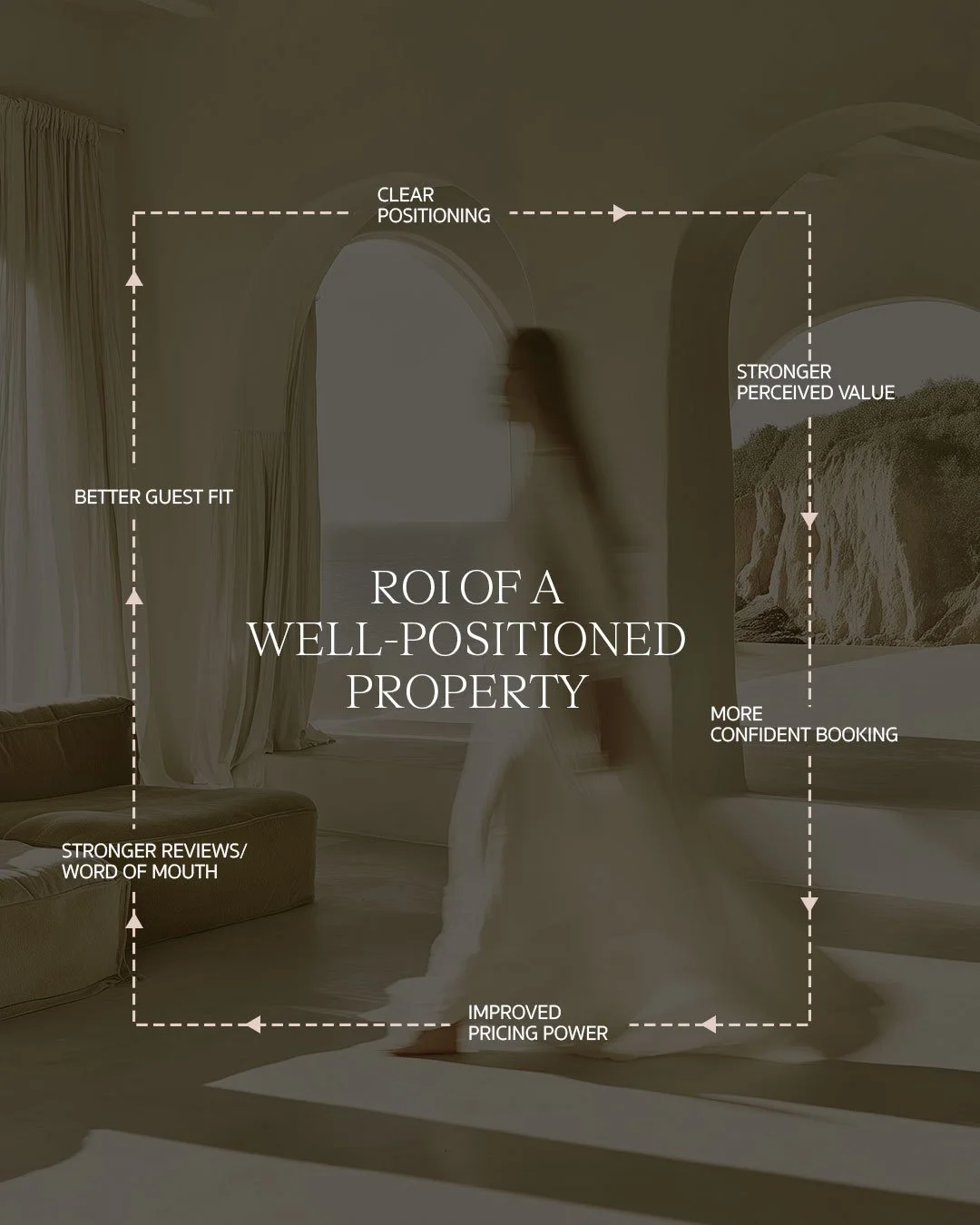
Contribution of hospitality branding to ROI
What is the real cost of weak hospitality branding?
Poor hospitality branding rarely fails because the logo looks outdated or the website feels unfinished. More often, it fails because the property never establishes a clear position in the guest's mind.
When that happens, every marketing effort becomes harder. You spend more to attract attention, only to compete against nearby properties offering similar rooms, amenities, and rates. Without a distinct perception, guests naturally compare what is easiest to measure, and price becomes one of the deciding factors.
The effects are not always immediate, which is why branding problems are often overlooked. Occupancy may remain steady, reviews may be positive, and the guest experience may genuinely be good. Yet the property struggles to command premium rates, generate word of mouth, or build the kind of reputation that creates long term demand.
Over time, these small gaps begin to compound. Marketing campaigns have to work harder to explain the property's value. New competitors become easier substitutes. Future redesigns become reactive rather than strategic, attempting to fix symptoms instead of addressing the underlying perception.
Strong hospitality branding changes that trajectory. It gives every decision, from the website and visual identity to guest communication and on-property experiences, a single strategic direction. Rather than relying on individual touchpoints to create value, the brand works as a connected system that continually reinforces why this property deserves to be chosen over another.
Ultimately, the cost of weak branding is not measured by how a hotel looks. It is measured by the revenue, pricing power, guest loyalty, and market distinction the property never fully realises because its value was never communicated with enough clarity.
So what actually makes sense for a hospitality brand owner?
The choice between a graphic designer and a hospitality branding agency is not really a comparison of skill. It is a difference in scope.
There are situations where working directly with a designer makes sense. If you already have strong creative direction internally, or you are a founder who can confidently define how the brand should feel across every touchpoint, then a designer can execute that vision effectively. In those cases, design becomes a tool for refinement, not discovery.
But most hospitality brands are not built in that environment.
They require decisions to be made about positioning, guest perception, narrative, and experience before any visual system can truly take shape.
This is where a branding agency changes the trajectory of the process.
The outcome is not just a more cohesive identity. It is a faster and more controlled path to clarity, where the brand does not need to be corrected later through redesigns or repositioning.
In that sense, it is less about outsourcing design, and more about compressing the distance between what the property is, and how it is perceived.
If you are shaping or refining a property, we work as a hospitality branding agency that defines the positioning and translates it into a complete brand and visual system built for consistency across every guest touchpoint.
How Elouvé builds hospitality brands
Elouvé Collective is a luxury branding, packaging, and creative direction studio working with hospitality, beauty, and lifestyle brands. For hotels and hospitality concepts, the challenge is making sure guests experience the same story from the moment they discover the property to the moment they leave.
Our process begins long before visual design. We work closely with founders and hotel owners to understand what the property should represent, who it is meant to attract, and how it can occupy a distinct position within an increasingly competitive market. That strategic foundation informs every creative decision that follows.
From there, we translate that positioning into a complete brand experience. This includes the visual identity, creative direction, messaging, digital presence, and the guest touchpoints that shape how the property is perceived before, during, and after a stay.
Rather than treating branding as a collection of individual deliverables, we see it as a connected system. Every interaction should reinforce the same idea, creating a brand that feels cohesive, memorable, and unmistakably distinct.
The goal is never simply to create a hotel that looks beautiful. It is to build a hospitality brand that commands stronger perceived value, attracts the right guests, and leaves a lasting impression long after check-out.
FAQ: Hospitality branding agency vs graphic designer
Is a hospitality branding agency worth it for a boutique hotel?
Yes, if the hotel needs more than visual polish. A hospitality branding agency is usually worth it when the property needs clearer positioning, stronger guest perception, better direct booking confidence, or a brand experience that supports premium pricing.
Can a graphic designer create a hotel brand identity?
A graphic designer can create a strong visual identity when the strategy is already defined. But if the hotel still needs to clarify its positioning, audience, brand story, tone of voice, and guest experience direction, that work usually needs a branding agency or strategist first.
Should a hotel rebrand before or after renovations?
Ideally, brand strategy should happen before major renovations or visual changes. That way, interiors, signage, website content, guest communication, and marketing all support the same positioning instead of being redesigned separately.
What should a hospitality branding agency deliver?
A hospitality branding agency should help define positioning, target guest, brand narrative, messaging, visual identity, creative direction, digital presence, and the key guest touchpoints that shape how the property is remembered.
How do I know if my hotel only needs design?
If your audience, pricing position, message, guest experience, and creative direction are already clear, then design execution may be enough. If those decisions are unclear, design alone will likely only improve the surface.
Final thought: are you designing a look or a hotel brand experience?
At some point, every property project reaches a simple but uncomfortable question. Are you trying to create something that looks refined, or something that actually shapes how people experience your property.
A look can be achieved through design. It can make a property feel polished, cohesive, and visually strong. It can create a first impression that feels aligned with a certain level of quality. But an experience is different. It is not defined by how things appear individually, but by how everything connects when someone interacts with the brand as a whole.
Because in hospitality, perception is not something that forms after the experience. It is something that is built into it from the very beginning. What you choose to define first will shape what people believe you are offering.
If you are considering a new hotel concept, a hospitality rebrand, or a stronger brand system for an existing property, Elouvé Collective can help define the positioning, identity, and guest experience direction before the visual system is built.
Book a free consultation or email hello@elouvecollective.com to discuss your hospitality brand.

Redefine Success
It All Begins Here
Confidence doesn’t always arrive with a bold entrance. Sometimes, it builds quietly, step by step, as we show up for ourselves day after day. It grows when we choose to try, even when we’re unsure of the outcome. Every time you take action despite self-doubt, you reinforce the belief that you’re capable. Confidence isn’t about having all the answers — it’s about trusting that you can figure it out along the way.
The key to making things happen isn’t waiting for the perfect moment; it’s starting with what you have, where you are. Big goals can feel overwhelming when viewed all at once, but momentum builds through small, consistent action. Whether you’re working toward a personal milestone or a professional dream, progress comes from showing up — not perfectly, but persistently. Action creates clarity, and over time, those steps forward add up to something real.
You don’t need to be fearless to reach your goals, you just need to be willing. Willing to try, willing to learn, and willing to believe that you’re capable of more than you know. The road may not always be smooth, but growth rarely is. What matters most is that you keep going, keep learning, and keep believing in the version of yourself you’re becoming.

Small Steps Create Big Shifts
It All Begins Here
Confidence doesn’t always arrive with a bold entrance. Sometimes, it builds quietly, step by step, as we show up for ourselves day after day. It grows when we choose to try, even when we’re unsure of the outcome. Every time you take action despite self-doubt, you reinforce the belief that you’re capable. Confidence isn’t about having all the answers — it’s about trusting that you can figure it out along the way.
The key to making things happen isn’t waiting for the perfect moment; it’s starting with what you have, where you are. Big goals can feel overwhelming when viewed all at once, but momentum builds through small, consistent action. Whether you’re working toward a personal milestone or a professional dream, progress comes from showing up — not perfectly, but persistently. Action creates clarity, and over time, those steps forward add up to something real.
You don’t need to be fearless to reach your goals, you just need to be willing. Willing to try, willing to learn, and willing to believe that you’re capable of more than you know. The road may not always be smooth, but growth rarely is. What matters most is that you keep going, keep learning, and keep believing in the version of yourself you’re becoming.

Turn Intention Into Action
It All Begins Here
Confidence doesn’t always arrive with a bold entrance. Sometimes, it builds quietly, step by step, as we show up for ourselves day after day. It grows when we choose to try, even when we’re unsure of the outcome. Every time you take action despite self-doubt, you reinforce the belief that you’re capable. Confidence isn’t about having all the answers — it’s about trusting that you can figure it out along the way.
The key to making things happen isn’t waiting for the perfect moment; it’s starting with what you have, where you are. Big goals can feel overwhelming when viewed all at once, but momentum builds through small, consistent action. Whether you’re working toward a personal milestone or a professional dream, progress comes from showing up — not perfectly, but persistently. Action creates clarity, and over time, those steps forward add up to something real.
You don’t need to be fearless to reach your goals, you just need to be willing. Willing to try, willing to learn, and willing to believe that you’re capable of more than you know. The road may not always be smooth, but growth rarely is. What matters most is that you keep going, keep learning, and keep believing in the version of yourself you’re becoming.

Make Room for Growth
It All Begins Here
Confidence doesn’t always arrive with a bold entrance. Sometimes, it builds quietly, step by step, as we show up for ourselves day after day. It grows when we choose to try, even when we’re unsure of the outcome. Every time you take action despite self-doubt, you reinforce the belief that you’re capable. Confidence isn’t about having all the answers — it’s about trusting that you can figure it out along the way.
The key to making things happen isn’t waiting for the perfect moment; it’s starting with what you have, where you are. Big goals can feel overwhelming when viewed all at once, but momentum builds through small, consistent action. Whether you’re working toward a personal milestone or a professional dream, progress comes from showing up — not perfectly, but persistently. Action creates clarity, and over time, those steps forward add up to something real.
You don’t need to be fearless to reach your goals, you just need to be willing. Willing to try, willing to learn, and willing to believe that you’re capable of more than you know. The road may not always be smooth, but growth rarely is. What matters most is that you keep going, keep learning, and keep believing in the version of yourself you’re becoming.