
A hotel brand is ready for opening when guests encounter one coherent promise from discovery and booking through arrival and the stay itself. The launch checklist should align identity, signage, website, collateral, staff tools and operational touchpoints before opening day.
A hotel can be built, furnished and inspected, and still not be ready to open. The brand tends to slip in the late details: a sign ordered before the name was final, a booking confirmation still carrying placeholder text, a front desk team nobody has briefed on how the hotel should sound.
Guests meet a hotel in sequence. They find it in search, book, arrive, sleep, eat and check out, and they judge all of it as one brand. This hotel brand launch checklist follows that order, from the first search result to the thank you email, so nothing gets missed. It is written for hotel founders planning an opening, including boutique hotels with a small team and a tight runway. If you want to ensure your positioning, identity, and assets are perfectly aligned before welcoming guests, partnering with an experienced hotel branding agency can help streamline this massive operational transition.
Key Elements of a Hotel Brand Launch Checklist
Use this table to give every area an owner before you read the detail. The timings count back from opening day and assume a runway of about sixteen weeks. If yours is shorter, the order of work stays the same and signage and print move to the front of the queue.
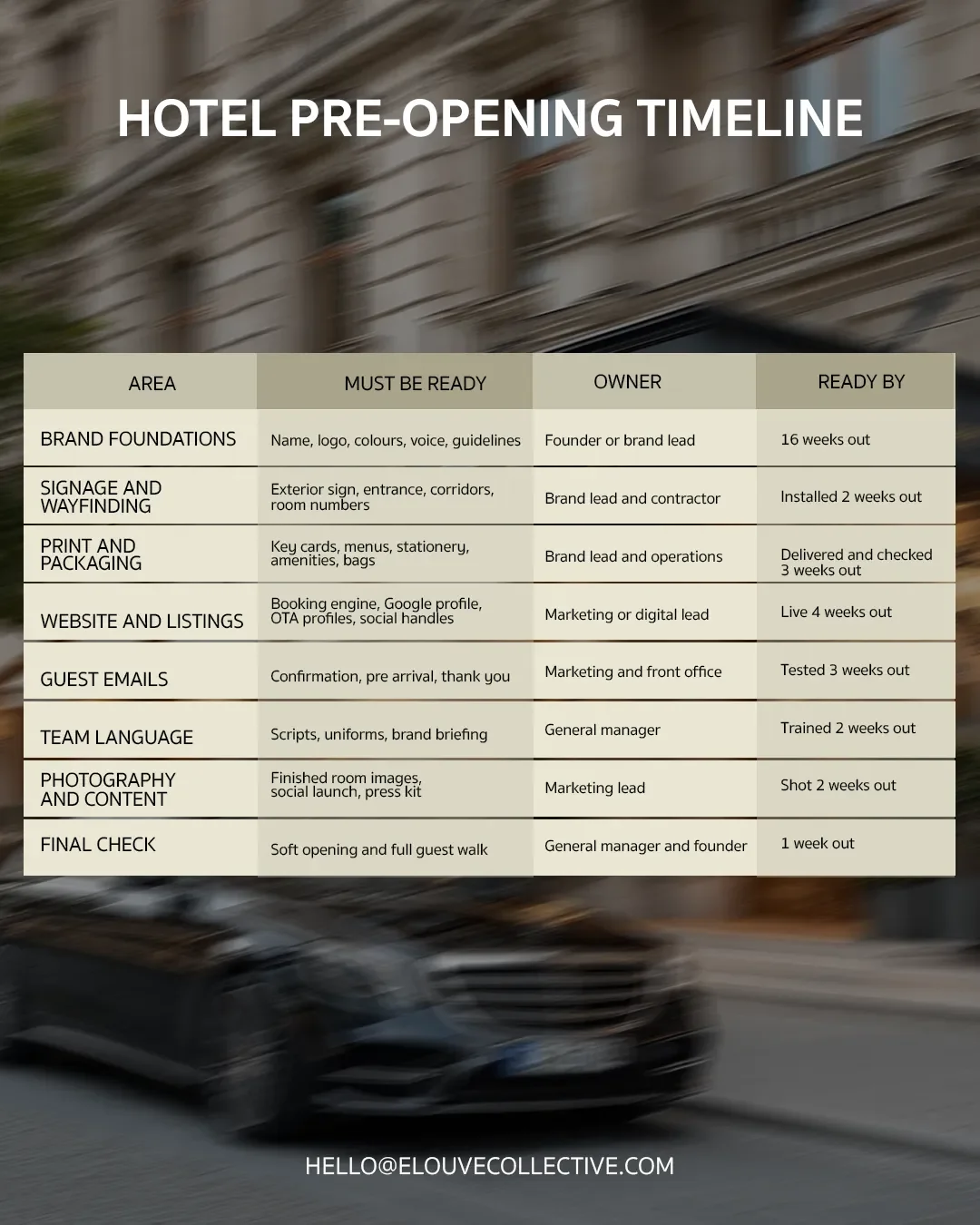
Every row has a section below with a list of what must be ready. If a row has no owner, that is where the opening will slip.
Your Brand Identity System Is Signed Off and Written Down
Everything else on this list inherits from this step. Before any supplier is briefed, confirm:
Hotel name, spelled exactly, including accents and punctuation
Final logo files for print, screen and signage
Colour palette with exact values for print and screen
Typefaces and where each one is used
Tone of voice, with example sentences
Brand guidelines in one shared document
One person with final approval
A colour value that changes after signage is ordered gets paid for twice. Undecided details at this stage turn into reprints later, because every sign, card, menu and email copies what is decided here. Share the same guidelines file with every supplier and make one person responsible for approving changes. Otherwise three suppliers end up with three slightly different answers.
Your Signage and Exterior Are Installed and Readable
Wayfinding is the first physical part of the brand a guest touches, and it gets tested at the hardest moment: a late arrival, luggage in hand, unsure which door to use. Confirm:
Main exterior sign, readable from the street and on approach
Entrance door details and opening hours
Wayfinding from the street, car park, lobby, lifts and corridors
Room numbers and floor markers
Lighting that works at night
Contrast, height and size that suit all guests
Safety and fire signage that fits the design
Walk the route from the street to a room at dusk, then again after dark. Stand where a guest would stand and check that each sign can be read without help. Signage has some of the longest lead times on this list, so it is ordered early, and any permit or landlord approval should be requested at the same time.
Your Website and Booking Engine Take a Real Booking
For most guests, the booking is the first experience of the hotel. Test:
A full booking on a phone, then a second on a laptop
Room names, rates, taxes and policies
The confirmation page and payment step
Photography, copy and contact details on every page
A cancellation, to check the policy text and the email that follows
Page speed on a mobile connection
Read the policy wording the way a guest would. Any placeholder text or test rate you find now is something a guest would have found on opening day.
Your Google and Travel Platform Listings Match Your Website
Many guests see the hotel on a map or a travel platform before they see your website. Check:
Google Business profile: category, hours, photos, map pin and phone number
OTA profiles on platforms such as Booking.com and Expedia
Social handles claimed and matching the hotel name
The same name, description, photos and contact details everywhere
OTA profiles are often built in a hurry and drift away from the website. Write one approved description and one photo set, then copy them to every channel. Check the map pin by walking or driving to it.
Your Guest Emails Sound Like the Hotel
Guests read these before they meet a single team member. Check:
Booking confirmation
Pre arrival email with directions, parking and check in details
Day of arrival message
Thank you email after the stay
Modification and cancellation emails
Sender name, reply address and mobile layout
Default templates from a booking system carry the system's voice. Rewrite the copy in the hotel's tone, apply the visual identity, and send test emails to a phone and a desktop. Guests return to the confirmation email to find directions and check in times, so it gets read more than most.
Your Arrival Experience Has Been Rehearsed
Run a full arrival with the team, with one person playing the guest. Time it. Check:
The greeting and the first words a guest hears
Check in flow and how long it takes
Key cards: design, sleeve and encoding on every door
Lobby scent, music volume and lighting
Welcome drink, note or small gesture
Luggage handling and where bags wait
Key cards need their own test. They are printed in volume and encoded by the lock system, so confirm the design prints cleanly, the card opens every door, and the sleeve has space to write the room number. Set music and lighting for a busy evening at six, since an empty lobby sounds and looks different once it fills.
Your Rooms Carry the Brand in the Small Details
Guests spend most of their stay in the room and handle most of what is in it. Check:
In room directory and wifi card
Do not disturb and make up room signs
Minibar and menu cards
Bathroom products and packaging
Stationery, pens and notepads
Welcome notes or turndown cards
QR codes, tested on two different phones
Proofread every printed item for the hotel name, wifi details and phone extensions. Place everything as it will sit on a normal day, then inspect the room from the bed, the desk and the bathroom door, which are the views guests actually have.
Your Menus, Print and Packaging Have Arrived and Been Checked
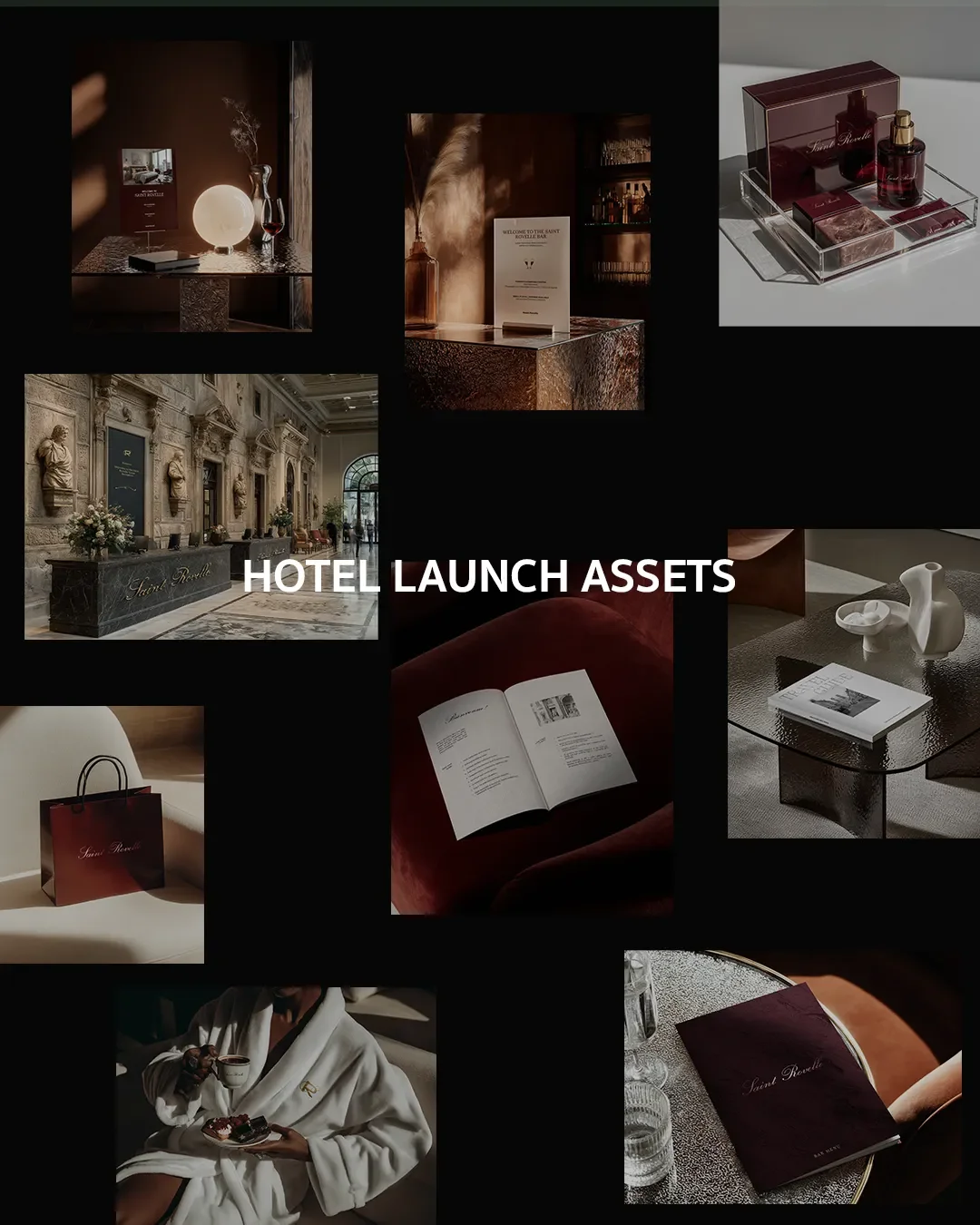
Print is the category most likely to arrive late, and hospitality launch assets multiply quickly once you list them. Confirm:
Food, drink and room service menus
Key card sleeves and welcome folders
Stationery and envelopes
Amenity packaging
Bags and gift packaging
Packaged food or takeaway items, if offered
Ask every supplier for proof, production and delivery dates in writing, then add a buffer of at least a week. When items arrive, check colour and finish against the approved proof, under the lighting of the room where each item will be used. Order long lead items such as custom amenity packaging first. Menus change late, so print a small first run and hold the larger order until prices and dishes settle. The critical path table in the launch plan section lists typical lead times.
Your Team Can Explain the Hotel in One Minute
Staff language is part of the brand, because guests hear it more than they read anything. Prepare:
A brand briefing for every team member, including housekeeping, kitchen and security
Greeting and phone answer wording
Email reply examples
Agreed names for rooms, spaces and dishes
Answers to the ten questions guests ask most
Uniforms fitted and delivered, with spare sizes
Write short example lines that people can say naturally, then let each person put them in their own words. Ask every team member to describe the hotel in one minute and listen for the same few ideas each time. Uniforms need fittings, alterations and spare stock, and many take six to ten weeks to produce, so they sit on the critical path.
Your Photography and Content Show the Finished Hotel
Launch images need to match the real rooms. Prepare:
Photography of finished rooms, lobby, dining spaces and exterior
Images shot after final styling, furniture and linen are in place
Social profiles complete, with a bio, link and highlights
First posts and an opening announcement scheduled
A press kit with the hotel story, key facts, images and a contact
A launch email for your waitlist or mailing list
Shoot after styling is complete. Guests who arrive to find different furniture, art or linen than in the photographs notice at once. For the social launch, claim handles early, build the profile weeks ahead, and have two to three weeks of content ready, since the team will have little time to create posts during opening week.
Your Launch Plan From 90 Days Out to Opening Day
This timeline shows when each area should reach a given stage.
| Timing | Focus | Done When |
|---|---|---|
| 90 to 60 days out | Brand foundations and long lead orders | Guidelines signed off. Signage, amenity packaging and uniforms ordered. |
| 60 to 30 days out | Digital build and content | Website, booking engine, listings and email templates built and tested. Photography planned. |
| 30 to 14 days out | Delivery and installation | Print delivered and checked. Signage installed. Photography shot. Team briefed. |
| 14 to 7 days out | Soft opening | Full guest journey tested. Fix list assigned. |
| 7 days to opening | Final check | Fixes closed. Social launch scheduled. Contingency kit ready. |
| Opening week | Monitoring | Daily review of guest feedback and the fix log. |
The critical path is the set of items that hold up everything else. Signage, packaging, uniforms and key cards sit on it because they take the longest to produce and cannot be rushed once ordered. Lead times vary by supplier, country and finish, so treat these as planning ranges and confirm each one in writing.
| Item | Depends On | Typical Lead Time | Order By |
|---|---|---|---|
| Exterior Signage | Final logo and colours, any permit approval | 6 to 10 weeks | 14 weeks out |
| Custom Amenities and Packaging | Final identity, product selection | 8 to 12 weeks | 14 weeks out |
| Uniforms | Design, sizing, fittings | 6 to 10 weeks | 12 weeks out |
| Wayfinding and Room Numbers | Final room list and typefaces | 4 to 8 weeks | 12 weeks out |
| Website and Booking Engine | Photography, copy, policies | 4 to 8 weeks | 12 weeks out |
| Key Cards | Lock system specification, final design | 3 to 5 weeks | 8 weeks out |
| Menus and Stationery | Final menu and pricing | 2 to 4 weeks | 6 weeks out |
Your Final Check Before Opening
Run a soft opening of one to three nights with friends, family, local partners and staff staying as guests. Include:
A full guest journey, from search result to booking, arrival, room, dining, checkout and thank you email
Every team member on shift, using the real scripts
A simple scorecard for each touchpoint: pass, fix before opening, or fix after opening
A fix list with a named owner and a date for each item
A go or no go decision made by the founder and general manager
Ask soft opening guests to write down what they noticed, including small things such as a mismatched typeface or a sign they could not find. The hotel opens when every fix before opening item is closed.
What to Do If You Are Running Behind
Set priorities by what a guest needs to get in and stay. Use this order:
Items guests must use or read to arrive and sleep: wayfinding, room numbers, key cards, the booking engine and confirmation emails.
Items guests see before and during the stay: photography, listings, menus and in room print.
Items that can follow in the first month: bags, gift packaging, secondary print, press kit extras and additional website pages.
The usual causes of slippage are signage delays, unfinished listings, a team that has not been trained, print that does not match the approved colours, and photography that does not match the finished rooms. Cover each early, and use a temporary fix where needed, such as a printed menu insert or a clean temporary sign set in the hotel's typeface.
Opening Week Contingencies
Prepare a small launch kit and a few ground rules for the first week:
Spare key cards, printed menus and in room cards, held at the front desk
A named decision maker in each department
A fifteen minute review every morning covering guest feedback, the fix log and anything that failed
A plan for system downtime, including the booking engine and door locks
A holding statement ready for social media or press if something goes wrong
FAQs: Hotel Brand Launch
What branding needs to be ready before a hotel opens?
The brand identity and guidelines, signage and wayfinding, key cards and in room print, menus, the website and booking engine, listings, guest emails, photography, team language and uniforms, and a social launch plan. Each of these should be tested as a guest would meet it, from search result to thank you email.
When should hotel branding be finalized before opening?
Aim for about sixteen weeks before opening. Signage, custom packaging and uniforms can take six to twelve weeks to produce, and none of them can be ordered until the identity is signed off.
What brand assets does a boutique hotel need for launch?
Logo files and colour and type specifications, brand guidelines, exterior and interior signage, key cards and sleeves, menus, stationery, amenity packaging, uniforms, website and booking engine, email templates, social profiles, photography and a press kit.
How do you keep opening day touchpoints consistent?
Use one guidelines file shared with every supplier and one person who approves changes. Check every delivered item against its approved proof, then walk the full guest journey during the soft opening and fix anything that does not match.
Where to Start
Begin with the table in the first section and mark every row that has no owner. Then check which long lead items still need ordering, because those often decide your opening date.
Elouvé Collective works with hospitality founders on brand strategy, visual identity and packaging design. If you want a second pair of eyes on your launch assets, timeline and critical path before opening, we can review them with you.
Prepare your hotel brand for opening. Get in touch with Elouvé Collective to start.
