
A brand audit compares what a premium brand intends to communicate with what customers actually see across every touchpoint. It should reveal inconsistent messaging, visual drift, weak hierarchy and experience gaps before a redesign is commissioned.
Every touchpoint looks acceptable on its own. The website is clean, the packaging is eye-catching, the Instagram grid holds together. Then you lay them side by side and something is slightly off. The cream is a different cream, the tone of voice varies with each touchpoint and each product line feels like it belongs to a different brand
That feeling deserves to be taken seriously, and a brand audit checklist is how you turn it into evidence. Reviewing the work of an established luxury branding studio can help you visualize the level of execution and seamless consistency your own touchpoints should maintain. This guide is a diagnostic process for existing premium brands: collect the proof, score six lenses, rank the findings, and decide between a refresh and a rebrand. The result is a short list of fixes in the right order, which is far more useful than a longer spreadsheet of observations.
Brand Audit Checklist at a Glance
What should a brand audit include?
A complete luxury brand audit includes evidence collection, six lenses, a consistency score, a severity and effort matrix, and a final call on refresh or rebrand. Each lens asks one question and is scored from one to five.
| Lens | Question It Answers | Evidence Needed | Scored On |
|---|---|---|---|
| Positioning | Is the brand clearly different from the alternatives your buyer compares it with? | Competitor screenshots, prices, category language | Distinctiveness |
| Visual Identity | Would someone recognise the brand with the logo covered? | Logo files, colour and type usage, imagery library | Recognition |
| Brand Experience | Does the brand behave the same way across teams and suppliers? | Emails, decks, proposals, customer replies, merchandise, visual tone across all touchpoints | Consistency |
| Packaging | Does every product and every reorder match the original standard? | Launch pack, current reorder, cartons, labels | Production Fidelity |
| Retail | Does the brand hold up in spaces and partners you do not control? | Store photos, signage, stockist displays | Standard Maintained |
| Ecommerce and Social | Do the digital channels look current and cared for? | Site, marketplace listings, profiles, templates | Currency and Polish |
After the six lenses come three decisions: score each lens, rank every finding on the severity and effort matrix, and call the result a refresh or a rebrand.
The Branding Audit Process: Diagnose, Score, Then Decide
How do you audit a brand?
You audit a brand by collecting evidence from every channel, scoring each lens on a one to five scale, ranking the findings by severity and effort, and then deciding whether the brand needs a refresh or a rebrand. The order matters. Opinions form early and change what people notice, so scoring comes first and the discussion comes second. Once the scores are on the table, a disagreement becomes a question about evidence.
Three people should be in the room: the founder, the creative lead or whoever signs off design, and whoever owns customer experience. The founder should not score alone. Founders are closest to what the brand was meant to be, which makes them the least able to see what is actually live. A second scorer with a different job catches what you have stopped noticing.
A touchpoint review asks whether each item exists and looks right. An audit asks how those items perform against each other and which problems to fix first. Our brand touchpoint checklist covers the list of places to look, and this guide scores what you find there.
Evidence Collection: Gather Everything Before You Judge Anything
Before anyone forms a view, pull the brand into one place. Collect the live website pages, social profiles, packaging for every product, decks, proposals, signage, supplier files, email templates and the last three years of campaigns. Capture what customers see, which means screenshots of the live channels and photos of the shelf, since master files show the intention and the live version shows the result.
Build one folder per lens and label every file with its date, its channel and who made it. Dates reveal when things started to change. Lay the material out on a shared board so the audit runs on evidence instead of memory, because memory always remembers the brand as it was approved.
Brand Positioning Audit: Judge Your Brand Against the Shelf It Sits On
Positioning is the first lens because everything else inherits from it. A premium buyer compares you with a handful of options, so the audit checks distinctiveness, price signals and category clichés against that handful.
Competitor Context: The Five Brand Shelf Test
Choose five brands your buyer genuinely considers: three direct competitors and two aspirational ones. Place each homepage, hero product and social profile next to yours and cover the logos. Then ask three questions. Can you tell your brand apart within three seconds? Do the materials, photography and language match the price you charge? Which category clichés do you share, such as botanical illustration, a thin serif wordmark or a beige palette?
Score five when the brand is visibly its own. Score one when it could be swapped with a competitor and nobody would notice.
Visual Identity Audit: Can Someone Name You With the Logo Covered?
This lens tests colour, type, imagery and tone of voice as a system. Pull twelve items from different channels and dates, remove the logos, and mix in a few competitor items.
The Recognition Test
Ask five people who know the brand to sort the items into ours and not ours. Score five when nearly everyone sorts correctly, three when about half do, and one when your own team gets them wrong. A low result usually traces back to imagery and colour first: photography shot by different people to different briefs, and a palette that has quietly grown extra shades.
Accessibility: Where Luxury Quietly Becomes Hard to Read
Pale palettes, small elegant type and text over imagery all look refined in a mockup. Check them on a phone in daylight. Body text should meet a contrast ratio of at least 4.5 to 1, and any price, ingredient list or button label that a customer struggles to read costs the brand authority. Accessibility is a brand quality issue as much as a compliance one, and it belongs in the score.
Brand Experience Audit: Where the Brand Slowly Stopped Matching Itself
Drift rarely arrives as one decision. It builds from small reasonable ones: a freelancer picks a nearby shade, a regional team loosens the spacing to fit a longer headline, a copywriter adds exclamation marks because the campaign needs energy. Each change passes review alone, and together they pull the brand away from itself.
To find drift, line up the same type of item from three different dates and from two different makers. Look for a shifting palette, loosened spacing and tone creep, and note who produced each item. Gradual inconsistency across teams, freelancers, suppliers and regions shows up fastest in socials, retail, emails, decks, proposals and customer service. Score five when the oldest and newest items look related, and one when they look like different companies.
Packaging Audit: Compare the Hero Product to the Reorder
Packaging drifts between production runs. Foil colour shifts, embossing gets shallower, a paper stock is substituted, and the label no longer matches the carton. Foil on light stock can also lose legibility once a finish changes.
Place the first production sample next to the current reorder and check the carton against the label against the primary pack. Photograph all three in daylight and under shop lighting. A supplier swap that saves a few pence per unit can quietly lower the perceived price of the whole range, so production drift deserves a line of its own in the audit.
Retail Experience Audit: Walk It as a Customer, Then as a Stranger
Check signage, staff language, display, service rituals and how stockists or partners present the brand. Visit once as a customer. Then ask someone who has never heard of the brand to walk the same space and describe what is sold and at what price level. Score it against the same standard you hold your owned channels to. Partner displays often run on assets that were retired elsewhere years ago, and the gap shows quickly here.
Ecommerce and Social Media Audit: Check the Places Nobody Reviews Anymore
Here’s how to audit your e-commerce/shopify store.
Open your website in one tab.
Open five other Shopify websites from brands in your industry in separate tabs.
Compare them side by side. If your website looks like five other Shopify templates in your industry, there’s a problem.
Analyse your imagery and art direction separately. A well designed user experience cannot fix weak imagery or generic art direction.
Cover your website header logo. Read the copy out loud and look at the overall experience. If the logo disappeared, would you still recognise the brand?
Scoring the Audit: Build Your Consistency Score
Score each lens from one to five using the same definitions every time, so two people looking at the same finding land on the same number.
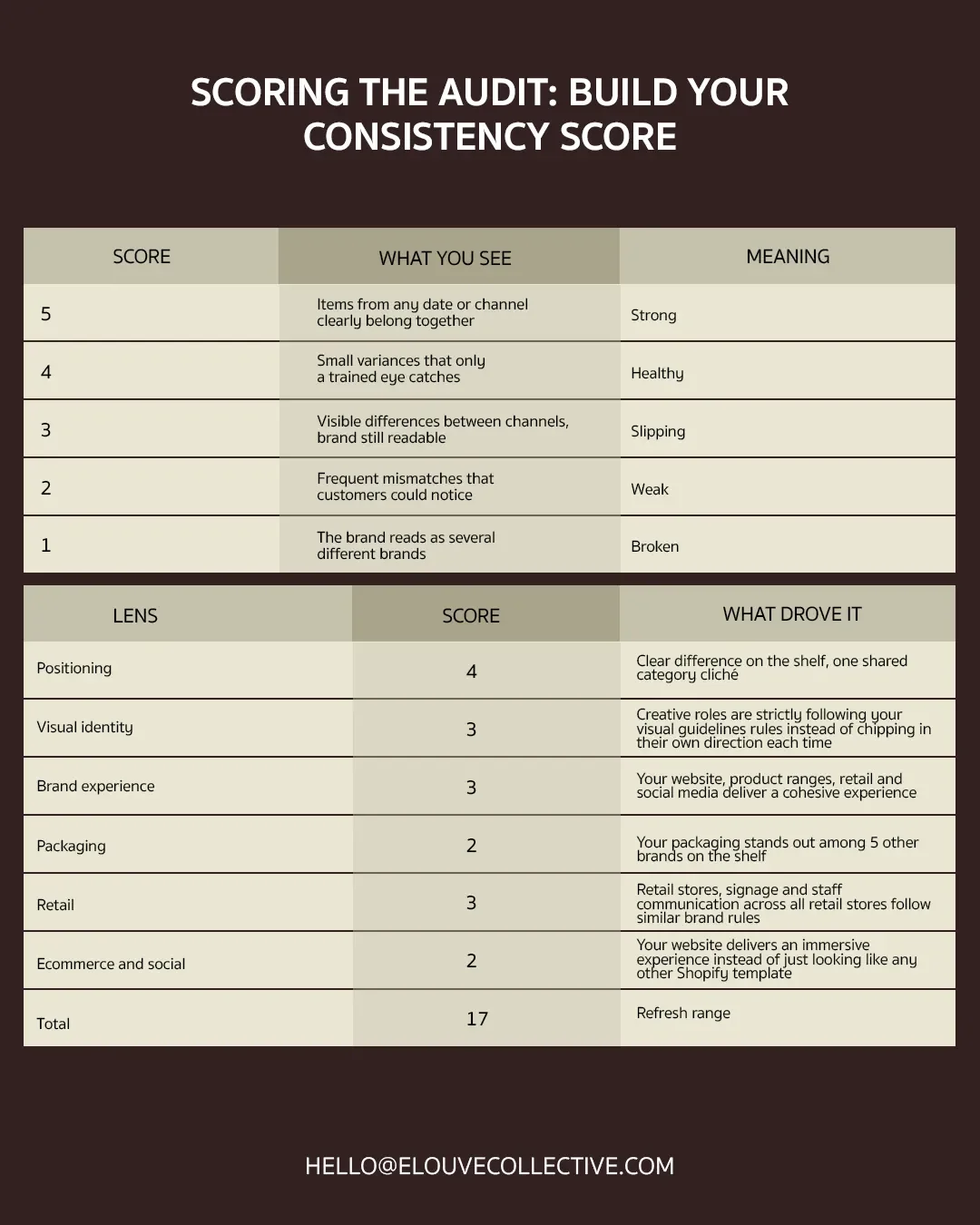
Add the six lens scores for a total out of 30. A total of 25 to 30 means hold course and review yearly. A total of 15 to 24 points to a refresh. A total of 14 or below opens a rebrand conversation. Here is an example scorecard for a skincare brand.
How do I know where my brand is inconsistent?
Read the scorecard from the bottom up. The lowest scoring lens shows where the inconsistency sits, and the evidence folder shows the pattern behind it: which channel, which supplier, which date. Low scores clustered around one team's output point to a process gap. Low scores across most lenses point to a foundation gap.
How to translate your audit into actionable branding steps
The Severity and Effort Matrix: What to Fix First
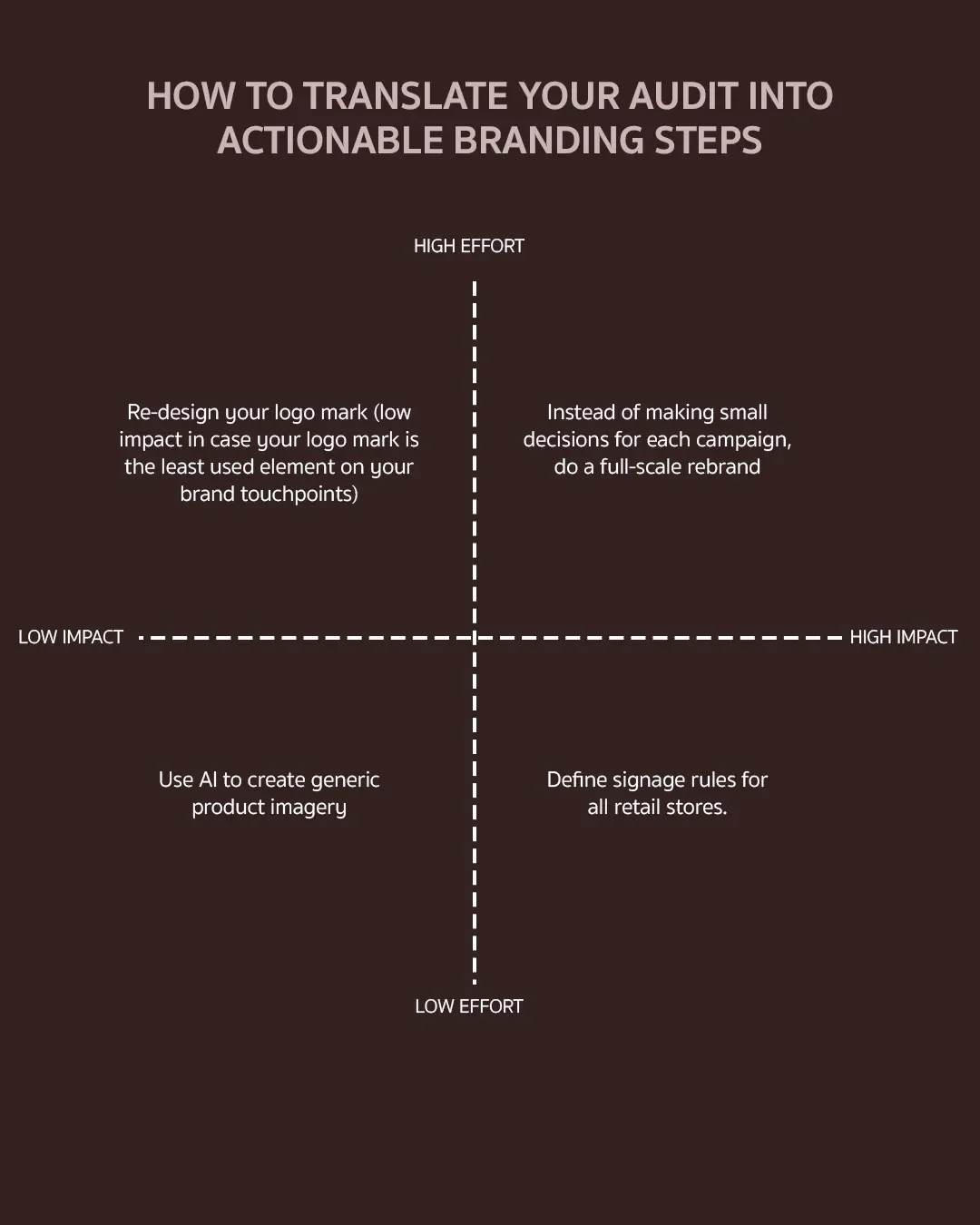
Every finding gets two ratings. Impact is how much it damages premium perception or recognition. Effort is the time, money and people it takes to fix. Plot each finding and the order of work becomes clear. After filling this matrix, you’ll have exact idea which branding tasks to prioritise.
| Impact | Low Effort | High Effort |
|---|---|---|
| High Impact | Define signage rules for all retail stores. | Instead of making small decisions for each campaign, do a full-scale rebrand. |
| Low Impact | Use AI to create generic product imagery. | Redesign your logo mark (low impact if your logo mark is the least used element across brand touchpoints). |
Keep a running worksheet so every finding has an owner and a date. Copy this into a spreadsheet and add one line per finding.
| Finding | Lens | Solution | Impact | Talent | Talent | Fix By |
|---|---|---|---|---|---|---|
| Retail stores not making a luxury impression | Retail |
|
High | Low |
|
This month |
| Low conversions on website | E-commerce |
|
High | High |
|
Sep 2027 |
Refresh or Rebrand: The Triggers That Separate Them
When does a brand audit lead to a rebrand?
A brand audit leads to a rebrand when the problem sits in the foundations. That means positioning scores two or below, recognition fails even with your own customers, or the business has changed in a way the brand no longer reflects. A refresh is the right call when positioning is strong and the damage sits in execution: drift, outdated assets and production slippage.
The lens scores give you the evidence for the call. Look for these rebrand triggers:
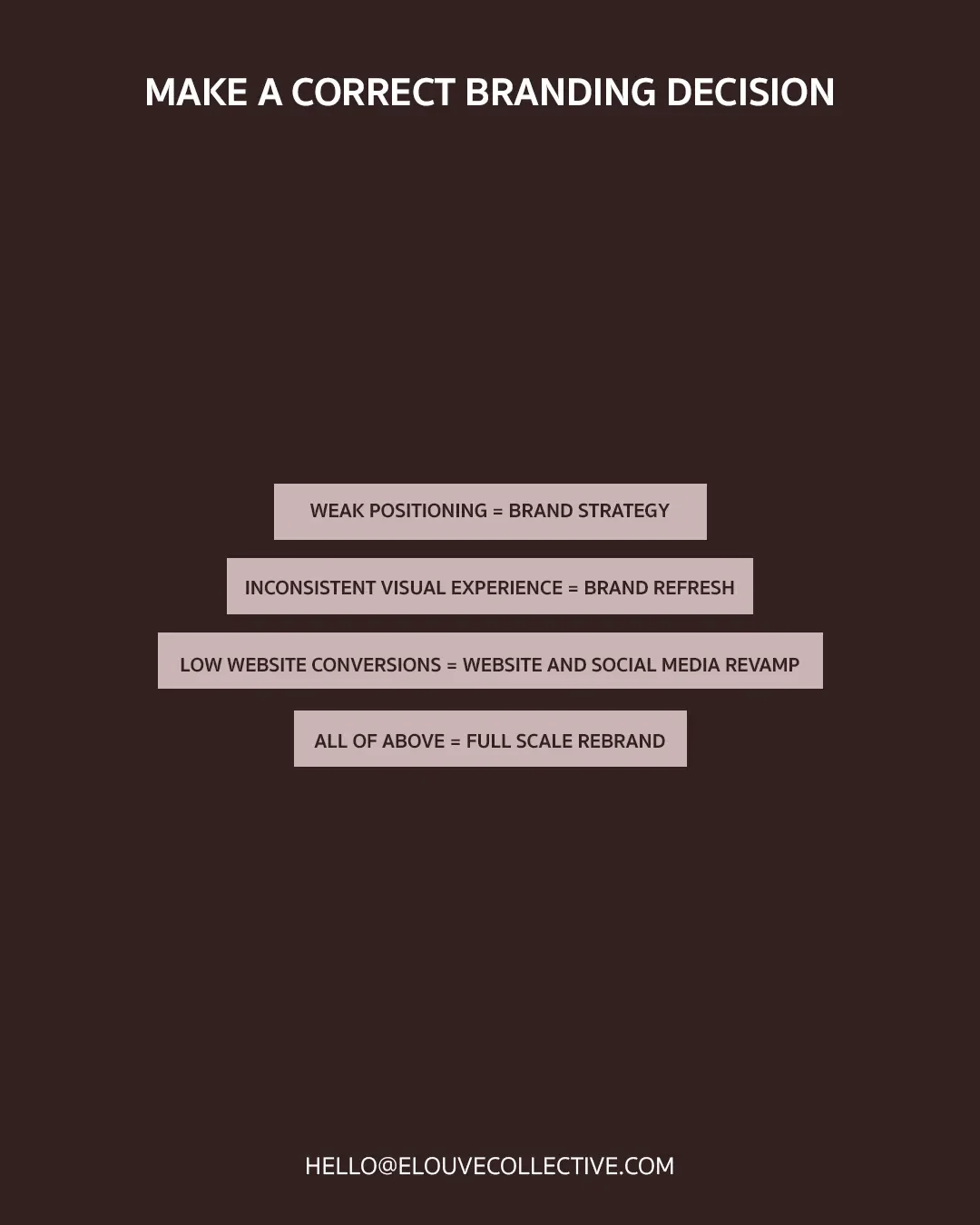
Understanding the core differences between a foundational luxury brand strategy vs visual identity is important here as fixing execution on top of a weak foundation wastes budget, and it is the most common reason a redesign disappoints. Many redesign briefs start with a new logo when the audit would have pointed to a supplier or a template.
FAQs: Brand Audit
How often should a luxury brand audit happen?
Once a year suits most premium brands. Run an extra one before a launch, a new market, a change of supplier or a leadership change.
How long does a brand audit take?
Allow two to three weeks for most premium brands. Collecting the evidence takes the longest, and scoring goes quickly once it is organised.
What does a brand audit cost?
Running it in house costs time. An agency led audit varies with the number of channels, products and markets, so ask for the scope lens by lens.
Who should run a brand audit?
Someone who did not make the work, such as an external strategist or an internal person outside the design team, with the founder as one of the scorers.
What happens after a brand audit?
You hold a scorecard, a ranked worksheet and a refresh or rebrand call. The fix now items start within the month, and the plan next items go into the next production or campaign cycle.
Where to Start
A redesign without an audit tends to repeat the same drift in better looking files. Elouvé Collective works with luxury brand founders on brand strategy and visual identity, starting with a clear read of where the brand stands today.
Audit your brand before redesigning. Book a brand consistency audit with Elouvé Collective.
