
Stock packaging is faster and usually less expensive, while custom packaging offers greater differentiation and control. The right choice depends on order volume, budget, timeline, product requirements and the role packaging must play in the brand experience.
Founders have two packaging routes. One is a custom shape no other brand uses. The other is a stock shape used by thousands of brands worldwide. Most founders in beauty and luxury want custom packaging straight away, and that is not always the right decision, depending on where they are in their journey.
The choice between custom packaging vs stock packaging is usually made early and without much long term thinking. It is a structural sourcing decision about moulds, tooling, minimums and lead time, and it locks in during the first three months of a project, long before anyone opens a design file. This guide covers what each route costs, where each one limits you, and how premium brands combine both.
Custom vs Stock Packaging at a Glance
The table compares both routes across the six factors that decide most projects. Figures are typical ranges and shift with supplier, material and complexity.
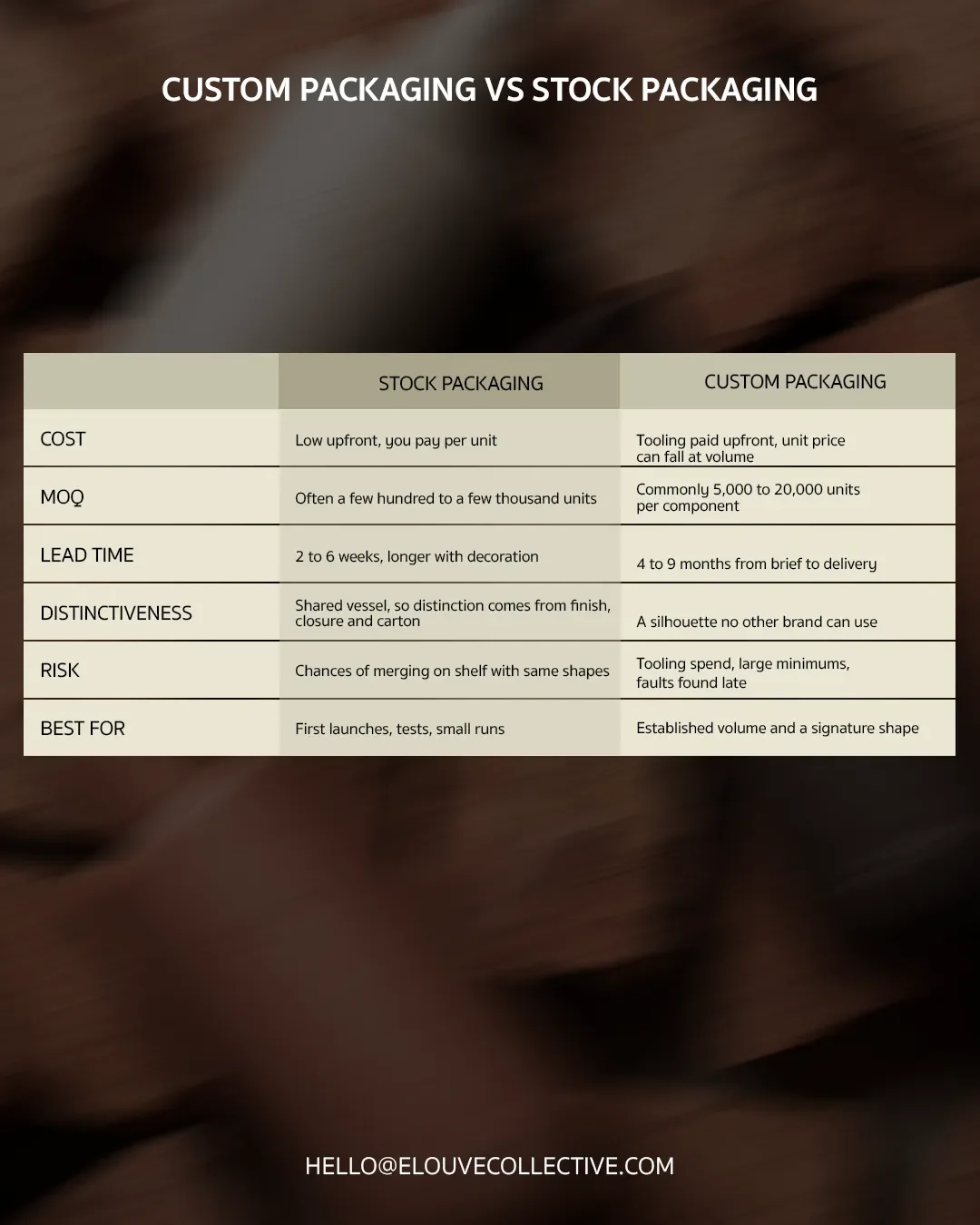
Should I use custom or stock packaging?
Most premium brands should launch with stock vessels and add custom finishing, closures and cartons, then move to a custom mould once reorder volume proves the product. Custom from day one makes sense only when the shape itself sells the brand and the budget can absorb the minimums.
What Stock Packaging Actually Means for a Luxury Beauty Brand
Stock packaging comes from existing moulds. A supplier has already paid for the tooling and sells bottles, jars, tubes and pumps from a catalogue to anyone who orders. For a stock packaging beauty brand, that means faster orders, smaller quantities and physical samples in hand before any commitment.
The trade is shared identity. Anyone can order the same vessel, so a pack only stands apart if something else on it differs. Many beauty brands people consider premium sit on catalogue vessels and build their look through colour, finish, closure and carton. If you are looking to scale this approach seamlessly across a full product range, explore our operational breakdown on managing a skincare packaging system multiple skus. Customers read the whole object, and the vessel is one part of it.
Two practical checks before you commit. Ask whether the line is stable, because suppliers retire ranges without much warning. Ask whether the colour or finish can be reserved for your brand, since some suppliers will do that for a volume commitment.
What a Custom Packaging Mould Actually Involves
A custom packaging mould is a tool cut to your design that produces your shape and nobody else's. For plastic that means an injection or blow mould. For glass it means a mould set the factory uses to form each piece.
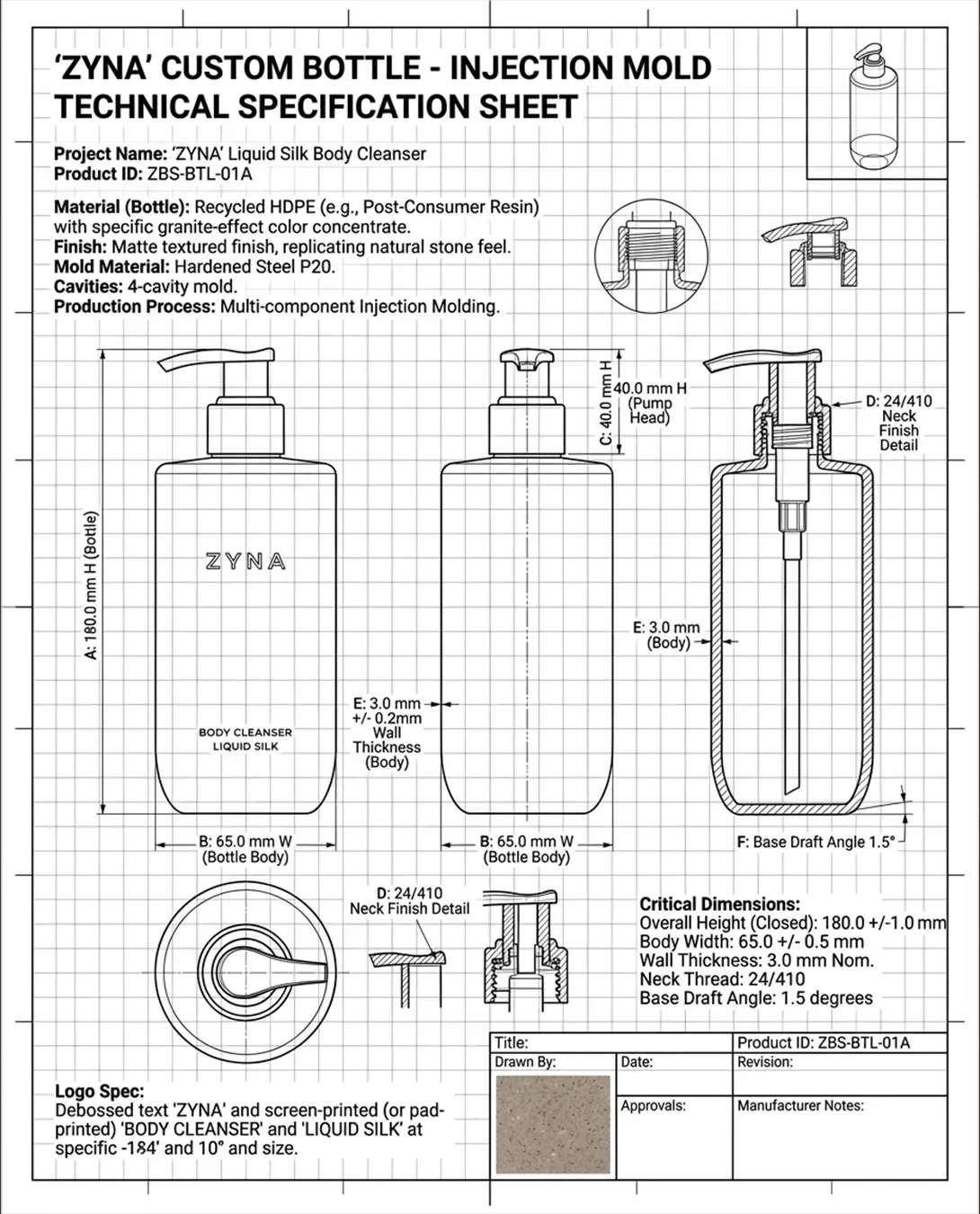
The process runs in stages:
Design and technical drawing, with wall thickness, neck finish and tolerances worked out against the closure.
A prototype or 3D print, so you can hold the shape before steel is cut.
Tool making and first samples.
Testing for fit, leakage, weight and finish.
Approval, which often takes more than one round.
What you are buying is exclusivity, control over proportions and a vessel that cannot be found in a catalogue. What it costs is time, minimums and the risk of a fault discovered after the tool is cut. To see exactly how these technical checkpoints fit into your overarching product timeline, check out our guide on the cosmetic packaging design process. Altering a finished mould is expensive and sometimes impossible, so the drawings deserve more scrutiny than the renders.
Tooling Costs and Where the Real Budget Goes
Tooling is a one time cost that works like a deposit on your brand's shape. As a rough guide, a single component mould commonly runs from a few thousand to tens of thousands. Simple caps and jars sit at the lower end. Glass with a complex form, tools with several cavities and multi part pumps sit at the top.
Four things drive the number: the material, how many cavities the tool has, how complex the shape is, and how many components you need to tool. A bottle, cap and collar are three tools, not one.
The hidden extras are where budgets slip:
Revision rounds after the first samples
Sample runs and shipping samples between countries
Compatibility, leak and drop testing
Colour matching and decoration set up
Storage of the tool between production runs
A buffer of around 20 percent on the quoted tooling figure is a sensible rule of thumb.
Is custom packaging worth the tooling cost?
It is worth it when the cost spreads across enough units to become small per unit, and when the shape drives sales. A tool costing 10,000 spread across 50,000 units adds 0.20 to each unit. The same tool across 5,000 units adds 2.00. If that added amount is a small share of your retail price and margin, the tooling is easy to justify. If it takes a large share, wait.
Packaging MOQ: The Number That Decides Everything
Packaging MOQ is the minimum order quantity, the smallest run a supplier will produce. Stock suppliers often sell from a few hundred units, sometimes fewer. Custom runs commonly start at several thousand per component, because setting up a line for a short run costs the factory almost as much as a long one.
That strains a first launch for two reasons. You pay for the volume before you know your sell through, so cash sits in boxes. And packaging stays in storage for years while a formula can change within one. A jar bought in the tens of thousands may no longer suit the product by the time you reach the last pallet.
Minimums also stack. Each component carries its own MOQ, and often a separate one per colour or decoration method. A pack with a bottle, cap, pump and carton is four commitments, not one. Ask every supplier for the MOQ per component, per colour and per finish, and ask whether they offer lower minimums on standard colours.
Lead Time: What Each Route Does to Your Launch Date
Stock packaging usually arrives in 2 to 6 weeks. Add decoration such as printing or foil and it moves to 6 to 10 weeks.
Custom packaging takes longer, and the stages add up:
Design and drawings: 3 to 6 weeks
Tool making: 4 to 8 weeks
Sampling and revisions: 4 to 8 weeks
Production: 6 to 10 weeks
Shipping by sea: 2 to 6 weeks
That totals roughly 4 to 9 months. The delays founders underestimate are extra sample rounds, colour approval, factory holiday closures, customs and artwork changes after sign off. The carton also cannot be finalised until the vessel dimensions are confirmed, so one late approval pushes everything behind it. Build four to six weeks of buffer before any retail date or campaign.
Closures: The Part of the Pack Customers Touch First
Caps, pumps, droppers and stoppers get handled before the product is ever used. Weight, sound and torque shape the impression: the click of a cap seating, the resistance of a pump, the smoothness of a thread. A rattling cap or a pump that sputters undermines the product regardless of how good the bottle looks.
That is why a custom or heavily modified closure on an otherwise stock vessel is one of the strongest moves in packaging. It puts effort into the part with the highest perceived value for the money. A fully new closure shape needs its own mould. A modified stock closure, with a matched colour, plating, a heavier feel or an engraved logo, needs decoration only and usually carries a lower minimum.
Check neck finish compatibility before ordering. A mismatch between thread and neck leaks. Test the closure with your actual formula too, because oils, actives and fragrance can attack certain plastics and seals.
Finishes: How to Make Stock Packaging Look Like Yours
Finishes change how a vessel looks and feels without a new mould. This is the section that rescues a tight budget.
Colour matching: a tinted or coated vessel matched to your brand colour reference
Frosting: a diffused, tactile glass surface
Metallisation and plating: metallic caps and collars
Soft touch coating: a velvet feel on plastic and some glass
Hot foil and screen printing: logos and detail directly on the vessel
Each finish has its own minimum and adds lead time, so confirm both early. Test for wear too, since coatings can rub or scratch in shipping and handling.
How can stock packaging still feel premium?
Three levers do most of the work.
The first is high end secondary packaging. A rigid box, lined tray or sleeve carries the brand into the moment of opening. The second is customised closures: colour, plating or engraving on the part customers touch. The third is colour combinations and finishes that have not been used before in your category. A particular glass tint, cap finish and carton stock together give a combination no other brand owns, even when the vessel itself is shared.
Labels and Cartons: The Cheapest Place to Be Fully Custom
Cartons and labels carry most of the brand at a fraction of mould cost. A cutting die for a carton typically costs a small fraction of a bottle mould, and the carton can change at each reorder without any new tool.
Carton structure is the first decision: tuck end, sleeve, drawer, magnetic or rigid two piece. Paper stock comes next, from uncoated and textured to recycled, and then the print methods: offset, foil, emboss, deboss and spot gloss. For labels, consider the material, how well it adheres to curved glass, and whether printing directly on the vessel gives a cleaner result.
For most brands this is the first custom investment to make. The carton is where you can be fully distinctive on a first launch budget.
First Launch vs Established Volume: When to Switch
The staged route works for most premium brands: a stock vessel with a custom carton and closure at launch, then a custom mould once volume justifies tooling. Here is how the decision runs by stage.
Concept and first launch. Under roughly 3,000 units per SKU in year one? Use a stock vessel. Make the carton, label, colour and closure finish custom.
Proven product. Reorders are coming in and sell through is predictable? Stay with the stock vessel. Upgrade the closure and secondary packaging, and ask the supplier to reserve your colour.
Established volume. Around 10,000 or more units per SKU each year, with a stable formula? Commission a custom mould for the hero product.
Range growth. Extend the custom shape across the line, and tool a second size only when its volume earns it.
When should a brand invest in a custom mould?
As a rule of thumb, invest when four things are true. You reorder at volume, roughly 10,000 units or more per SKU each year. The formula is stable. The shape is part of how customers recognise the brand. And cash can cover tooling plus the first minimum without squeezing marketing.
If one of those is missing, wait a reorder cycle. Signals that you are ready include customers photographing the pack, retailers asking for exclusivity, and a supplier discontinuing your vessel or another brand launching in it.
A Decision Checklist for Premium Founders
Answer yes or no to each question. The brackets show whether it tests cost, risk or fit.
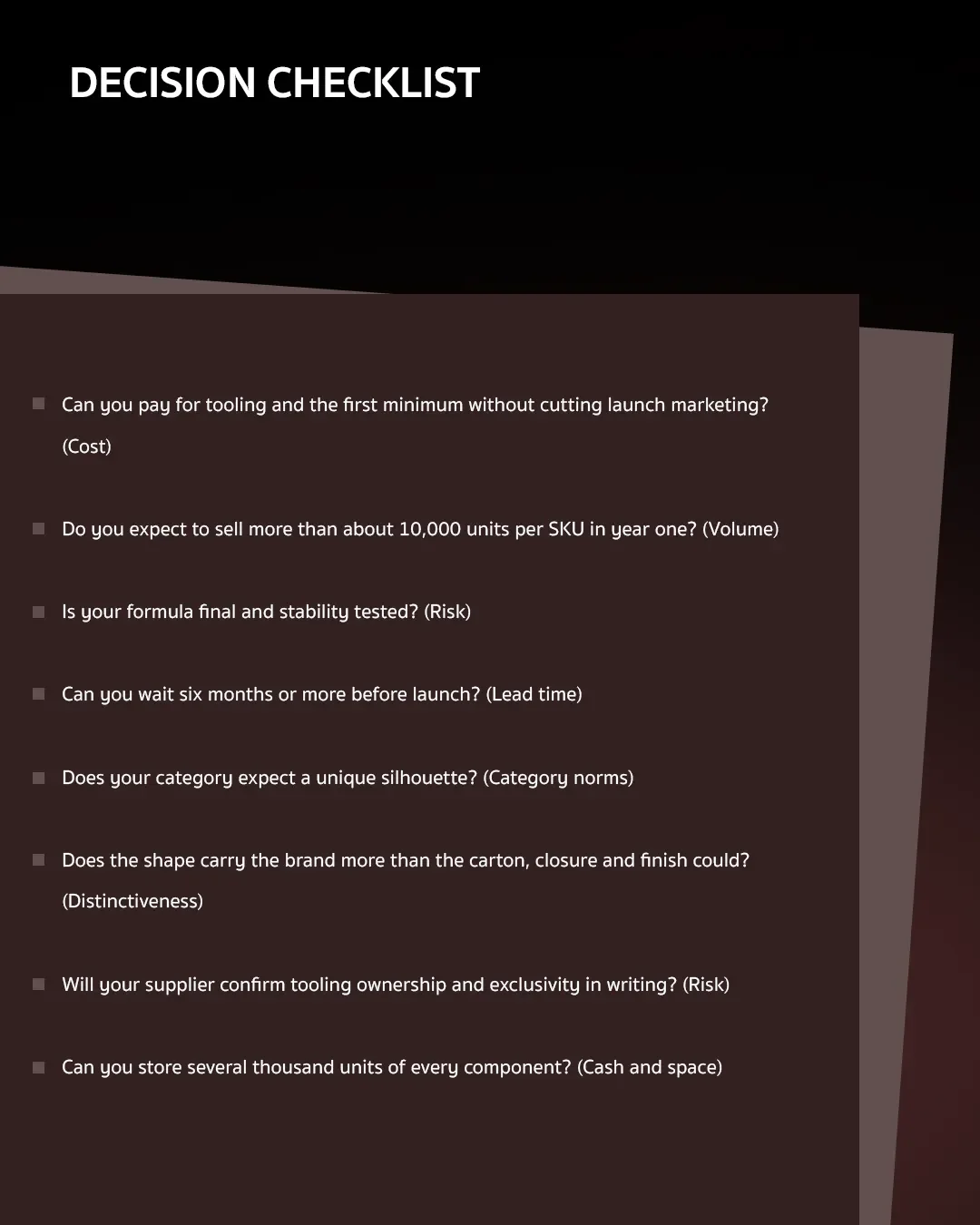
0 to 3 yes: Use a stock vessel with a custom carton and finishing.
4 to 5 yes: Use a stock vessel with a custom closure and secondary packaging, and plan the mould for your next stage.
6 to 8 yes: A custom mould makes sense for your hero product.
Custom Cosmetic Packaging: Questions to Ask Before You Brief Anyone
Custom cosmetic packaging involves several parties, usually a supplier, a filler and a design team, and the answers below belong in writing before any design work begins.
Who owns the tooling, and where is it stored? Can it move to another supplier?
Is the shape exclusive to you, and for how long?
What tolerances apply to height, neck finish and wall thickness?
How many sample rounds are included, and what does each extra round cost?
What is the MOQ per component, and what is the minimum reorder?
What happens if a batch fails inspection?
Who tests compatibility with the formula?
FAQ: Custom Packaging vs Stock Packaging
Is custom packaging worth it for a first launch?
Usually not for the vessel. Tooling and minimums tie up cash before you know demand. Custom cartons, closures and finishes deliver most of the distinctiveness for far less.
How much does a custom packaging mould cost?
Commonly from a few thousand to tens of thousands per component, depending on material, cavities and complexity. Request quotes for every component, and include samples and testing in the budget.
What is a typical packaging MOQ for beauty brands?
Stock components often start in the hundreds. Custom components commonly start in the thousands, often 5,000 or more per component. It varies by supplier, colour and decoration method.
Can stock packaging still feel luxury?
Yes. Weight, closure feel, finish, carton and colour make a pack feel premium, and every one of them can be customised on a stock vessel.
Who owns the tooling once it is made?
That depends on the contract. Suppliers often hold the tool even when you paid for it, so agree ownership, storage and transfer rights in writing before the first payment.
Where to Start
List your components, expected volumes and launch date, then work through the checklist above. That gives you a clear view of which parts of the pack deserve custom work now and which can wait.
At Elouvé Collective, we design packaging for beauty, fashion, hospitality and lifestyle brands, from the structural decision through to the finished carton. If you want a second opinion before you commit to tooling, get in touch to choose the right packaging route for your brand.
