
A mockup shows how packaging may look, a prototype tests structure or interaction, and a production sample shows what a manufacturer can actually make. Founders often need more than one because each answers a different commercial or production question.
Your designer emails you the packaging design. You open it, zoom in and spend the week obsessing over it. The black looks deep, the gold looks rich, you show it to everyone you trust, and you approve it.
Three months later the products arrive and you hate them. The black is flatter, the gold is duller and the whole thing looks nothing like the design you fell in love with.
What you fell in love with was a picture on a screen. A screen cannot show how ink sits on board, how foil catches the light or how a lid closes.
Packaging samples come in three types, and each one answers a different question. A mockup answers "does it look right?" A prototype answers "does it work?" A production sample answers "will it be made this way every time?" Once you know which question you are asking, you know which sample to pay for and which one to sign.
This guide covers what each sample is, what it proves, where it stops being useful, and how to approve it before production begins.
Packaging Prototype vs Mockup vs Production Sample: What Is the Difference?
Here are the three in one line each:
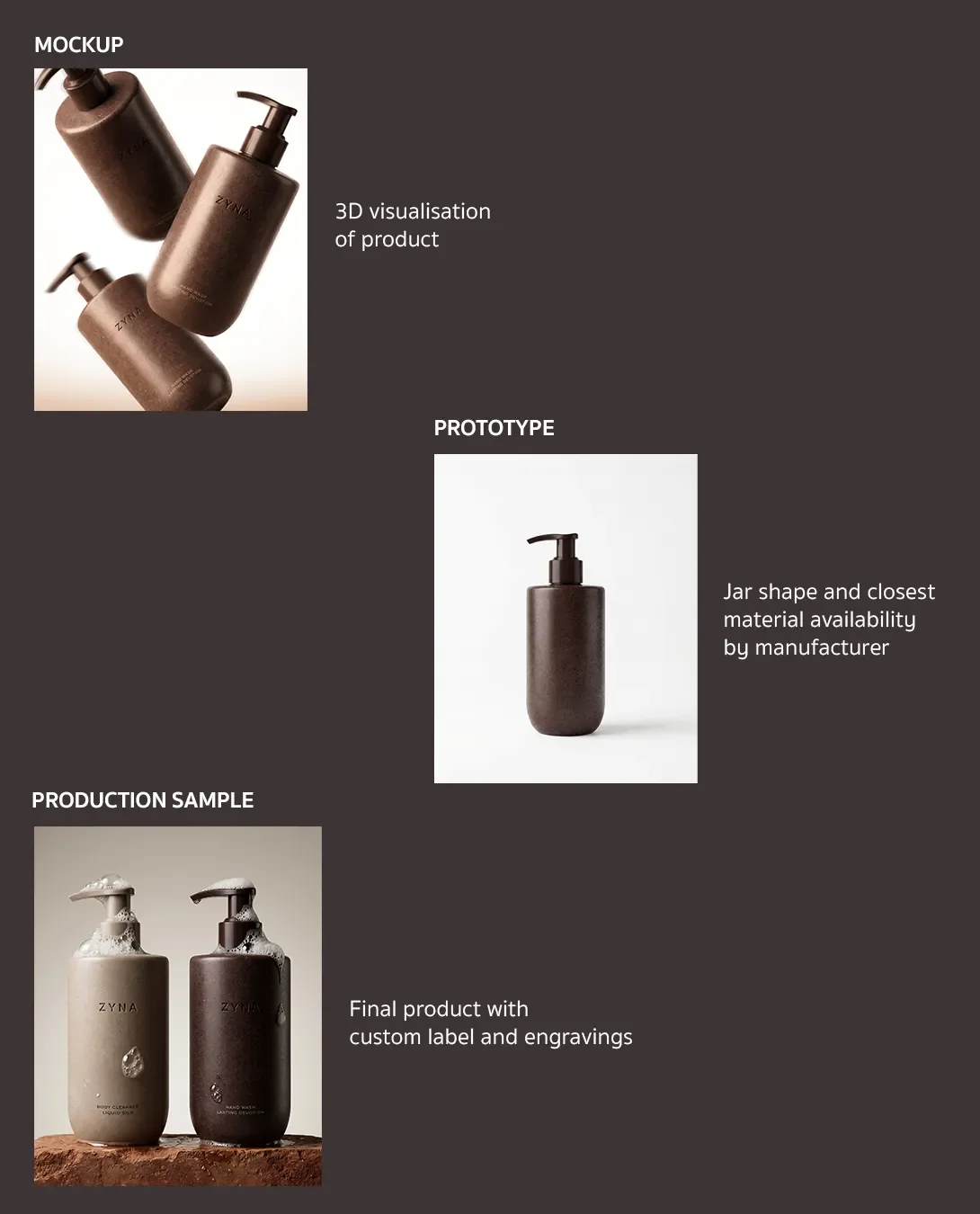
Packaging mockup: a digital visualisation of your packaging, such as a 3D render or flat design, built to show look, proportion and brand feel.
Packaging prototype: a working structural model used to test shape, fit, closure, weight and the unboxing sequence.
Packaging production sample: a piece made on the real manufacturing process with the real materials, inks and finishes. It is the benchmark your supplier is measured against.
What is the difference between a mockup and a production sample?
A mockup shows the intended design. A production sample shows what the factory will actually make. A mockup is a digital visualisation, so its materials and finishes are simulated on screen. A production sample uses the specified stock, the real inks and the real foil, embossing and coatings, which makes it the only one of the two that works as a reference for the run. Mockups guide decisions. Production samples settle them.
Packaging Mockup: What It Shows and When to Use It
What a packaging mockup is
A mockup is the fastest and lowest cost way to see your packaging. It is a digital visualisation, such as a 3D render of the pack on a clean background or in a styled scene, with materials and finishes simulated on screen.
Founders use mockups to align a team, show investors the brand world, open early retailer conversations and plan campaign imagery before stock exists.
What it can and cannot tell you
A mockup proves proportions, layout, hierarchy and how the brand reads next to competitors. It cannot prove structure, true colour on your chosen stock or how a finish behaves under light.
The risk here is small in cost and larger in expectation. A colour approved on a screen becomes a promise that the print may not keep. Mockups work well for teaser content and early concept visuals. (If you want to understand how these early digital visualisations factor into the broader development timeline, check out our guide on the cosmetic packaging design process. Keep any claim about the final finish out of that imagery until a real sample exists.
Packaging Prototype: What It Shows and When to Use It
What is a packaging prototype?
A packaging prototype is a working model of the pack's structure. It is built to answer practical questions. Does the bottle sit securely in the insert? Does the lid open cleanly? Does the pack survive being picked up, shaken and shipped?
A cosmetic packaging prototype usually includes the outer box, the insert and the actual product, such as a glass jar or dropper bottle, so fit and weight can be checked together. Print on a prototype is often approximate, because the point of the piece is how it works in the hand.
Structural testing on a prototype covers fit, closure strength, magnet pull, lid tolerance, weight, stacking and a simple transit test. You can photograph a prototype for internal review and structural notes. Save hero imagery for a later sample.
Do I need a physical packaging prototype?
Usually yes when:
You are making a rigid box with an insert
The pack has a magnetic, ribbon or custom closure
The product is glass, heavy or fragile
The structure is new to your supplier
Often no when:
You are using a standard structure your supplier already makes
The dieline has been produced before for a similar product
You are reordering with no changes
On cost and risk, a prototype is a small fraction of a production run. A wrong insert found after thousands of units are made is far more expensive than a prototype round. Deciding whether to build from scratch or modify an existing structure is a vital milestone; read more about choosing between custom vs stock packaging.
Production Sample: What It Shows and Why It Is the One You Are Held To
What a packaging production sample is
A production sample is made on the actual process, with the real board, inks, coatings and finishing. You may also hear it called a pre production sample. It is the first time you see colour, foil, embossing and structure together on final materials.
This is the sample to use for hero photography, product listings and campaign shots, because it shows what customers will receive.
Why approving it is a commercial decision
When you sign a production sample, it becomes the standard. If the run matches it, the supplier has met the agreement, even if you later wish the red were warmer. That makes approval a financial checkpoint as much as a creative one, and it belongs with the person who owns both the budget and the brand.
It carries the highest cost per piece of the three samples and the lowest risk, because everything left to check is consistency. Ensuring this exact material execution aligns with a premium aesthetic is critical—see our deep dive into what makes packaging feel luxury.
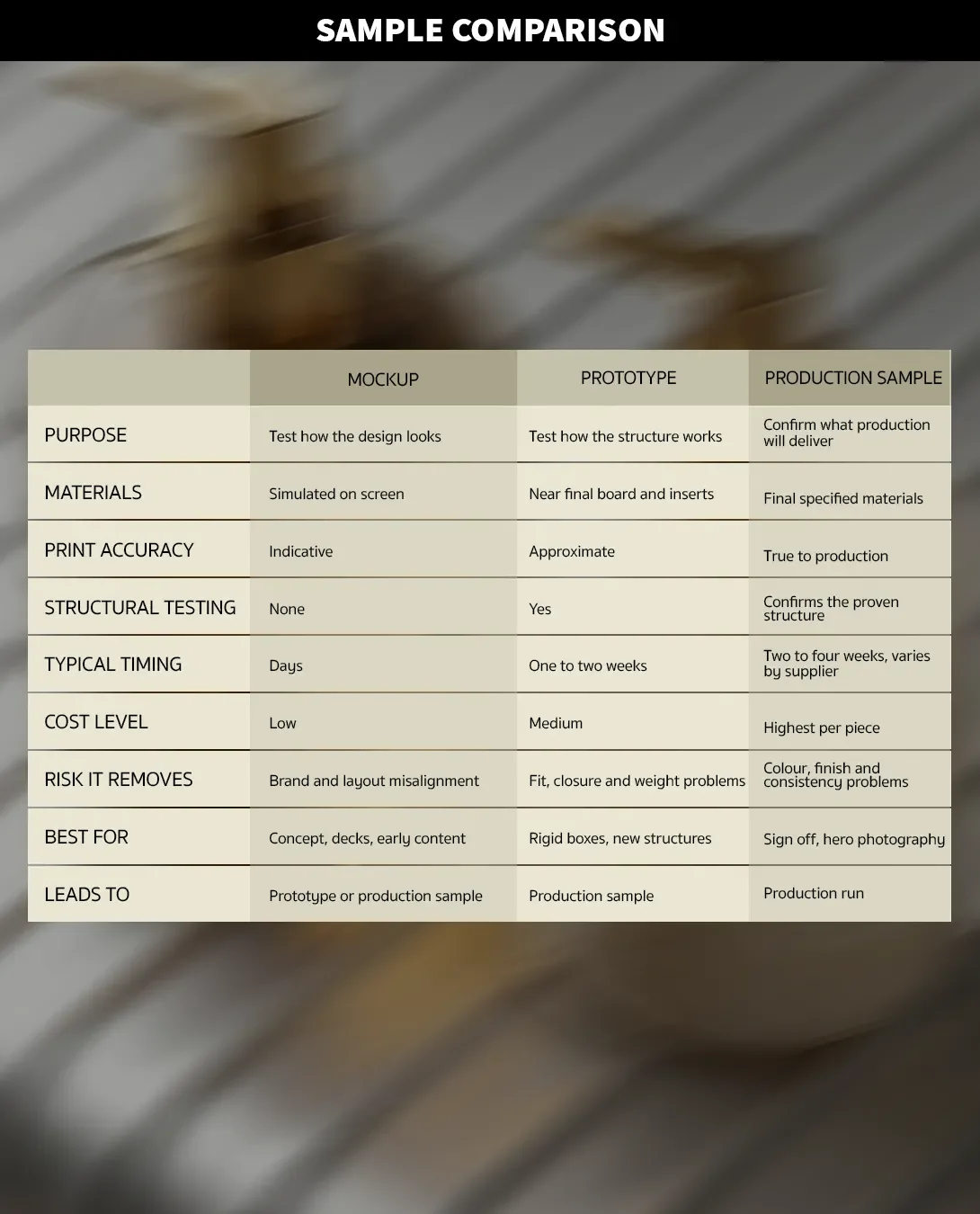
Prototype vs Mockup vs Production Sample Side by Side
Which Sample You Need at Each Stage of a Launch
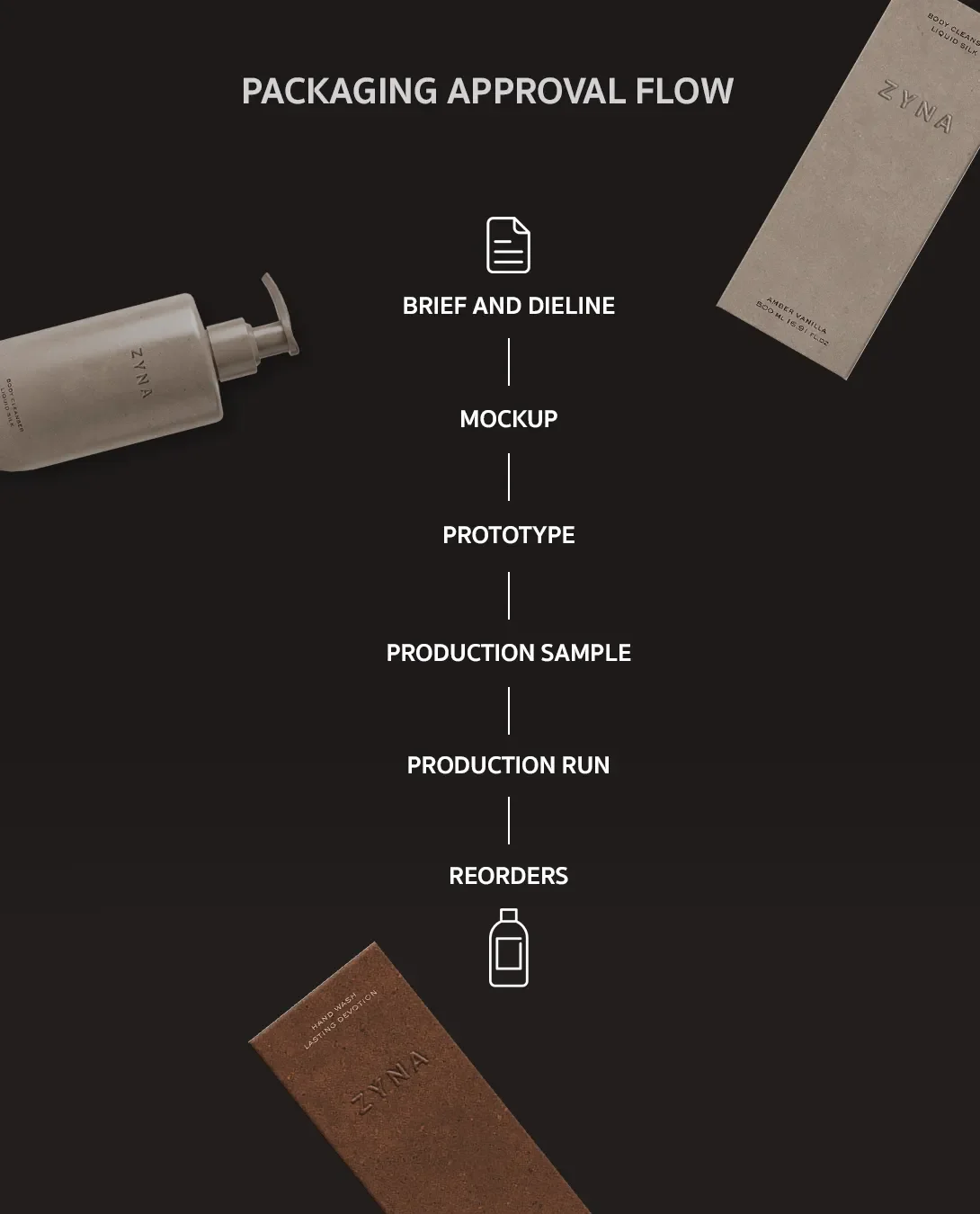
The usual sequence runs like this:
Brief and dieline: you share the product dimensions, materials and finish ambitions.
Mockup: the team confirms the design direction on a digital visualisation. Gate: brand approved.
Prototype: the structure is tested with the real product. Gate: fit and closure approved.
Production sample: colour, finish and materials are confirmed on the real process. Gate: signed off by a named approver.
Production run: the supplier builds to the signed sample.
Reorders: each batch is compared back to that same signed sample.
Early concept: a mockup is enough. Spend your budget on getting the idea right.
Before launch: add a prototype if the structure is new or the closure matters. Build teaser content from the mockup.
First production run: the production sample is the one to approve. Photograph it for launch assets.
Reorders: compare new batches against the signed sample. Ask for a fresh sample only when the supplier, board or finish changes.
Most founders do not need all three at full spend. A standard structure can move from mockup to production sample. A new rigid box with a magnetic closure will use all three. At Elouvé Collective we manage sampling from first mockup through prototype to the approved production sample, so you pay for the rounds your project needs and no extra ones.
Materials and Print Accuracy: What Each Sample Can and Cannot Show
Materials change how a design looks and feels. Board caliper affects how a lid sits and how a wrap folds at the edges. The same ink looks different on coated, uncoated and textured stock, and a dark colour can shift noticeably between them.
Pantone and CMYK also behave differently. A Pantone colour is mixed to a standard, while CMYK builds colour from four inks, so the same brand shade can land differently depending on which one the printer uses. A screen proof adds another gap, since screens glow and paper reflects. Only a printed sample on your chosen stock shows the real result.
Foil, embossing and spot UV depend on tooling and pressure, so they read correctly only on later samples. Use this table to see what each sample can prove.
| Attribute | Mockup | Prototype | Production sample |
|---|---|---|---|
| Board thickness and wrap | No | Partly | Yes |
| Colour on final stock | No | Partly | Yes |
| Pantone match | No | No | Yes |
| Foil | No | Partly | Yes |
| Embossing or debossing | No | Partly | Yes |
| Spot UV | No | No | Yes |
| Closure strength | No | Yes | Yes |
| Barcode scan | No | No | Yes |
Packaging Sample Approval Checklist: What to Confirm Before You Sign Off
What should I approve before production?
Work through this list with the sample in your hands and the brief beside it.
☐ Dimensions: measure against the dieline and spec sheet.
☐ Stock and finish: confirm board, coating, foil, embossing and spot UV match the spec.
☐ Colour: compare against the approved colour reference in daylight.
☐ Structural fit: place the real product in the pack and check the insert.
☐ Closure: open and close it repeatedly and test the magnet or ribbon.
☐ Barcode and legal copy: scan the barcode and check every line of required text.
☐ Photographed record: photograph every angle and keep the files with the date.
☐ Written sign off: record approval in writing with a named approver.
Packaging Sample FAQs
Is a prototype the same as a mockup?
No. A mockup is a digital visualisation that shows how the pack looks, while a prototype is a physical model that shows how it works. A prototype is built to test structure, fit and closure, and a mockup is built to test the design.
How many sample rounds should a founder budget for?
Budget for one mockup round, one prototype round and one production sample round. Add a contingency for one correction round on the production sample, especially for foil or deep colours.
Can you skip the prototype?
Yes, when the structure is standard or your supplier has already produced it. Skipping a prototype on a new rigid box with an insert is a risk worth avoiding.
Who owns the dieline and tooling after approval?
That depends on your agreement. Dielines you commission from a designer are often yours once paid, and tooling made by a supplier may stay with them unless you agree otherwise in writing. Settle this before you approve the sample.
Planning Packaging for a Launch?
We handle packaging from the first mockup, through prototype, to the approved production sample, so the pack you sign is the pack that ships.
Plan your packaging development with Elouvé Collective.
