
How to Design a Skincare Packaging System That Works Across Multiple SKUs
Table of Contents
- The Problem With Designing One Product at a Time
- What Is a Packaging Design System?
- Fixed vs Flexible: The Framework That Holds a Range Together
- How Do You Design Packaging That Can Scale?
- How Should Skincare SKUs Be Differentiated?
- Building Your Color and Material Logic
- Structural Consistency: Sizes and Formats That Scale
- How Do You Keep Skincare Packaging Consistent Across Products?
- Designing for the Shelf and the Screen
- Where Founders Get This Wrong
- Planning Your Future Launches
- Production Handoff and Guidelines
- A Simple Framework for Auditing Your Current Range
- When to Bring in a Packaging or Brand Partner
- FAQs
A scalable skincare packaging system separates fixed brand elements—structure, logo placement, typography and label grid—from flexible SKU elements such as colour, size and product-specific claims. This lets a growing range stay recognisable while making each product easy to distinguish on shelf and in ecommerce thumbnails.

Product family mockup portfolio
The Problem With Designing One Product at a Time
Most skincare brands start with one product. A serum, a moisturizer, something with a story worth telling. The founder spends weeks on the label, the finish, the unboxing moment. It looks incredible on the shelf, alone.
Then the second product launches. Then the third. And somewhere around SKU six or seven, the range starts to look like six or seven different brands sharing a logo. Different bottle shapes bought from different suppliers because nobody planned for a matching set. Label layouts that shift depending on who briefed the designer that month. A shelf that reads as noise instead of a collection.
This isn't a design failure. It's a planning gap. Packaging designed one product at a time will always fracture as the range grows, because nobody decided in advance what should stay fixed and what's allowed to change. A packaging system fixes that before it becomes a problem, not after you've already reordered stock in three mismatched bottle shapes. Working alongside a dedicated skincare-branding-agency ensures these architectural guidelines are established early.
What a Packaging System Actually Controls
What Is a Packaging Design System?
A packaging system is the set of rules that govern every SKU in a range so that new products can be added without a redesign each time. It defines what stays constant across the whole line (structure, closures, core visual language) and what's allowed to flex per product (color, size, specific callouts). Done properly, a customer can pick up any product in your range and immediately recognize it as part of the same brand, even if they've never seen that exact SKU before.
Think of it less like a set of individual labels and more like a template with variables. The template is fixed. The variables change per product.
Fixed vs Flexible: The Framework That Holds a Range Together
Every scaling packaging decision comes down to sorting elements into one of two categories.
| Element | Usually Fixed | Usually Flexible |
|---|---|---|
| Bottle or jar structure | Yes, across a category | Rarely, unless format demands it |
| Closure type | Yes | No |
| Core logo lockup and typography | Yes | No |
| Label layout grid | Yes | No |
| Color or finish | Maybe | Yes, assigned by logic |
| Product name and claim copy | No | Yes |
| Size and fill volume | No | Yes |
| Print method (foil, emboss, etc.) | Yes, as a system | No, applied consistently |
The mistake most founders make is flexing the wrong things. Changing structure per launch is expensive and breaks shelf recognition. Changing color per launch, when it's tied to a clear logic, is exactly what a system is built to do.
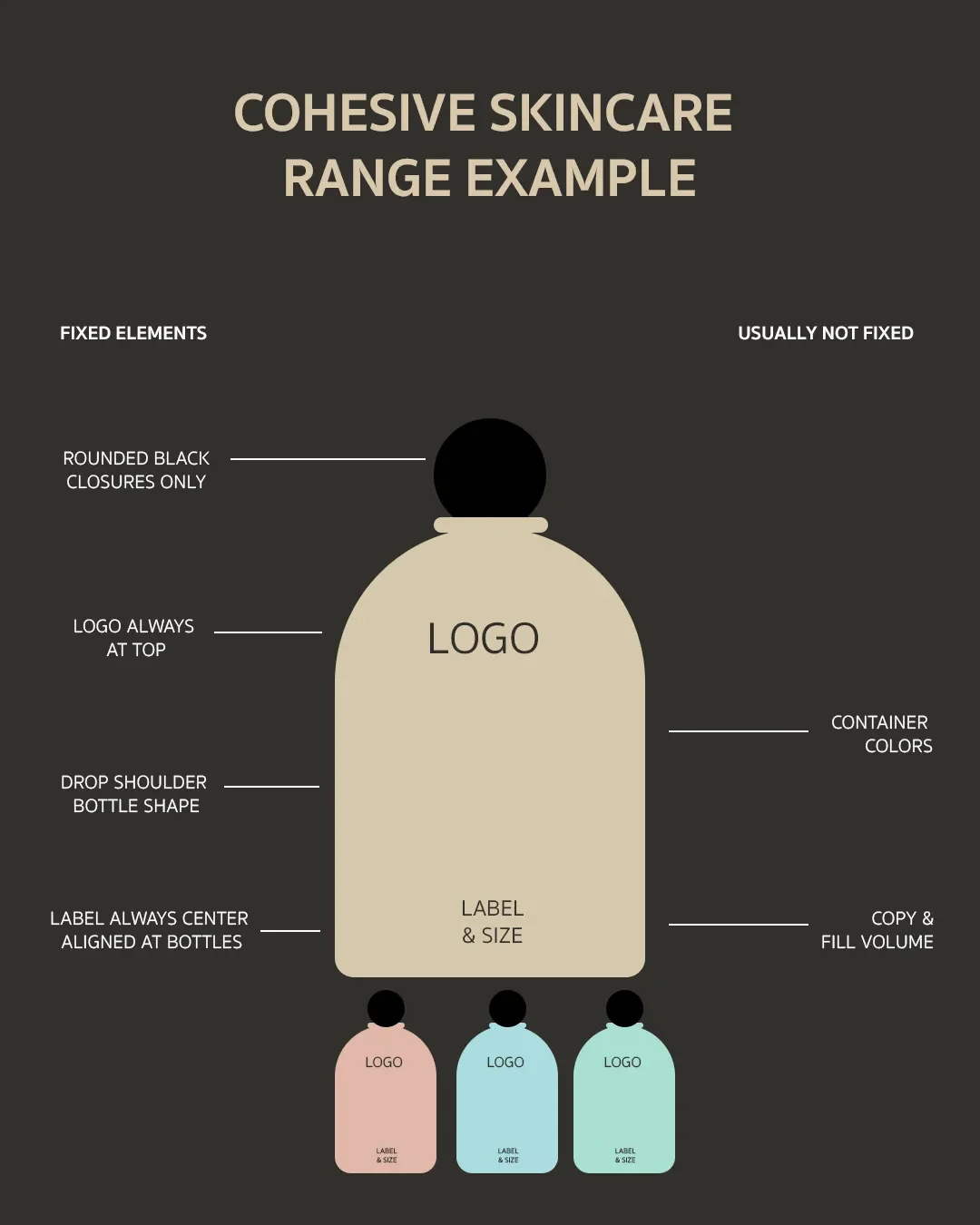
Fixed and flexible packaging design rules for beauty products
Master Architecture: The Framework Everything Else Sits On
How Do You Design Packaging That Can Scale?
Scalable packaging starts with a master architecture, a single reference document (or file set) that defines every fixed element before a single new product is designed. This includes the base structure and dimensions, the closure family, the label grid and margins, typography rules, the logo lockup and its minimum size, and the print or finishing techniques approved for use.
Once this exists, every future SKU is designed against it rather than from scratch. A new product brief becomes: which variables change here, not what should this look like. That's the difference between a founder making creative decisions eight times a year and a founder making one structural decision that holds for the next fifty products. For an in-depth breakdown of structural layouts, explore our skincare-packaging-design-guide.
Build the master architecture assuming you'll have twenty SKUs, even if you currently have three. Retrofitting a system onto an existing range is always more expensive than planning one from the start, because it usually means reprinting stock and sometimes retooling molds.
Variant Coding and Product Families
How Should Skincare SKUs Be Differentiated?
Once the fixed architecture is locked, SKUs need a clear, consistent way to be told apart, what's usually called variant coding. There are a few reliable approaches, and most strong ranges combine more than one:
By color, assigned to a category, skin concern, or product family (e.g. all brightening products in a warm gold, all barrier repair products in a muted clay)
By icon or symbol, a small consistent mark that shifts per concern or ingredient hero
By label position or band, a colored strip or block that stays in a fixed location but changes hue
By typographic weight or size hierarchy, useful for differentiating product type within a family without touching color
Grouping SKUs into product families (cleansers, treatments, moisturizers, or grouped by skin concern such as barrier, brightening, hydration) gives you a coding structure that scales cleanly, because a new SKU simply slots into an existing family rather than requiring a brand new rule.
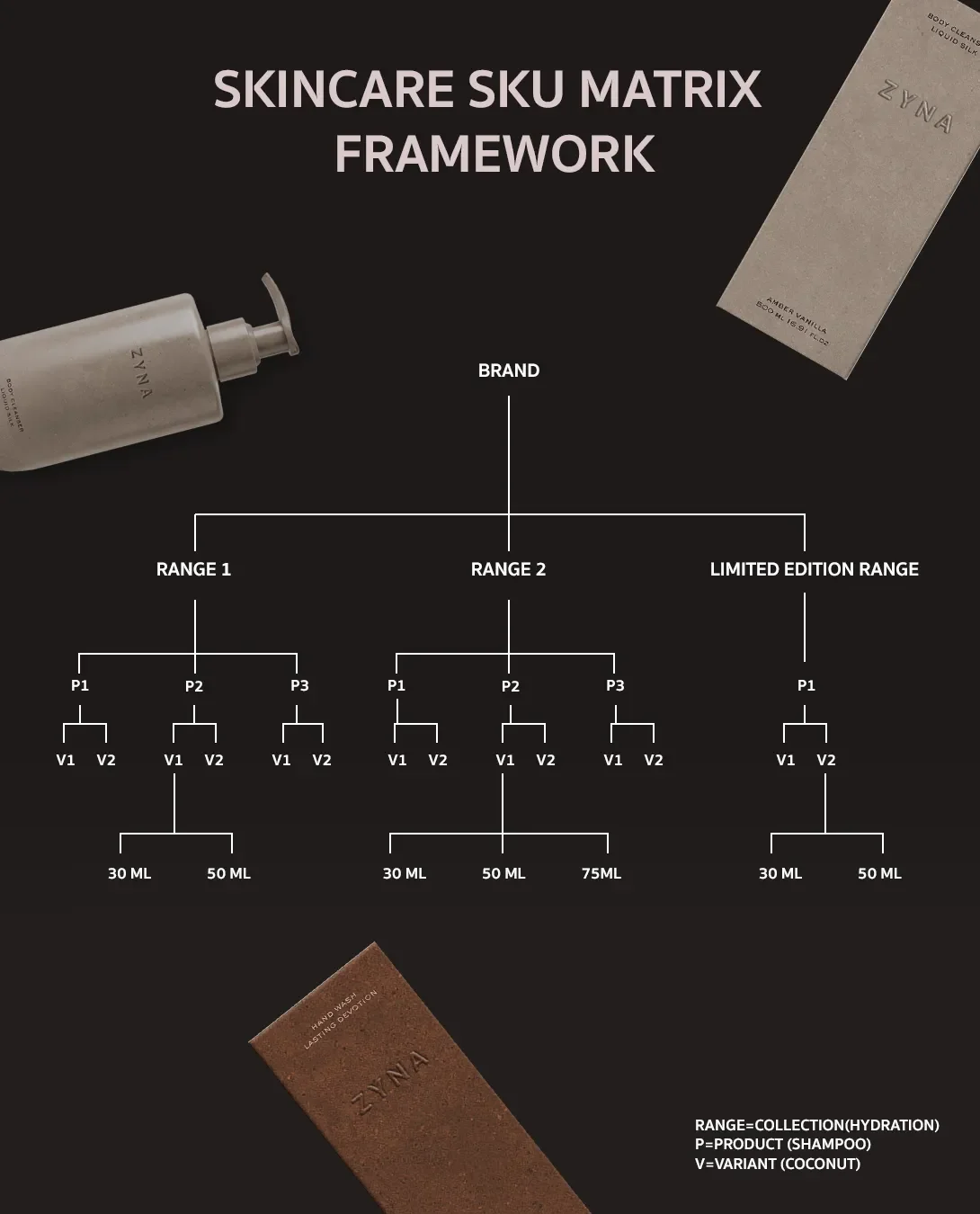
Skincare SKU matrix framework
A Simple SKU Matrix
Mapping this out on paper before production saves confusion later. A basic version looks like this:
| Product Family | Fixed Structure | Color Code | Size Options | Label Variable |
|---|---|---|---|---|
| Hydration | 50ml jar | Soft blue | 15ml, 50ml | Concern icon, claim line |
| Brightening | 30ml pump bottle | Warm gold | 30ml, 60ml | Concern icon, claim line |
| Barrier repair | 50ml tube | Muted clay | 30ml, 75ml | Concern icon, claim line |
Every new product gets slotted into a row. If it doesn't fit an existing family, that's a signal to either create a new family deliberately or reconsider whether the product belongs in the current architecture at all.
Building Your Color and Material Logic
Color and material choices should be decided as a system, not a mood board exercise repeated per launch. Before your range hits ten SKUs, decide the logic that will assign color going forward: is it tied to skin concern, ingredient hero, product type, or collection? Pick one primary logic and stick to it, because mixing logics (color by concern for half the range, color by collection for the other half) is what causes shelf confusion later.
Material choices follow the same rule. If your hero product uses frosted glass, decide now whether frosted glass is a brand standard or a one off choice for that product. Materials that can't be matched consistently across suppliers as you scale volume will eventually force a redesign, usually at the worst possible time, mid reorder with a supplier who can't source the original finish anymore.
Structural Consistency: Sizes and Formats That Scale
Structure is the most expensive thing to change later, so it deserves the most planning up front. A few practical rules:
Lock your container family early, and choose formats with supplier flexibility (multiple manufacturers who can produce the same or near identical mold) so you're not stuck if one supplier's minimums or lead times change.
Plan for size changes within the same structure family rather than introducing new shapes per size. A 15ml and a 50ml version of the same jar, sharing the same cap and closure, keeps the system intact. A completely different bottle shape for the travel size does not.
Confirm minimum order quantities before locking structure. Founders often choose a beautiful bespoke mold at low volume, then discover the minimums jump sharply once they need to reorder at scale, forcing a switch that breaks visual consistency right when the brand is growing fastest.
Label Hierarchy and Print Systems
How Do You Keep Skincare Packaging Consistent Across Products?
Consistency across a growing range comes down to label hierarchy, a defined order of what information appears where, in what size, and in what weight, applied the same way on every SKU. A strong hierarchy typically follows this order: brand mark, product name, concern or benefit callout, size or volume, then required regulatory text (ingredients, warnings, batch code).
Once this hierarchy is set as a template, adding a new SKU becomes a matter of dropping new copy into existing slots rather than redesigning the label from the ground up. This is also what keeps packaging consistent when ingredient lists change or regulatory text needs updating market by market. Build the template with enough flexible space around required text so a longer ingredient list in one region doesn't break the layout.
Print systems matter just as much. Standardizing on one or two print methods (foil stamping, embossing, digital label printing) across the whole range keeps unit costs predictable and keeps the finish consistent, rather than negotiating a new print process with every launch.
Designing for the Shelf and the Screen
A packaging system has to work in two very different environments, and most founders only design for one.
Retail shelf recognition depends on silhouette and color block, recognized from a distance before a customer reads a single word. This is why locking structure and color logic matters so much: a customer should be able to spot your brand's shape and color language across a crowded shelf before they've read the label.
Ecommerce thumbnails are a much smaller, flatter test. At thumbnail size, fine label detail disappears, and what's left is color and silhouette, almost exactly the same signals as the shelf, just compressed into a 200 pixel square. If your product photography and packaging don't hold up at thumbnail size, they're working against your product listings before a customer clicks through.
Test both. Print a mock shelf set at actual scale, and shrink your product photos down to thumbnail size on a phone screen. If products become hard to tell apart in either test, the system needs more differentiation, not less.
Designing for the Shelf and the Screen
| Mistake | Why It Hurts | The Fix |
|---|---|---|
| Designing each new SKU as a one off | Breaks shelf and thumbnail recognition | Build against the master architecture every time |
| No shared visual grammar across products | Range reads as unrelated items | Lock a single color and coding logic early |
| Ignoring supplier minimums until reorder | Forces mid range structural changes | Confirm MOQs before locking any mold or structure |
| Treating labels as one off design jobs | Slows down every new launch | Build a label template with defined variable zones |
| No plan for size variants | Creates mismatched sub ranges | Design size options within the same structure family |
Planning Your Future Launches
The real test of a packaging system isn't how the first few products look together, it's how easily product ten fits in. Before every new launch, run it against three questions: does this product belong to an existing family, or does it need a new one deliberately created for it? Does it fit inside the fixed architecture, or does it require a structural exception? And if it's an exception, is that exception worth the cost of breaking consistency?
Most successful ranges plan launches in clusters rather than one at a time, mapping two or three future SKUs against the matrix before production even starts on the first. This catches structural gaps early, while changes are still cheap.
Production Handoff and Guidelines
A packaging system only holds up if it survives contact with manufacturers, printers, and anyone briefing a new SKU after the founder isn't the one writing every spec by hand. That means documenting the system properly: exact Pantone or CMYK values, approved materials and finishes by supplier, die lines and label templates with locked and variable zones marked, and minimum size and placement rules for the logo.
This becomes your production guidelines, the document a new designer, a new supplier, or a new hire can work from without a call to the founder for every decision. Without it, consistency depends entirely on one person remembering every rule, which is exactly the bottleneck a packaging system is meant to remove.
A Simple Framework for Auditing Your Current Range
If your range already exists and looks inconsistent, audit it before designing anything new.
Line up every current SKU side by side, physically or in photos
Check structure: how many different bottle or jar shapes are in use, and could any be consolidated
Check color: is there a clear, explainable logic, or does it look decided launch by launch
Check label layout: does information appear in the same place and hierarchy across every SKU
Check thumbnail and shelf tests: can each product be told apart at a glance, and can they be recognized as one brand from a distance
Identify which SKUs would need to change to bring the range into a consistent system, and which are close enough to leave alone
This audit usually reveals whether you need a light refresh (tightening color and label logic) or a full architecture rebuild (restructuring format and print systems). Both are far cheaper to plan for now than to fix after another ten products have launched.
When to Bring in a Packaging or Brand Partner
Some ranges reach a point where founder led decisions on packaging stop being sustainable, usually somewhere around rapid SKU growth, inconsistent shelf presence a customer has started to notice, or repeated manufacturing headaches caused by structural choices made too early without a system in mind.
That's usually the point to bring in a partner who can build the master architecture properly the first time, one that holds as the range grows rather than needing to be rebuilt at SKU fifteen. If your range is at that stage, it's worth building a scalable packaging system before the next launch rather than after the shelf has already become inconsistent.
FAQs
How do you keep skincare packaging consistent across products? By locking a master architecture (structure, closure, label grid, typography) that stays fixed across the range, and only allowing a small, clearly defined set of elements like color or size to change per product.
How should skincare SKUs be differentiated? Through variant coding, typically by color, icon, label position, or typographic hierarchy, organized around product families so new SKUs have a clear place to sit rather than requiring a new rule each time.
What is a packaging design system? A defined set of fixed and flexible rules that govern every product in a range, allowing new SKUs to be designed quickly and consistently without a full redesign for each launch.
How do you design packaging that can scale? By building the master architecture assuming future growth from the start, locking structure and print systems early, and planning size and color logic before the range reaches double digit SKUs, rather than retrofitting a system after the fact.
Conclusion
A skincare range doesn't fall apart because a founder made bad design choices. It falls apart because packaging kept getting decided one launch at a time, with no shared logic holding it together. A system fixes that. It gives you a fixed architecture to build from, a clear way to differentiate SKUs, and a structure that holds whether you're launching your fourth product or your fortieth.
Build a scalable packaging system now, before another round of mismatched stock forces the redesign later. Book a discovery call today!
