
When Should a Skincare Brand Rebrand? 7 Signs Your Identity Has Outgrown the Business
Table of Contents
- What a Skincare Rebrand Actually Changes
- When should a skincare brand rebrand?
- Sign 1: Your Positioning Statement No Longer Describes What You Actually Sell
- Sign 2: Retailers and Buyers Ask You to Explain the Brand Before They Will Stock It
- Sign 3: Your Visual Identity Reads Mass Market While Your Price Point Reads Prestige
- Sign 4: You Have Outgrown Your Founder Story but Still Lead With It
- Sign 5: Every New Product Launch Feels Like a Fight With the Existing Identity
- Sign 6: Your Customer Has Changed but Your Brand Voice Hasn't
- Sign 7: Internal Teams Cannot Agree on What the Brand Stands For
- Brand Refresh or Rebrand: How to Tell the Difference
- What to Preserve From the Existing Brand
- How to Prepare for a Rebrand
- Frequently Asked Questions
Quick Answer: When Should a Skincare Brand Rebrand?
A skincare brand should consider rebranding when the business has materially changed but the identity has not—common triggers include SKU expansion, retail growth, audience shift, inconsistent packaging, price-position mismatch and internal brand confusion. A refresh is enough when strategy still fits; a full rebrand is needed when positioning no longer describes the business.
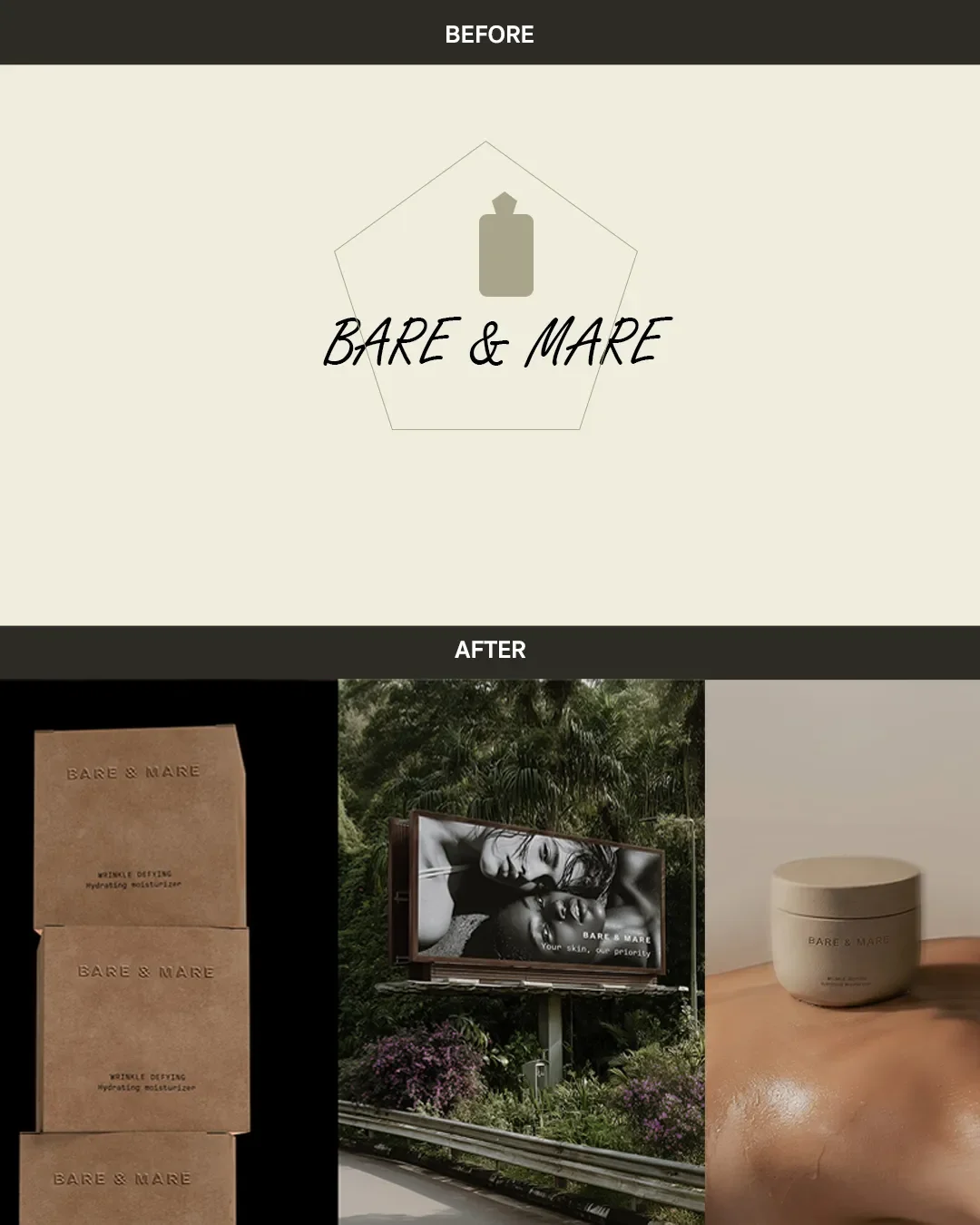
Before and after rebranding, portfolio project: Bare & Mare
Most skincare founders do not wake up asking "should I rebrand." They ask something closer to "why does this feel wrong now when it felt right two years ago." The products are performing. The team is bigger. The retail conversations are more serious than they used to be. And somewhere in that growth, the identity stopped keeping up.
This guide is a diagnostic, not a mood board exercise. It walks through the seven signs that actually indicate a brand has outgrown its business, what a rebrand changes versus what a refresh changes, what to protect when you do it, and how to prepare so the process does not put growth at risk. If you are looking for specialized guidance, partnering with an experienced skincare branding agency can help ensure your identity scales seamlessly.
What a Skincare Rebrand Actually Changes
A rebrand is not a new logo. It is a full realignment of how the brand is built, which usually touches:
Positioning and messaging architecture
Visual identity system, including logo, color, typography, and packaging structure
Packaging materials and format across the full product range
Tone of voice across product copy, website, and retail collateral
Retail and wholesale facing assets, including sell sheets and line sheets
Digital identity across the website and social presence
A refresh touches some of these. A rebrand touches most of them, because the underlying business the identity was built for no longer matches the business that exists today.
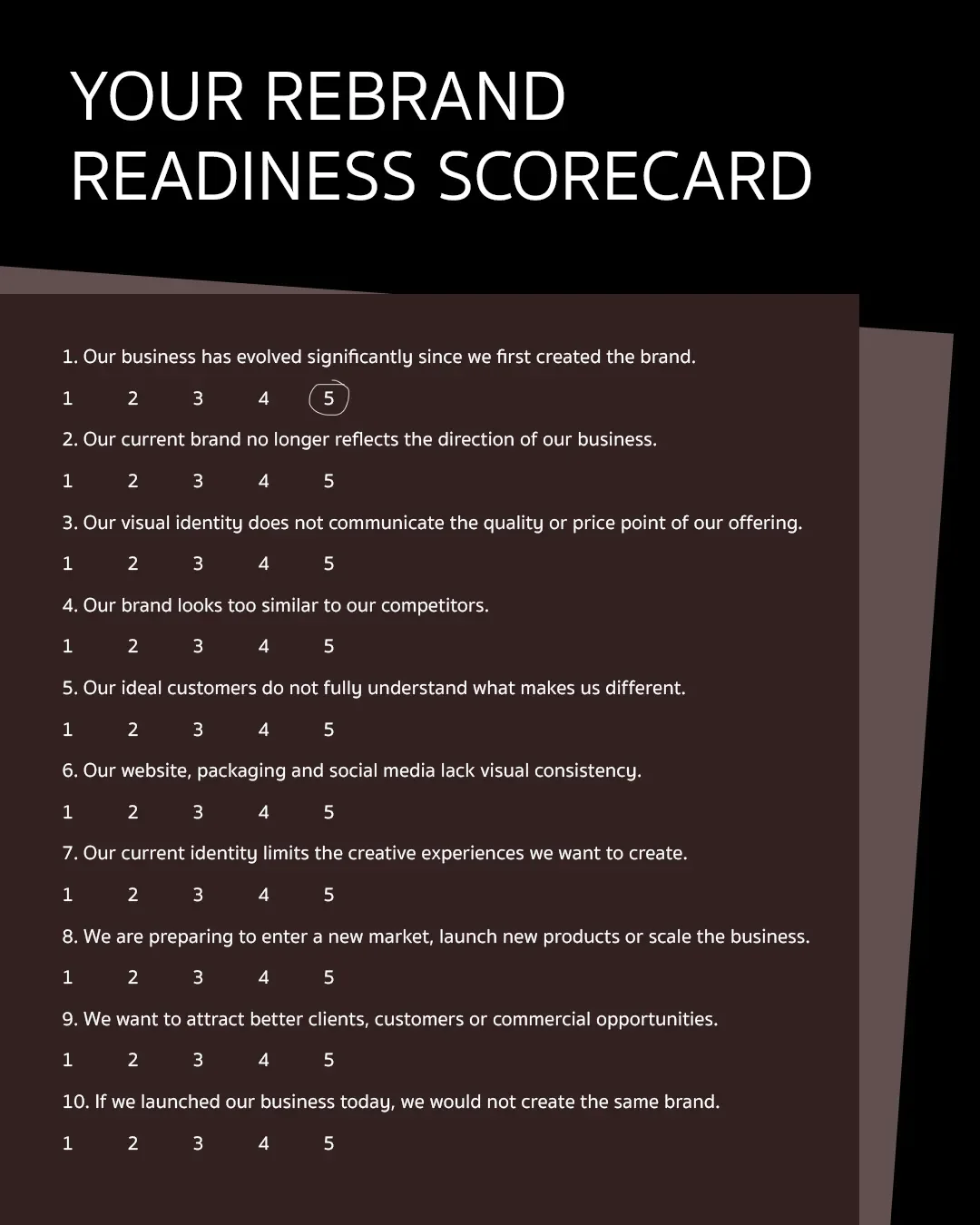
Skincare brand rebrand readiness checklist
When should a skincare brand rebrand?
A skincare brand should consider a rebrand when the business has changed in a way the current identity cannot describe or support, such as expanding from a single hero product to a full range, moving into retail, shifting audience, or outgrowing the founder led story that built the brand initially. If more than two or three of the signs below are present at once, that is a strong indicator.
Sign 1: Your Positioning Statement No Longer Describes What You Actually Sell
This is the most common growth stage trigger. A brand launches around one hero product with a tight, specific promise. Eighteen months later there is a full range, a subscription model, or a shift from direct to consumer sales into wholesale. The original positioning was built for a narrower business than the one that exists now. To evaluate where your messaging needs adjusting, you can map your assets against a structured beauty brand positioning framework to realign your value proposition.
If you find yourself explaining the brand differently depending on who is asking, your positioning statement has already stopped doing its job. The identity has not expanded with the product range, so every new SKU has to be justified rather than simply belonging.
Sign 2: Retailers and Buyers Ask You to Explain the Brand Before They Will Stock It
This is a retail move trigger, and it is one of the clearest commercial signals a founder can get. Packaging and brand identity are meant to do the explaining on shelf, without a founder in the room. If a buyer needs a verbal pitch to understand what the product is, who it is for, and why it belongs on their shelf, that is a positioning failure being mistaken for a sales problem.
Brands that move from online only to retail distribution are especially exposed here. A digital first identity built for a product page and an Instagram grid does not always translate to a shelf, a counter, or a buyer meeting.
Sign 3: Your Visual Identity Reads Mass Market While Your Price Point Reads Prestige
This is where inconsistent packaging becomes a business problem rather than an aesthetic one. It shows up when a brand launched lean, with a first packaging run chosen for cost and speed, and then scaled price faster than it scaled design. The result is a product that costs like a prestige brand but photographs, unboxes, and sits on a shelf like a mass market one.
Customers price a product visually before they read the label. If your visual identity and your price point are telling different stories, you are asking the customer to resolve a contradiction the brand should have resolved for them.
Sign 4: You Have Outgrown Your Founder Story but Still Lead With It
This is where legacy equity gets complicated. At launch, the founder story often is the brand. It is the reason the first hundred customers trusted an unknown name. But as the business scales past the founder's personal network, and as the team, retail partners, and customer base grow well beyond that original circle, leading every touchpoint with a personal origin story can start to cap how big the brand can become.
The goal is not to erase the founder story. It is to figure out which parts of it are genuine equity worth protecting, and which parts were simply doing the job of positioning until the brand had something stronger to say.
Sign 5: Every New Product Launch Feels Like a Fight With the Existing Identity
This is the clearest sign of SKU expansion outpacing the system. A brand identity built for three products was never designed to flex across a range of twenty. If every new launch requires the team to bend the existing system, create one off exceptions, or quietly abandon parts of the guidelines because they do not work at scale, the identity is undersized for the catalog it now needs to hold. Building a robust beauty brand identity system ensures that future expansions snap effortlessly into place.
A properly built identity system should make new product launches easier over time, not harder. If launches are getting more difficult as the range grows, that is the system telling you it needs to be rebuilt, not patched again.
Sign 6: Your Customer Has Changed but Your Brand Voice Hasn't
This is the audience shift trigger, and it is often the hardest one for founders to see from inside the business. Early adopters are rarely the same people driving revenue two or three years in. A brand voice built to speak to a small, highly engaged niche can start to feel dated, narrow, or slightly off key to the broader customer base the business has since attracted.
This does not always mean the original audience was wrong. It means the brand has matured into a bigger, sometimes different customer, and the tone of voice is still speaking to the room it started in.
Sign 7: Internal Teams Cannot Agree on What the Brand Stands For
This is an internal alignment trigger, and it is usually the last sign to surface because it happens behind the scenes. When marketing, product, and sales are each describing the brand differently in their own materials, there is no longer a shared reference point protecting consistency. Guidelines exist, but nobody is treating them as the source of truth anymore.
This is rarely a discipline problem. It is usually a sign that the identity itself has stopped giving the team something clear enough to align around.
Brand Refresh or Rebrand: How to Tell the Difference
What is the difference between a brand refresh and rebrand?
A refresh is a visual update within an existing strategy. A rebrand is a strategic overhaul that can include the visual identity but is not limited to it, often extending to positioning itself.
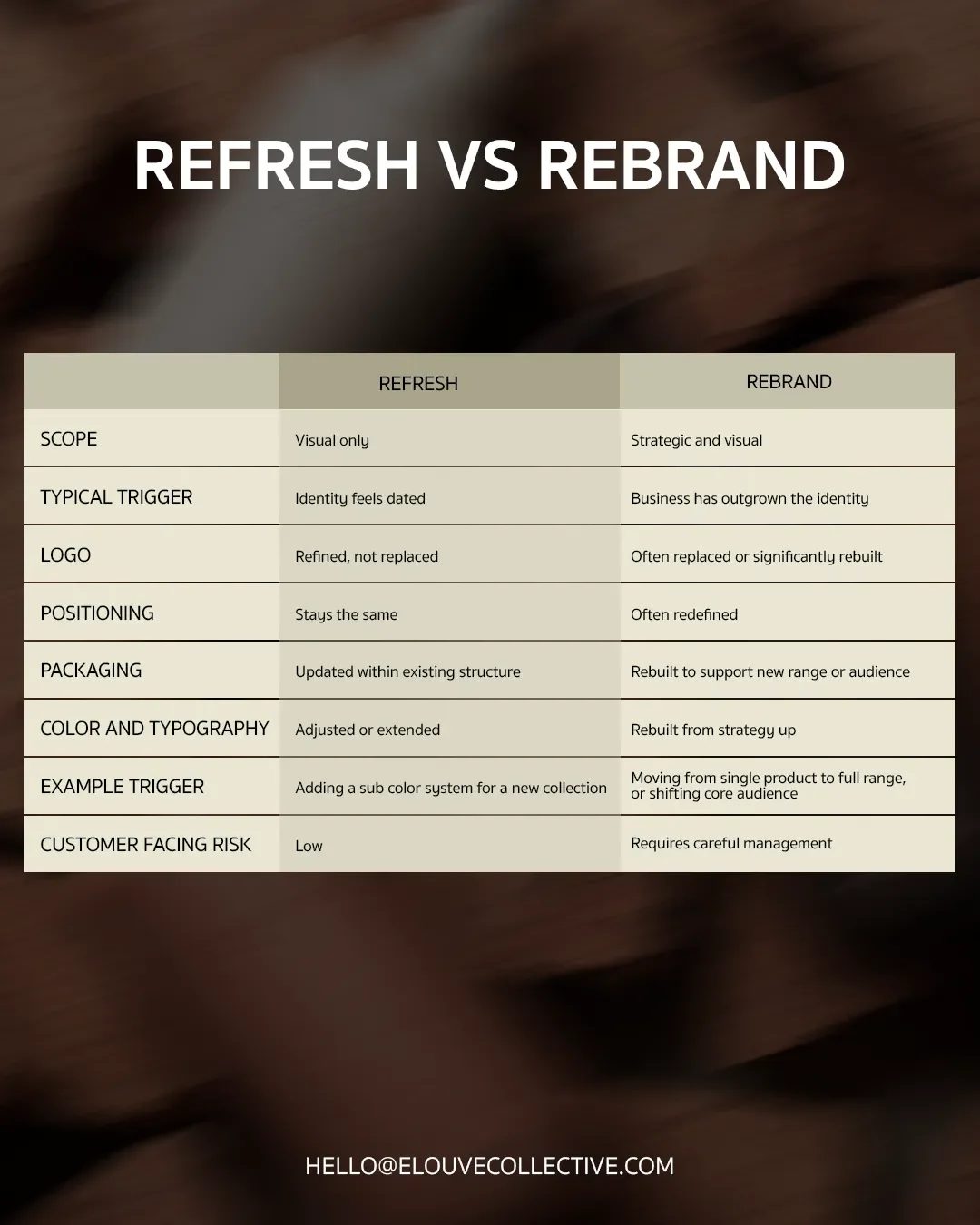
Brand refresh versus rebrand comparison for beauty brands
If the issue is that the brand feels slightly tired but still describes the business accurately, a refresh is usually enough. If the issue is that the brand no longer describes the business at all, a refresh will not hold, and a rebrand is the right call.
What to Preserve From the Existing Brand
What should a beauty brand keep during a rebrand?
A rebrand does not mean starting from zero. The goal is to keep whatever equity customers already recognize and trust, while rebuilding what no longer fits. That usually means preserving:
A signature color, scent cue, or packaging silhouette customers already associate with the brand
Any naming convention customers use to talk about products, even informally
Founding story elements that still carry genuine credibility, even if they are no longer front and center
Product formulations and claims customers already trust, since a rebrand should never be mistaken for a reformulation
Core values that shaped the original positioning, even where the language describing them changes
The brands that lose customers during a rebrand are usually the ones that changed everything at once with no visible thread back to what came before. The brands that keep customers are the ones that made the change feel like an evolution rather than a replacement.
How to Prepare for a Rebrand
How do I rebrand without losing existing customers?
Preparing properly is what protects existing customers through the transition. A readiness process, done in order, looks like this:
Audit what is actually broken. Go through each of the seven signs above and identify which ones apply. This becomes the brief for the rebrand rather than a vague sense that "it needs updating."
Separate legacy equity from legacy habit. Not everything from the original brand is worth keeping just because it is familiar. Use the preservation list above as a filter.
Define the audience you are building for now, not the audience you launched to. This should be explicit before any visual work begins.
Sequence the rollout. Decide what changes first, such as packaging on new SKUs, versus what changes across the whole range at once. A staged rollout is often lower risk than a single relaunch date.
Brief existing customers before the change is visible. Even a short heads up before packaging changes on shelf reduces the sense of disruption significantly.
Treat the identity system as a deliverable, not a style guide. It should include positioning, visual system, packaging specifications, tone of voice, and retail facing assets, built to hold the business you are scaling into, not just the one you have today.
FAQs: When Should a Skincare Brand Rebrand
When should a skincare brand rebrand?
When the business has outgrown the story the current identity tells, most commonly after SKU expansion, a retail move, an audience shift, or when internal teams can no longer describe the brand consistently.
What is the difference between a brand refresh and rebrand?
A refresh updates the visual identity within an existing strategy. A rebrand rebuilds the strategy itself, which then reshapes the visual identity, packaging, tone of voice, and retail assets around it.
How do I rebrand without losing existing customers?
Preserve recognizable equity such as color, scent cues, and trusted product claims, define the audience you are building for now, sequence the rollout instead of changing everything at once, and communicate with customers before the change becomes visible.
What should a beauty brand keep during a rebrand?
Any signature visual or sensory cue customers already associate with the brand, naming conventions customers use organically, credible founding story elements, and the product formulations and claims that earned trust in the first place.
If more than a couple of these seven signs sound familiar, the identity is not failing. It has simply become smaller than the business it now has to carry.
Assess whether your skincare brand needs a refresh, a full rebrand or no change yet. Get in touch with our team today to start the conversation.
