
Beauty Brand Positioning Framework for Skincare and Wellness Founders
Quick answer: Beauty Brand Positioning Framework
Beauty brand positioning defines who your skincare or wellness brand is for, the category space it will own, the belief and promise behind it, the proof that makes the promise credible, and the boundaries that keep it distinctive. Set these decisions before naming, visual identity or packaging so every later choice reinforces the same position.
What is beauty brand positioning and why does it matter?
Positioning is the decision that comes before every other brand decision. Before the name, before the logo, before the packaging brief, before a single word of copy gets written, positioning answers one question: what space do you occupy in someone's mind, and why should they choose you over the next fifteen brands on the shelf.
Most founders skip this step or rush it into a single sentence they never revisit. Then eighteen months later, they're rebranding, not because the logo aged badly, but because nobody ever settled what the brand actually stood for. The visual identity was covering for a positioning gap the whole time.
Definition of Beauty brand positioning: It is the set of standing decisions that define who a skincare or wellness brand serves, what category it competes in, what it believes, what it promises, and what it refuses to be. It's settled before naming, identity or packaging, and everything downstream should trace back to it.
What is beauty brand positioning?
If you strip away the frameworks and the workshop language, positioning is really just an argument. It's the case your brand makes for why it deserves a specific place in a specific person's routine, told through a category claim, a belief, and a promise, and backed by a reason people should trust any of it.
Beauty brand positioning vs brand identity
It's easy to conflate positioning with identity because they get designed around the same time, sometimes by the same team. But they're not the same job.
Positioning is strategic. It lives in language, decisions and internal alignment. Identity is expressive. It's the name, the logo, the packaging, the tone of voice guide, the photography style. Identity is how positioning gets seen and felt.
The order matters because identity built on unclear positioning tends to default to trend. A founder without a settled point of view ends up picking a bottle shape because a competitor's worked, or a color palette because it's having a moment on Pinterest. None of it is wrong exactly, but none of it is anchored either, and anchored is what makes a brand recognizable a year later instead of forgettable in a season.
Positioning gets decided first. Identity gets built to express it. This piece stays entirely on the positioning side. If you're further along and ready to translate positioning into a visual identity, that's a separate process worth its own dedicated brief.
The demographic trap: what positioning is not
Ask most founders what their positioning is and you'll get some version of the same worksheet answer: a 25 to 40 year old woman, urban, disposable income, tired of serums that don't work. It sounds specific. It isn't.
That's a media buying persona, not a positioning. It tells an ad platform who to target. It doesn't tell a customer why this brand and not the one next to it on the shelf, and it doesn't give a founder anything to build a product line, a tone of voice or a category claim around.
Audience beyond demographics
Real positioning doesn't require a narrow age bracket at all. Some of the sharpest beauty and wellness brands built their entire identity around an axis that has nothing to do with age or income. A few that actually hold up:
Subcategory. Building for curly hair specifically. Building for hands, or scalp, or lips, when everyone else treats them as an afterthought category on a bigger brand's shelf.
A specific problem. Acne that persists into adulthood. Eczema. Menopause skin. Sensitivity that most "gentle" lines still aggravate.
A ritual or life moment. A morning routine brand. A postpartum recovery line. Travel sized rituals for people who never settle into one bathroom shelf.
A formulation stance. Retinol only. Fragrance free by design, not by apology. Actives led, with everything else stripped out.
A value system. Slow beauty. Refillable packaging as a non negotiable. Cruelty free as the entire premise, not a footnote.
How to position a skincare or wellness brand in six steps
Once audience is defined as an axis rather than a demographic, positioning comes down to a small number of decisions. Get these settled and everything else, naming, identity, packaging, copy, becomes a matter of execution instead of guesswork.
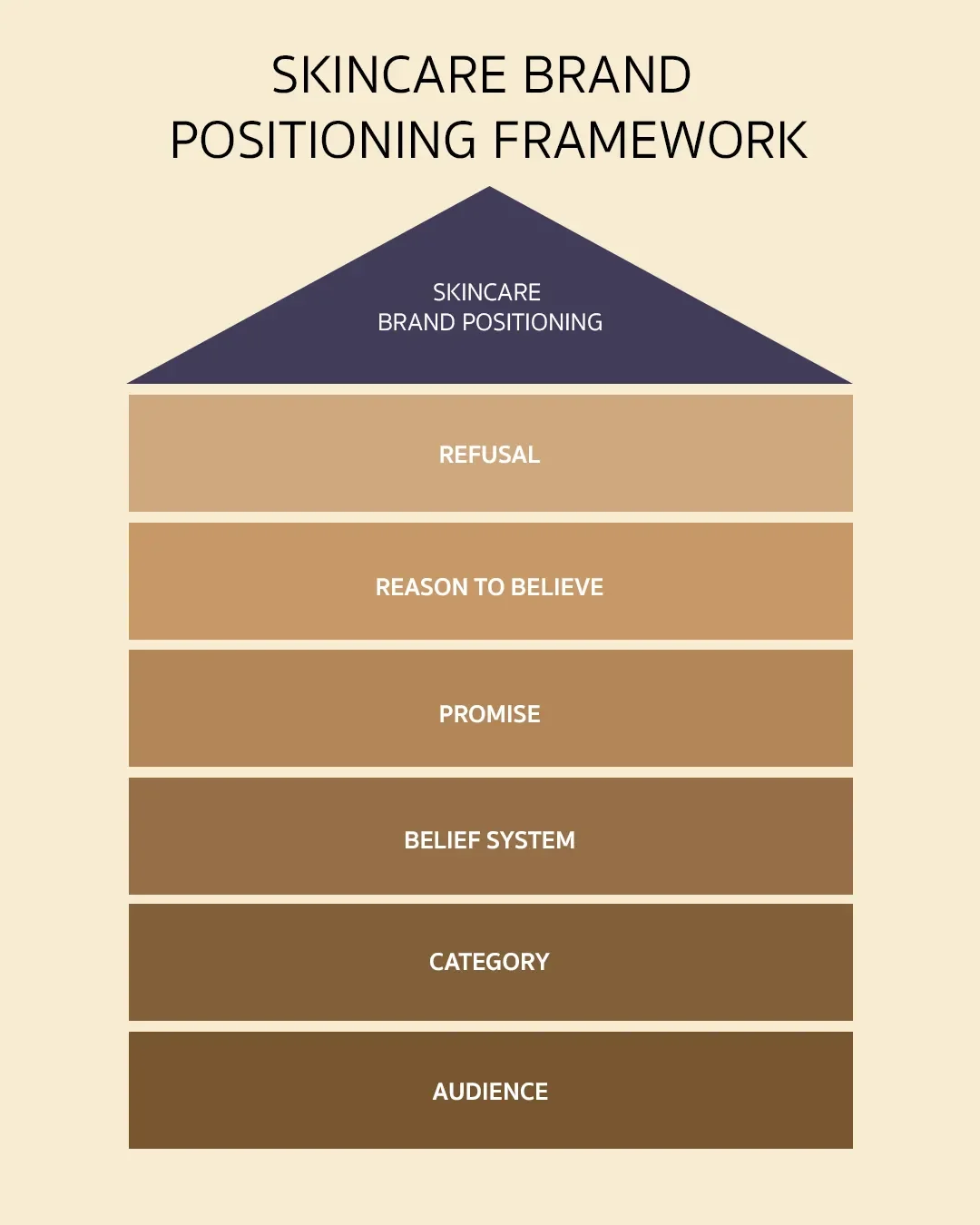
Skincare brand positioning framework
The framework at a glance
• Audience axis: define a real need, ritual, subcategory or value system rather than a broad demographic.
• Category gap: identify the space competitors have left open or expressed poorly.
• Belief system: state a clear point of view about beauty, skin or wellness.
• Promise: explain the meaningful outcome the customer can expect.
• Reason to believe: support the promise with formulation, process, expertise or evidence.
• Refusal: name what the brand will not claim, imitate or become.
How do I position a skincare brand?
Practically, this means working through each element in order rather than jumping straight to a tagline. Define the audience axis first. Name the gap in the category you're stepping into. State what you believe about skin, wellness or beauty that most brands don't say out loud. Turn that belief into a promise you can actually keep. Back the promise with a reason to believe it. Then decide, explicitly, what you will not be, because that refusal is often what makes the rest of it credible.
Who you're actually for (and who you're not)
A brand that tries to serve everyone ends up speaking to no one specifically, and in a crowded category, specific is what gets remembered. Picking an audience axis, whether that's a subcategory, a problem, a ritual or a belief, also means picking who the brand is not for. That's not a limitation. It's the thing that makes the promise land harder for the people it is for.
The category claim: what shelf are you actually competing on
This is the decision founders tend to make too late, usually after the product is already formulated and the packaging brief is already written. Category claim isn't the ingredient list. It's the shelf you're telling the customer's brain to file you under.
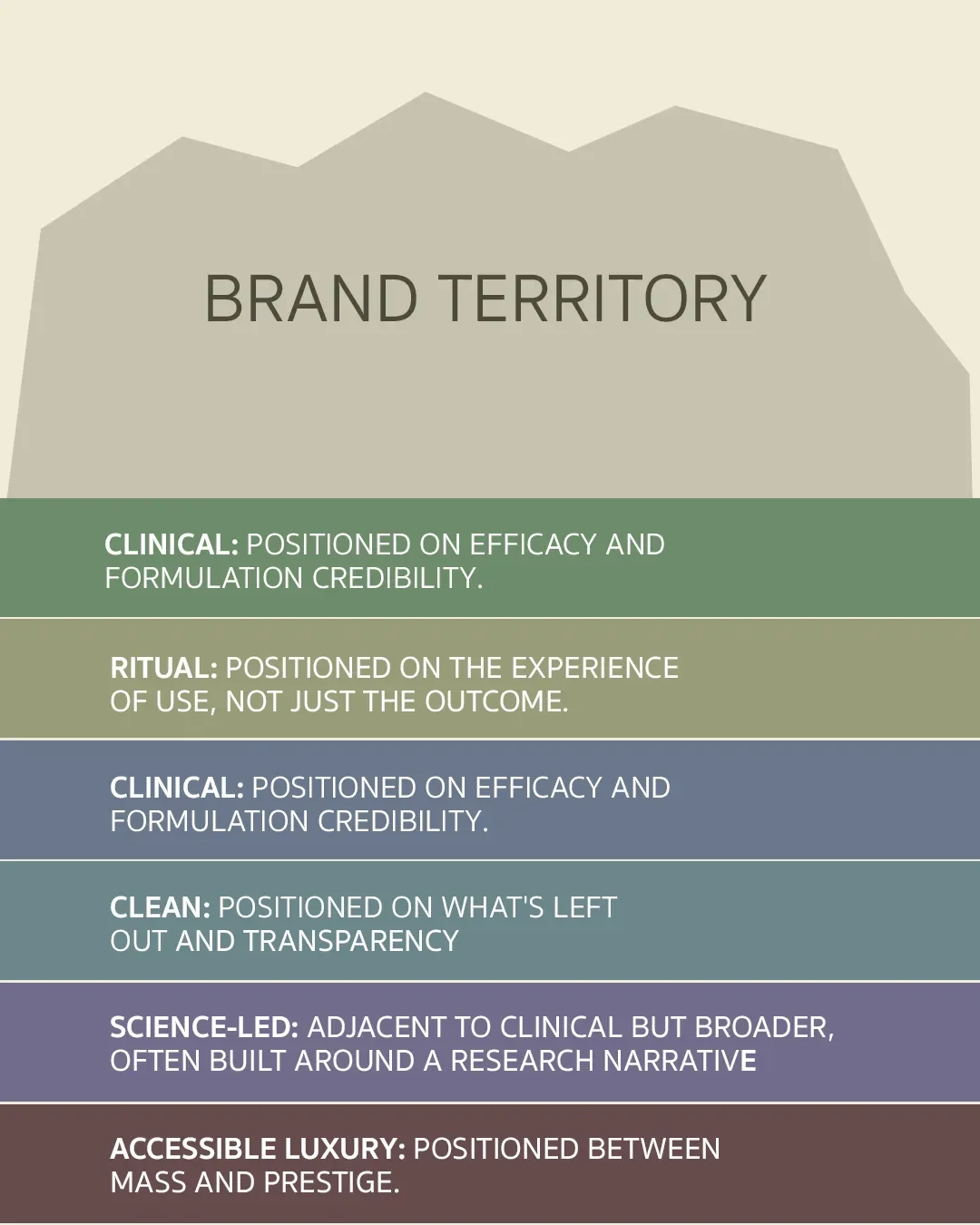
Navigating brand territories: Defining the distinct market frameworks that anchors a brand's strategic messaging and product positioning.
Clinical
Positioned on efficacy and formulation credibility. Often leans on percentages, actives, dermatologist language. The reason to believe usually comes from results, not ritual.
Ritual
Positioned on the experience of use, not just the outcome. Texture, scent, the few minutes of routine itself become part of the value, not a side effect of it.
Clean
Positioned on what's left out. Ingredient transparency and formulation restraint become the entire argument, and the burden is proving that restraint doesn't come at the cost of performance.
Science led
Adjacent to clinical but broader, often built around a research narrative, a founder with a formulation background, or ongoing product development framed as an evolving body of work rather than a finished line.
Accessible luxury
Positioned between mass and prestige. The promise is a premium experience without a prestige price tag, which means the reason to believe usually has to work harder, since price alone isn't doing the signaling.
Finding your category gap
The gap is wherever the existing options in your audience's routine are either overserved by one of these categories or completely absent from it. If every acne brand in your customer's feed is clinical and cold, a category gap might be an acne brand that's ritual and warm. The gap is rarely about inventing a new category. It's usually about noticing which claim nobody in your specific audience axis has taken yet.
Finding your point of difference without copying a bigger brand's language
Clean, natural, results driven. These claims show up on so many product pages that they've stopped meaning anything. A customer reads them and files the brand under generic, not under memorable.
What makes a beauty brand different from competitors?
Difference doesn't usually come from a claim nobody else has thought of. It comes from a belief stated specifically enough that it couldn't be copy pasted onto a competitor's site without sounding wrong there.
This is where belief system, promise and reason to believe do their work together:
Belief system. The point of view the brand holds about skin, beauty or wellness that most brands in the category don't say directly. Not a mission statement. An actual stance, specific enough to disagree with.
Promise. What the customer gets if the belief is true. Stated plainly, without hedging it into vagueness.
Reason to believe. The proof that the promise isn't just marketing. A formulation choice, a founder story, a process, a result, something concrete a customer can point to.
A brand that believes skin barrier health matters more than short term glow, promises visible calm within a defined window, and backs it with a specific formulation restraint, has something to say that "clean, results driven skincare" never will.
Tone of authority: how your brand sounds when it makes a claim
Before a single line of copy gets written, positioning should already answer how the brand sounds when it's making a claim. This gets tested here, not discovered during the copywriting process.
Three broad registers to choose from, though most brands land somewhere between two of them:
Expert. Speaks with clinical confidence. Leads with evidence, formulation detail, credentials.
Intimate. Speaks like a trusted friend who happens to know skincare. Leads with empathy, shared experience, the specific frustration the customer already feels.
Insider. Speaks like someone who's already ahead of the customer, in the know before it's mainstream. Leads with discovery, specificity, a slightly elevated vocabulary.
What the brand refuses to be
This is the decision founders skip most often, and it's usually the one that gives positioning its edge. A refusal is a stated boundary: what the brand will never claim, never look like, never sound like, even if it would be commercially convenient.
A clinical brand might refuse to ever use ritual language, even in a campaign that would benefit from it. A clean brand might refuse to ever run a percentage based efficacy claim, even when the formulation would support it. The refusal isn't a limitation on growth. It's what stops the brand from drifting into generic the first time a trend cycle makes drift tempting.
How positioning shapes packaging and digital
Positioning doesn't design the packaging or the website, but it should constrain every decision made about them later. A clinical positioning with an insider tone of authority is going to reject soft, romantic packaging language before a designer ever opens a file. A ritual positioned brand is going to reject a stark, lab coat aesthetic on the product page, even if it photographs cleanly. For a step-by-step breakdown on defining these market boundaries, see our full wellness positioning guide.
Beauty brand positioning checklist: is yours actually working?
Run your current brand against these:
Could a competitor's name replace yours on your own homepage without the copy sounding wrong there too?
Can you state your category claim in one word, or does it take a paragraph to explain?
Is your audience defined by an axis, or is it still a demographic worksheet?
Do you have a stated belief, or just a mission statement nobody could disagree with?
What does your brand refuse to be, and can you name it in one sentence?
Does your promise have a reason to believe attached, or is it just an adjective?
If more than two of these are hard to answer, positioning is the gap, not the packaging, the name or the photography.
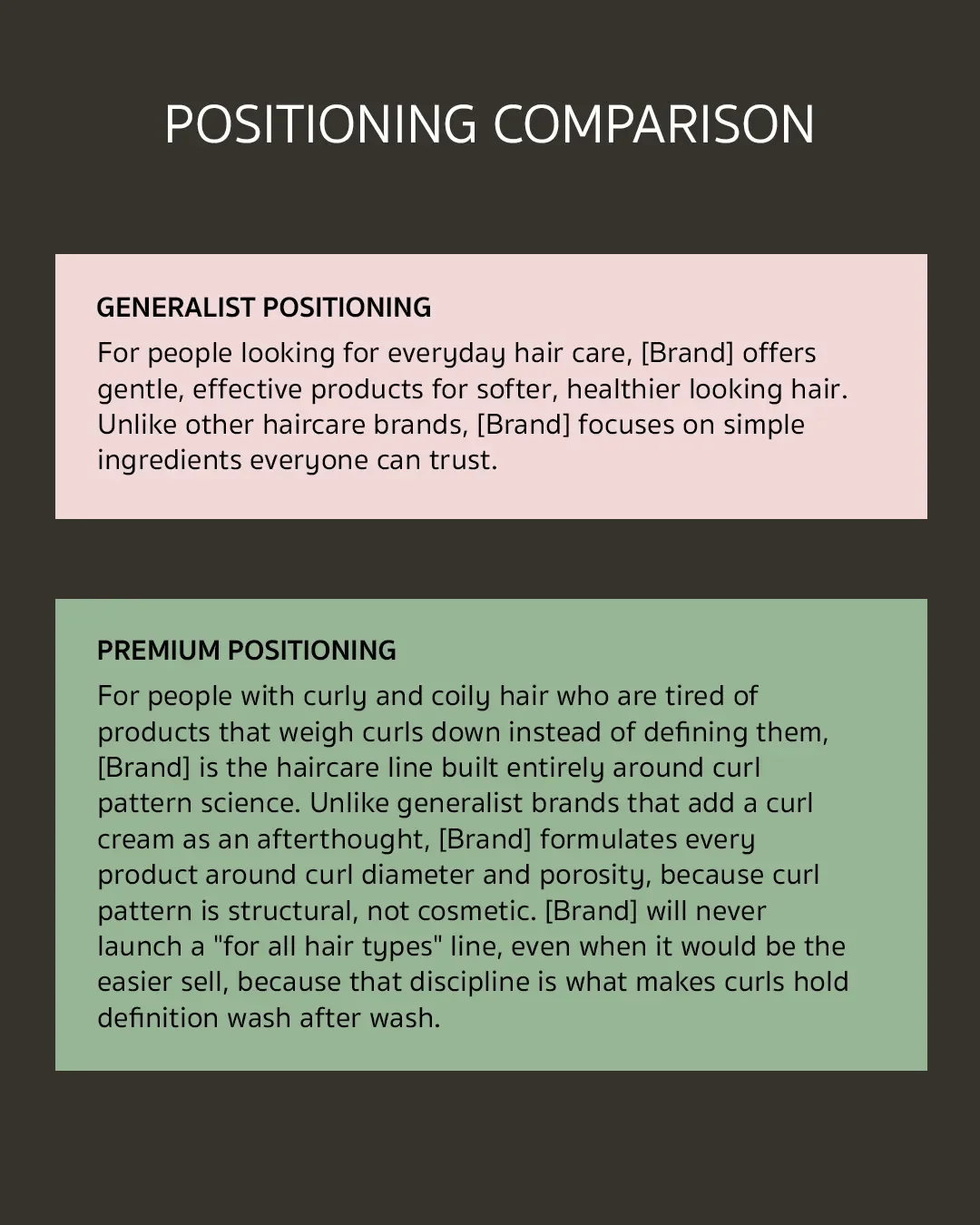
Comparing generalist vs. premium frameworks: How a narrow, problem-specific focus shifts a brand's market narrative away from generic claims.
Beauty brand positioning examples: before and after
Before: A skincare founder positions around "women aged 25 to 40 who care about clean beauty." The category claim is never stated. The belief is "we care about ingredients," which every brand on the shelf also claims. No refusal is defined. Eighteen months in, the brand rebrands because the identity "doesn't feel premium enough," when the actual issue was never visual.
After: The same founder repositions around a subcategory axis: skin barrier repair for people who've over exfoliated their way into sensitivity. Category claim: clinical, but warm rather than cold. Belief: barrier health matters more than instant glow. Promise: visible calm within four weeks. Reason to believe: a formulation built entirely around barrier supporting actives, with actives that irritate left out. Refusal: never running a "results in 48 hours" claim, even under pressure from a launch timeline. The identity brief that follows almost writes itself, because every visual decision has something to check itself against.
Founder worksheet
Work through this in order. Each answer should be a sentence, not a paragraph.
Audience axis: subcategory, problem, ritual, formulation stance, or value system, not a demographic.
Category gap: which claim is missing or overserved in your audience's current routine.
Belief system: the stance you hold that most brands in your category don't say directly.
Promise: what the customer gets if that belief holds true.
Reason to believe: the concrete proof behind the promise.
What you refuse to be: the claim, look or tone you won't adopt, even when it's tempting.
Once these six are filled in, you have a positioning, not a worksheet answer.
FAQs: Beauty brand positioning
What is beauty brand positioning?
It's the set of decisions, audience, category claim, belief, promise, reason to believe and refusal, that define where a skincare or wellness brand sits in a customer's mind before any naming, identity or packaging work begins.
How is positioning different from branding?
Positioning is strategic and internal. Branding, or identity, is the expression of that strategy through name, visuals, packaging and voice. Positioning should always come first.
Do I need a narrow demographic to position my brand?
No. Some of the strongest positioning comes from a subcategory, a specific problem, a ritual, a formulation stance or a value system, not an age and income bracket.
How does positioning shape packaging and visual identity?
It sets the boundaries identity has to work inside. Category claim and tone of authority rule out certain visual directions before a designer ever starts, which keeps identity work focused instead of open ended.
What happens after positioning is set
Positioning doesn't launch a brand on its own. Once it's settled, it becomes the brief for everything that follows: naming that fits the category claim and tone, a visual identity that expresses the belief instead of just looking nice, and packaging that a customer can place correctly on a shelf without reading a word of copy. That's a separate body of work, and one worth approaching deliberately rather than starting from a mood board.
What makes a beauty brand different from competitors? A beauty brand becomes distinctive when its audience, category claim, belief, promise, proof and boundaries reinforce one another. Generic claims such as clean, premium or results driven are not enough unless the brand can express them through a specific point of view and credible evidence.
Ready to turn positioning into a coherent brand system? Explore Elouve's skincare branding services or contact the studio to discuss strategy, identity and packaging.
