
How to Choose a Luxury Branding Studio When Your Brand Needs to Feel Premium
Table of Contents
- 1. What Does a Luxury Branding Studio Actually Do?
- 2. Start With the Brand You Are Trying to Build
- 3. What Makes a Branding Studio Truly Luxury?
- 4. What Makes Premium Work Hard to Fake?
- 5. Look at Their Portfolio for Thinking
- 6. Does the Studio Understand Your Industry?
- 7. Evaluate Their Approach to Brand Strategy
- 8. Look Beyond the Logo
- 9. Ask How They Approach Creative Direction
- 10. Understand Who Will Work on Your Brand
- 11. How to Assess the Studio's Process
- 12. Red Flags to Watch For
- 13. Questions to Ask Before Hiring
- 14. How to Compare Two Studios
- 15. Final Thoughts
Quick answer: How to Choose a Luxury Branding Studio
The right luxury branding studio should demonstrate strategic thinking before aesthetics: clear positioning work, category understanding, a portfolio with range, transparent senior involvement, defined deliverables and a process that connects strategy to identity, packaging and customer touchpoints. Compare studios on those criteria—not visual taste alone.
Every industry has agencies that can create visually appealing work but cannot actually build a brand that has a meaning Scroll through enough portfolios and a pattern emerges: the same gold foil, the same restrained sans serif, the same moody product shot on a stone plinth. It looks expensive. It does not necessarily mean the studio understands why a brand should look that way, or whether that look is even right for your customer. The real question when you are choosing a partner is not whether their work is beautiful. It is whether they can uncover what makes your brand valuable and translate that into something a customer recognizes, desires, and trusts, on purpose, project after project. This guide goes past the usual checklist advice and gets specific about what to actually look for, with examples from beauty, lifestyle, and hospitality branding along the way.

What Does a Luxury Branding Studio Actually Do?
A luxury branding studio is not the same thing as a general branding agency or a graphic design studio that happens to have a few premium clients. The distinction shows up in what the studio is actually optimizing for. A general agency is usually optimizing for a finished, functional identity: a logo that works across applications, a palette that is on brand. A luxury branding studio is optimizing for something harder to measure, the feeling a customer has in the ten seconds before deciding whether the price is justified.
That feeling is not built by one asset. Think about how a skincare customer decides a serum is worth sixty dollars rather than fifteen. It is rarely the formula alone. It is the weight of the glass bottle in the hand, the restraint of a single line of type on the label, the way the brand's Instagram grid never shows a discount code. A luxury branding studio is the team responsible for making sure every one of those decisions points in the same direction, not just the logo and the palette.
Start With the Brand You Are Trying to Build, Not the Studio You Want to Hire
Before comparing a single studio, you need clarity on your own positioning, audience, price point, category, and ambitions. This is the step most founders skip, because it feels slower than just looking at portfolios, and portfolios are fun to look at. But a studio that is exactly right for an emerging fashion label will not automatically be right for a boutique hotel, a niche fragrance house, or a premium subscription service, because the customer psychology behind each purchase is different.
Consider two founders hiring around the same time. One is launching a jewelry brand where the customer is buying permanence and heirloom quality. The other is launching a wellness supplement brand where the customer is buying trust in an unregulated category. A studio whose strongest instincts are engraved textures and low saturation metallics may build a beautiful jewelry style identity for the wellness brand that still feels wrong on shelf, because the codes that build trust in one category can read as cold or overly formal in another. Know which problem you are actually solving before you start comparing studios, because the studios themselves will not always flag the mismatch for you.
What Makes a Branding Studio Truly Luxury?
Genuinely sophisticated branding work is different from branding that simply borrows luxury clichés without understanding why those choices work in the first place. Gold foil, a fine serif logotype, black and white photography, generous negative space: these are tools, not a formula, and a studio that reaches for the same combination on every brief is not practicing luxury branding. It is decorating.
The difference shows up in restraint. A brand like Aesop, often cited as a reference point in this space, is instructive precisely because its identity resists almost everything a less confident brand would add: no loud claims on the packaging, no crowded shelf presence, apothecary style bottles that look closer to a chemistry set than a cosmetics display. That restraint is a strategic decision about what the brand is willing to leave out, not a default aesthetic. A studio capable of that kind of thinking can tell you, specifically, why an element is missing from a design, not just what was added.
What Makes Premium Work Hard to Fake
Premium branding is difficult to imitate because it depends on judgment built through repetition across many brands, not on a set of visual ingredients anyone can copy. Two studios can both use a warm off white background, a delicate serif, and a muted sage palette, and one result will feel considered while the other feels like a template with the client's name swapped in. The gap is rarely in the individual choices. It is in the small decisions around them: the exact weight of the type against the amount of white space, whether the photography is lit to feel intimate or simply well exposed, whether the copy sounds like it understands the customer or is filling a content requirement.
This is also why premium work tends to age well while trend driven branding does not. An identity built around a genuine understanding of the brand's value still makes sense in five years, because it was never dependent on a look that was fashionable at the time. An identity built by copying whatever premium branding looked like that year ages the way any trend does, quickly and visibly.
Look at Their Portfolio for Thinking, Not Just Aesthetics
Instead of asking “do I like these designs,” ask a harder question: could I tell these brands apart with the logos removed. Pull up three projects from the same studio side by side. If the typography, color instincts, and photography direction are nearly interchangeable across a skincare brand, a hotel, and a fashion label, the studio has a strong personal style, which is not the same thing as strategic range.
What you actually want to see is evidence that the studio solved a different problem for each client. One brand's identity might lean into color because its founder's voice is the product. Another might strip almost everything back because the product itself needs to be the hero. A studio that can explain why each project looks the way it does, rather than describing the whole portfolio as “our aesthetic,” is showing you strategic thinking rather than a single recycled style.
Does the Studio Understand Your Industry and Its Customer?
A studio does not need to have worked exclusively within your category, but it does need to understand the buying psychology and visual codes of your market, because those codes tell a customer where a brand sits before they read a single word. Often the strongest work comes from a studio with just enough outside distance to avoid repeating what every other brand in the category is doing, paired with enough research discipline to avoid the mistakes only an outsider would make.
Beauty, Lifestyle, and Hospitality Look Different Up Close
Premium beauty branding usually leans on precision: tight color control, packaging that performs under a bathroom shelf light and a phone camera flash equally well, and copy that survives being screenshotted and shared. A serum brand's studio should be thinking about how the label reads at thumbnail size on a phone screen, not only how it looks in a studio product shot.
Lifestyle and fashion branding tends to prioritize a point of view over precision. The customer is often buying into a perspective as much as a garment, so tone of voice, editorial choices, and even what a brand refuses to talk about carry as much weight as the visual identity itself.
Hospitality branding operates at a different scale entirely. The same identity has to hold up on a website, a printed menu, a room key, staff uniforms, and the physical materiality of a building, often across several years and property expansions. A studio without experience translating a flat identity into physical space will often produce a beautiful logo suite that becomes awkward the moment someone applies it to a hallway sign or a bar menu. Ask a studio, specifically, how their approach shifts across categories like these. One answer for every category tells you something important.
Evaluate Their Approach to Brand Strategy
A premium identity cannot compensate for unclear positioning, and this is where expensive rebrands quietly fail. The visuals launch to praise, and eighteen months later the founder still cannot explain in one sentence why a customer should choose this brand over the next one. Ask how the studio approaches strategy: how they define audience and differentiation, how they think about brand architecture if you plan to launch sub brands later, and how much competitive research happens before a single mood board is built.
The strongest studios can walk you through a past project and explain the chain of reasoning: this is what we learned about the customer, this is the gap we found against competitors, and here is exactly how that positioning shows up in the type choice, the color story, and the packaging structure. If a strategy question quickly turns into a description of the design process instead, that is worth noticing.
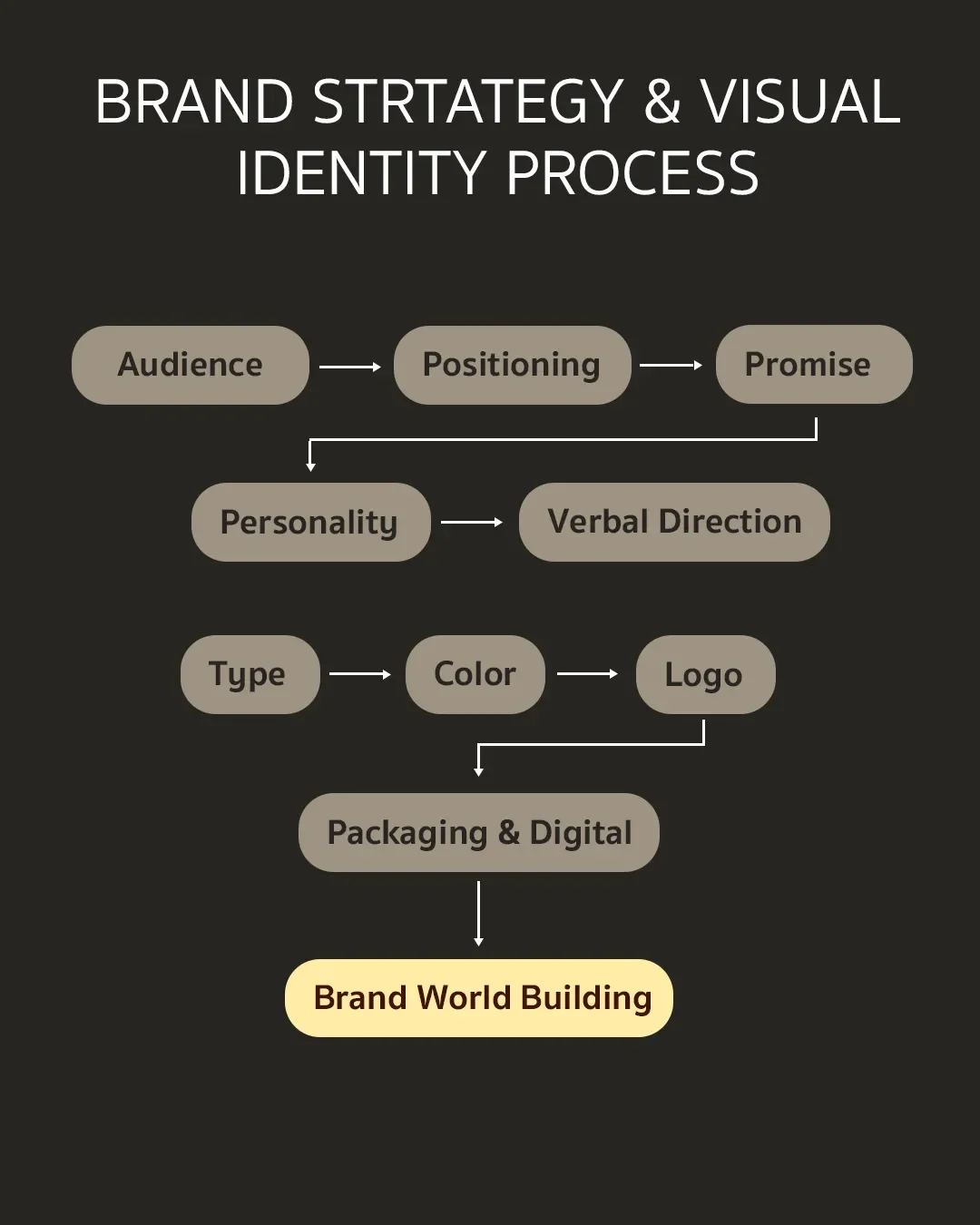
brand strategy to visual identity process for premium brands
Look Beyond the Logo: What Will They Actually Design?
A full luxury branding engagement often extends well beyond a logo and color palette, and this is where scope confusion causes the most friction later. A serious engagement can include visual identity, packaging structure and materials, website design, photography and art direction, social media systems, print collateral, retail or interior touchpoints, and the full set of assets needed for launch.
Two studios quoting very different prices are often quoting for very different amounts of work. One proposal might stop at a brand guidelines document. Another might include packaging engineering, a full photoshoot direction, and a website build. Before comparing numbers, get a precise list of deliverables from each studio, ideally touchpoint by touchpoint, so you are comparing scope against scope rather than one total figure against another.
Ask How They Approach Creative Direction
Two studios can offer identical deliverables on paper and still produce completely different results, because the gap lives in creative direction rather than the deliverables list. Creative direction is how references are chosen and combined, how a mood board becomes an actual material and color decision, and how imagery is directed so a single photograph tells the same story as the packaging next to it.
Ask a studio to walk you through one project from its earliest references to its finished system. A studio with strong creative direction can usually point to a specific early decision, a reference image, a material sample, that shaped the whole project, and explain why. A studio that jumps straight from “we explored a few directions” to the final result, without being able to describe that reasoning, is often working more instinctively than its finished portfolio suggests.
Understand Who Will Actually Be Working on Your Brand
There is a real difference between a founder led boutique studio, a senior creative team, and a larger agency structure, but team size on its own is not the useful signal. Some of the most considered branding work comes from small, founder led studios where the same one or two people stay involved from strategy through final production. Some comes from larger teams with clear senior oversight at every stage.
What actually matters is who is responsible for the thinking on your specific project, and whether that person is the one you are speaking to in the pitch or someone your account gets handed to afterward. It is reasonable to ask directly: who leads strategy and creative direction here, and will they still be involved by the time we reach production.
How to Assess the Studio's Process Before You Sign
A strong process should walk through discovery, strategy, creative exploration, presentation, refinement, production, and implementation, with a clear sense of what actually happens, and what you will see, at each stage. A studio that can only describe its process in broad terms, such as “we start with research and then move into design,” is often improvising project by project rather than working from a system refined across many clients. A useful test is to ask how many rounds of creative direction are typically presented, and what happens if the client is not convinced by the first round. A studio with a mature process will have a clear answer, because they have needed one before.
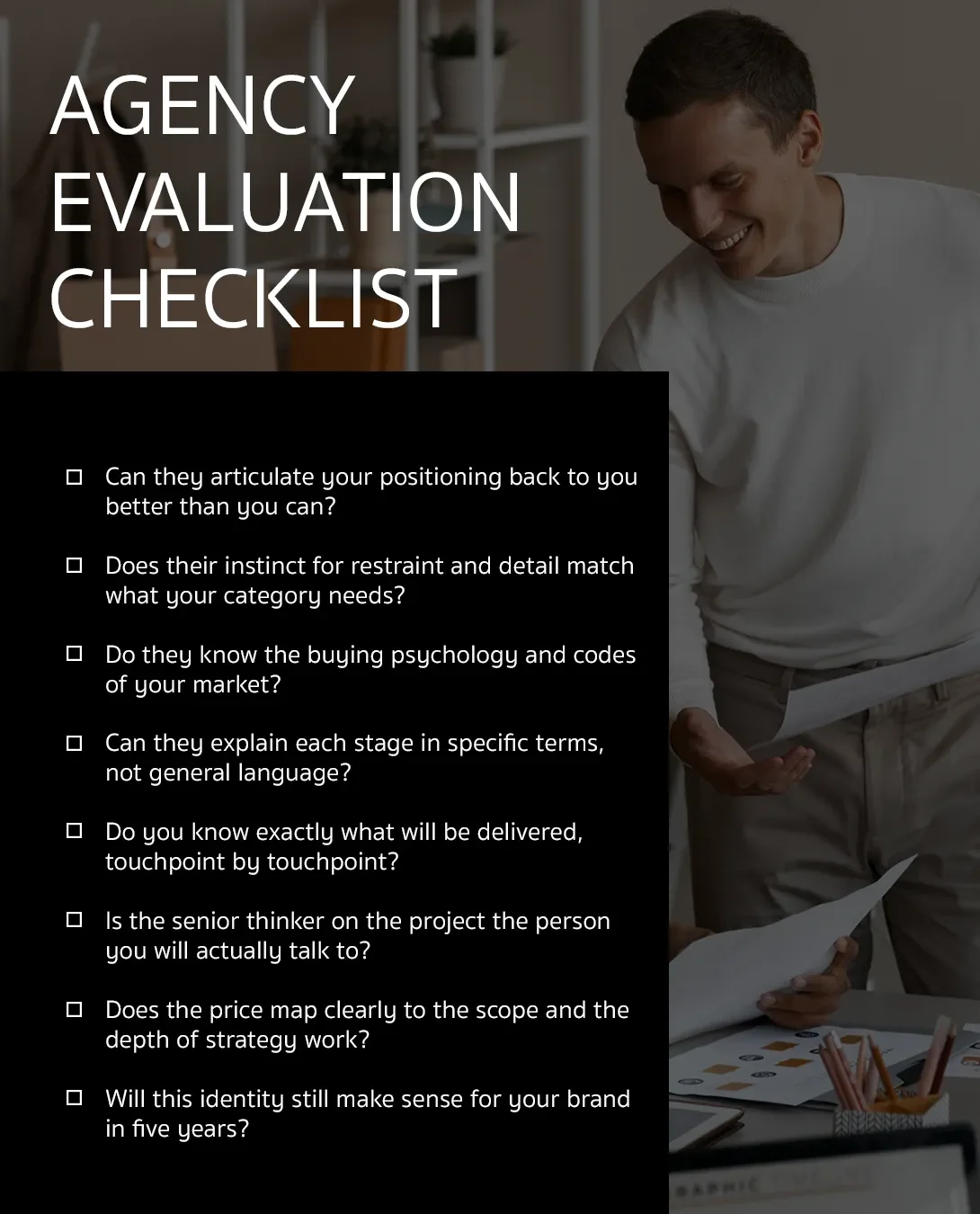
Luxury branding studio evaluation checklist for founders
Red Flags to Watch for When Choosing a Branding Studio
Some warning signs surface early, before a single design is shown.
| Red flag | What it usually means |
|---|---|
| Portfolio looks visually repetitive | The studio applies one style regardless of the brand in front of them.[cite: 8] |
| Heavy reliance on generic luxury aesthetics | Gold, serif type, and black and white photography with no strategic reasoning behind the choices.[cite: 8] |
| No clear strategic process | The identity may look polished but has nothing underneath it once trends shift.[cite: 8] |
| Extremely broad “we do everything” positioning | Little real specialization in the discipline of building premium brands.[cite: 8] |
| Unclear deliverables | Scope disagreements tend to surface midway through the project, not before.[cite: 8] |
| No explanation of who does the work | Junior staff may end up handling the parts of the project you were sold on senior thinking for.[cite: 8] |
| Pricing that does not correspond to scope | A low number is often cutting corners you will not notice until launch.[cite: 8] |
| Promises of a premium brand without discussing positioning | A sign the studio sells aesthetics rather than brand building.[cite: 8] |
The Questions to Ask Before Hiring a Luxury Branding Studio
A short list of direct questions, taken into a discovery call, reveals more than any portfolio review:
How would you describe our positioning after this conversation?
What does your strategy process actually involve, and how long does it take?
Who on your team will be doing the thinking on our project, day to day?
What is included in the scope, and what counts as an additional cost?
What does your timeline look like from discovery to launch?
How many rounds of revision are included, and what happens beyond that?
Who manages production and implementation once the identity is approved?
Can you walk me through how a past project moved from references to a finished system?
How to Compare Two Luxury Branding Studios
Rather than choosing based on portfolio preference alone, compare studios across the same set of criteria so the decision is not just a matter of taste.
| Comparison point | What to look for |
|---|---|
| Strategic fit | Can they articulate your positioning back to you better than you can? |
| Creative fit | Does their instinct for restraint and detail match what your category needs? |
| Industry understanding | Do they know the buying psychology and codes of your market? |
| Process | Can they explain each stage in specific terms, not general language? |
| Scope | Do you know exactly what will be delivered, touchpoint by touchpoint? |
| Communication | Is the senior thinker on the project the person you will actually talk to? |
| Investment | Does the price map clearly to the scope and the depth of strategy work? |
| Long term value | Will this identity still make sense for your brand in five years? |
FAQs: How to choose a luxury branding studio
How do I choose a luxury branding studio?
Start with your own positioning, audience, and category before comparing studios. Then evaluate portfolios for strategic thinking rather than aesthetics alone, ask direct questions about process, team, and scope, and compare finalists against the same set of criteria rather than choosing on visual preference.
What should I look for in a branding agency?
Look for a clear strategic process, a portfolio that shows range rather than one repeated style, transparency about who will actually work on your project, and deliverables that are specific enough to compare against other studios on equal terms.
What makes a branding studio right for premium brands?
A studio suited to premium brands understands restraint, has judgment that goes beyond applying a luxury look, and can explain how its approach shifts across categories such as beauty, lifestyle, and hospitality rather than using one method for every client
How many luxury branding studios should I compare?
Shortlist two or three credible fits and compare the same scope, team involvement, strategic process and implementation responsibilities.
The Right Studio Should Make Your Brand Feel More Like Itself
Luxury branding is not about making every brand look luxurious. It is easy to forget that while comparing portfolios, because so many are chasing the same handful of visual signals. The right studio should uncover what already makes your brand valuable, whether that is a founder's obsessive attention to one ingredient, a hotel's sense of place, or a jeweler's relationship to craft, and translate that into a distinctive world customers recognize, desire, and trust. A studio that understands this will ask harder questions before showing you a single design, because the design was never really the point. The positioning underneath it is.
See if Elouvé is the right fit for your premium brand. Book a discovery call with Elouve or email us directly at hello@elouvecollective.com
