
Premium haircare branding must make performance, audience and product roles easy to understand while avoiding generic salon cues. Differentiation comes from a specific position, disciplined range architecture, credible language and a packaging system built to scale.
Haircare branding comes down to three decisions. What does your brand believe about hair? How does your range help people choose? Will your packaging hold up in a stylist's hands and on a bathroom shelf? Get those right and a salon grade line stands out even when its formulas sit close to everyone else's.
Most founders reach branding with a strong formula and a crowded category. Bond repair, scalp care and shine are claimed by dozens of brands, and a shelf of neutral bottles with a sans serif wordmark gives a stylist little reason to remember yours. This guide covers haircare brand identity from positioning to label design. It includes how to use salon endorsements, organise a range by hair type, write performance claims you can stand behind, design bottles that work with wet hands and set up a clear visual hierarchy.
What Salon Grade Means in Haircare Branding
Salon grade is a perception before it is a specification. Stylists read it from how a brand behaves: clear usage guidance, a range that fits a consultation, consistent quality across sizes and packaging that works at the basin. Consumers read it from the price, from seeing the product in their own salon and from their stylist's recommendation.
Comparing the three main haircare categories shows where a salon grade line needs to behave differently.
| Salon grade | Prestige retail | Mass market | |
|---|---|---|---|
| Main buyer | The stylist first, then the client | A shopper choosing in store or online | A shopper choosing on price and familiarity |
| How trust forms | Professional use and recommendation | Reviews, press and ingredient story | Advertising and repeat habit |
| What the label must do | Explain the product to a stylist in seconds | Create desire and shelf presence | Communicate benefit and value quickly |
| Typical claims | Specific and performance based, tied to results in the chair | Benefit led, with ingredient detail | Broad and emotional |
| Packaging priority | Handling, speed and backbar clarity | Aesthetic and gifting appeal | Cost and shelf impact |
| Price signal | Premium, supported by professional access | Premium, supported by brand story | Value |
A salon grade brand has to pass a professional test and a consumer test. Many premium haircare brands design for one and lose the other. A line that looks beautiful online but is awkward to use at the basin loses stylists. A line that looks clinical loses the shopper who wants to feel something when they pick it up.
How to Brand a Premium Haircare Line
How do you brand a premium haircare line?
Start with a point of view on hair, define the stylist and the customer you serve, build a range that explains itself, then carry that position through your packaging, claims and visual identity. Strategy comes first, because logo and bottle decisions only make sense once the position is clear.
A practical order of work looks like this:
Choose a point of view. Decide what your brand believes about hair. It might be that healthy hair is built over time, that texture deserves its own science, or that colour should look expensive for months. Pick a belief a stylist can repeat in one sentence.
Name your customer precisely. A curl specialist, a high volume colour salon and a client who wants one simple routine each need something different from a brand.
Decide what you will own. One hair type or one concern, covered fully, is easier to remember than five covered lightly.
Audit the competition. Line up five competitors and note their claims, colours, typefaces and bottle shapes. The patterns you see are the ones to avoid. The gaps show where your line can look and sound different.
Turn the position into rules. Write down tone of voice, colour, typography, photography and how the range is structured, so every new product and every new salon partner receives the same brand.
Haircare brand identity most often goes wrong at step one. Founders choose a palette and a bottle before they have decided what the brand stands for, and the result looks like the category average.
How to Use Salon Endorsements in Haircare Branding
A stylist's recommendation carries more weight with a client than any advert. Branding can make endorsement easier to earn and easier to keep.
Give every product a one line explanation of what it does and who it suits, so a stylist can recommend it in a sentence or two.
Create simple tools for the salon: a hair type guide, consultation cards, shelf talkers and a short usage sheet.
Choose stylists whose work fits your position, and show their real work in a consistent photography style.
Make the professional size and the retail size look like one family, so a client recognises at home what they saw in the salon.
Set clear guidelines for how salons display and describe your brand, so the presentation stays consistent across every location.
If you plan to use endorsement lines on packaging or online, such as a professional use statement, get written permission and check the advertising rules in your market first.
How to Organise a Haircare Range by Hair Type
How should haircare ranges be organised?
Organise a haircare range around the first decision your customer makes. For most premium lines that is hair type or texture, followed by concern, then the step in the routine. Choose one main organising system and keep the others secondary, so a stylist or customer can find the right product in seconds.
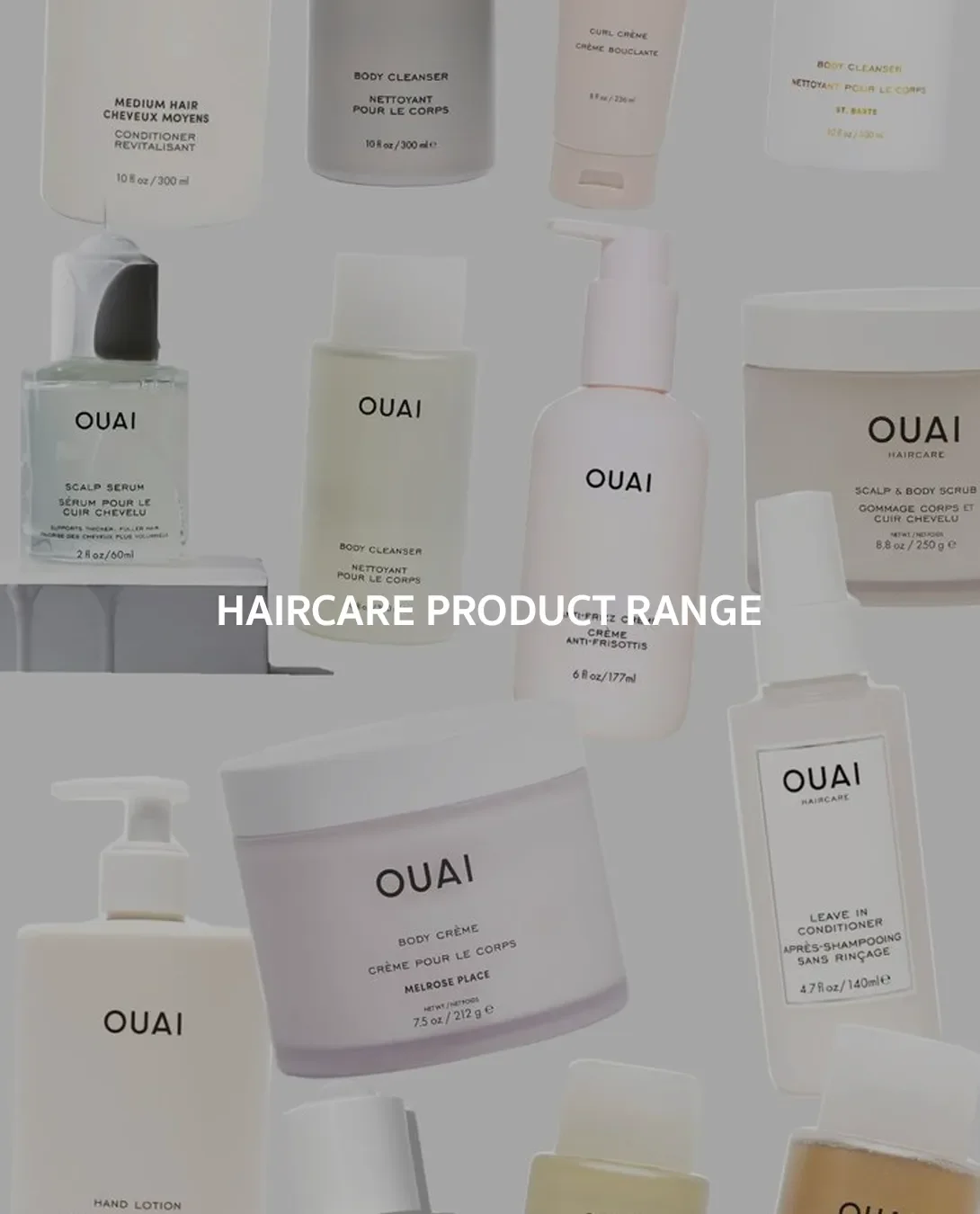
Hair type navigation works when it is consistent. Use one simple system, such as colour coding, numbers or short texture descriptors, and place it in the same position on every label. Explain on the pack and on your website how to choose. Mixing three systems in one range, for example concern names, hair type codes and ingredient names, forces the customer to decode your catalogue before they can buy. Structuring your collections with a clear beauty brand architecture ensures that new treatments and styling products fit into your line without diluting your core range.
Here is a range diagram showing how the levels stack, with an illustrative example of a line built around texture.
| Level | What it does | Illustrative example |
|---|---|---|
| Brand | Holds the point of view | A haircare line built around texture health |
| Hair type | The first choice a customer makes | Fine and straight, Wavy, Curly, Coily |
| Concern | Narrows the choice | Hydration, Repair, Volume, Scalp |
| Routine step | Tells the customer what to use next | Cleanse, Condition, Treat, Style |
| Hero product | Anchors each hair type | One product stylists reach for daily |
Names that describe function age better than names that describe a trend. Keep size formats related too: a backbar size, a retail size and a travel size should share the same label logic and visual family.
How to Write Performance Claims for Haircare
Performance claims are where premium brands gain or lose credibility. Words such as repairs, restores or damage free draw scrutiny from stylists, shoppers and regulators.
Describe what the product does and when. A claim about visible frizz reduction after one wash is stronger than a claim about transformation.
Tie each claim to evidence: a clinical test, a consumer panel or a stylist trial. Keep the records.
Give each product one headline benefit, two supporting points and ingredient detail last.
Use the same claim wording on the pack, the website and the salon materials.
Review claims with a regulatory specialist before printing, because rules differ between the UK, the EU and the US.
Restraint reads as confidence. A shorter, provable claim makes a salon grade line feel more professional than a long list of promises.
Haircare Packaging and Bottle Ergonomics
What makes salon packaging feel professional?
Salon packaging feels professional when it works at the basin before it looks good on a shelf. That means a stable base, a secure grip, controlled dispensing, labels readable at arm's length, materials that survive water and product, and a consistent design across every size.
Salon haircare packaging gets handled all day by stylists with wet or product covered hands. These details separate a professional bottle from a decorative one:
Grip. Glossy smooth surfaces slip. A soft touch coating, a textured band or a matte finish with enough friction helps. Test every sample with wet hands.
Shape and weight. The bottle should stand steady on a trolley, sit comfortably in one hand and fit standard backbar shelving and shower caddies.
Dispensing. A pump on a one litre backbar bottle needs a different output from a pump on a 250 ml retail bottle. Match pump, flip cap or tube to the viscosity of each product, and choose a locking pump for travel sizes.
Materials and labels. Print and labels need to hold up in steam and water. A label that lifts in the shower damages a premium impression quickly.
Name placement. Put the product name and hair type where a stylist reading from a shelf will see them, usually on the upper front, at a size readable from arm's length.
Ask your packaging manufacturer for samples and use them in a working salon for a week before you commit to production. Real use shows problems no render can.
Visual Hierarchy on Haircare Labels
A label has a few seconds to work. Visual hierarchy decides what the eye reads first, second and third, and for a haircare line the order should match how people choose.
Brand name
Product name
Hair type or concern indicator
Key benefit
Size and usage
Ingredients and regulatory text
Use scale, weight and colour contrast to rank this information. Stay with one typeface family and two or three weights. If you colour code hair types, keep the colours within one palette so the range still reads as a family. A quick test helps: place the bottle two metres away and check whether you can read the product name and hair type. If you cannot, the hierarchy needs work.
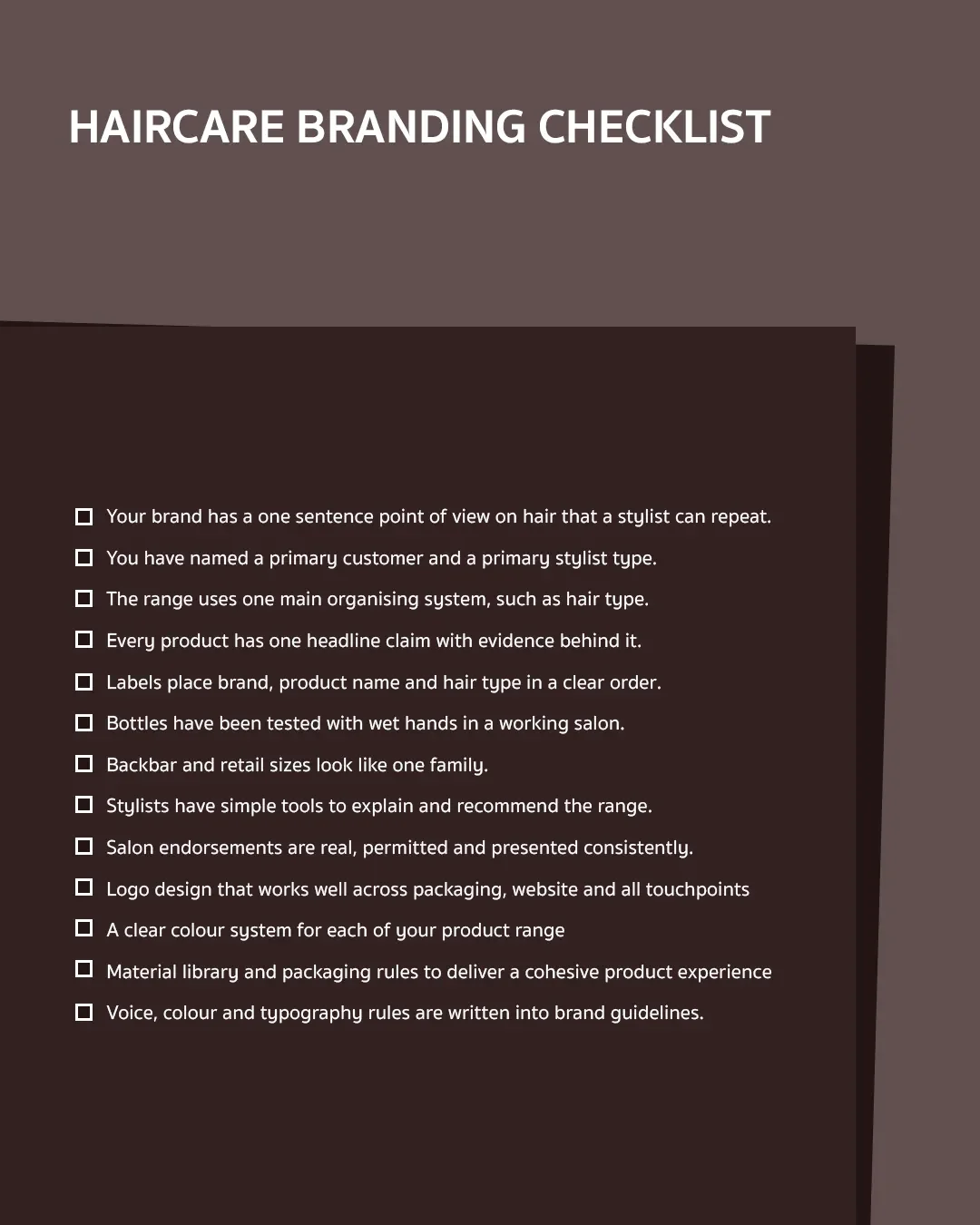
Premium Haircare Branding Checklist
Use this list to check a line before production.
Discuss your haircare brand with Elouvé Collective.
FAQs: Haircare Branding
What is premium haircare branding?
Premium haircare branding is the strategy, identity, packaging and messaging that position a haircare line as high quality and credible. It covers the brand's point of view, range structure, claims, visual identity and the way the product feels in use.
How long does haircare branding take?
It depends on scope. A strategy and identity phase usually takes several weeks, and packaging development takes longer because of sampling, testing and production. A clear brief and early decisions on sizes and formats shorten the timeline.
Should a haircare brand launch in salons or online first?
Both routes work. Launching in salons builds professional credibility and stylist advocacy. Launching online gives faster customer data. Design the identity and packaging for both from the start, so the brand looks consistent wherever it appears.
Does a salon brand need a different identity for retail?
No. Use one identity with different formats. The retail pack can simplify information for a shopper, while the professional pack can add usage detail for a stylist, as long as both share the same name, hierarchy, colour and typography.
How do you make haircare packaging look premium?
Control the details: a confident hierarchy, restrained colour, quality closures, a grip that suits wet hands and finishes that survive daily use. Consistency across every size does more for a premium feel than decoration.
How to Choose a Haircare Branding Agency
Look for an agency that starts with strategy, understands the professional channel and can take a project from positioning through to packaging. Ask how they test bottles and closures, how they handle claims and label hierarchy, and what you will receive at the end: guidelines, packaging artwork and launch assets.
As a specialized luxury branding agency, Elouvé Collective works with haircare and beauty founders on brand strategy, visual identity and packaging design, with Shopify builds and ongoing creative partnership when a brand is ready to grow. If you are building a salon grade line and want a clear position, a range that explains itself and packaging that works at the basin, we would like to hear about it.
