
Hotel signage and wayfinding turn brand identity into a physical system that helps guests move with confidence. Successful systems combine navigation, legibility, accessibility, materials and tone without allowing decoration to obscure function.
Guests meet a hotel brand on foot. They read the name above the door, look for the desk, search for the lift and check a room number against the key card. Each of those moments runs on signage, and most of it gets chosen late, by whoever is closest to the contractor. This guide covers hotel signage design and wayfinding as part of brand identity: what a signage system contains, how to map the guest journey, how to carry typography, colour and tone into physical signs, and what to hand to a fabricator. It focuses on environmental graphics and navigation in and around the building. Print collateral, launch tasks and service standards sit in other guides.
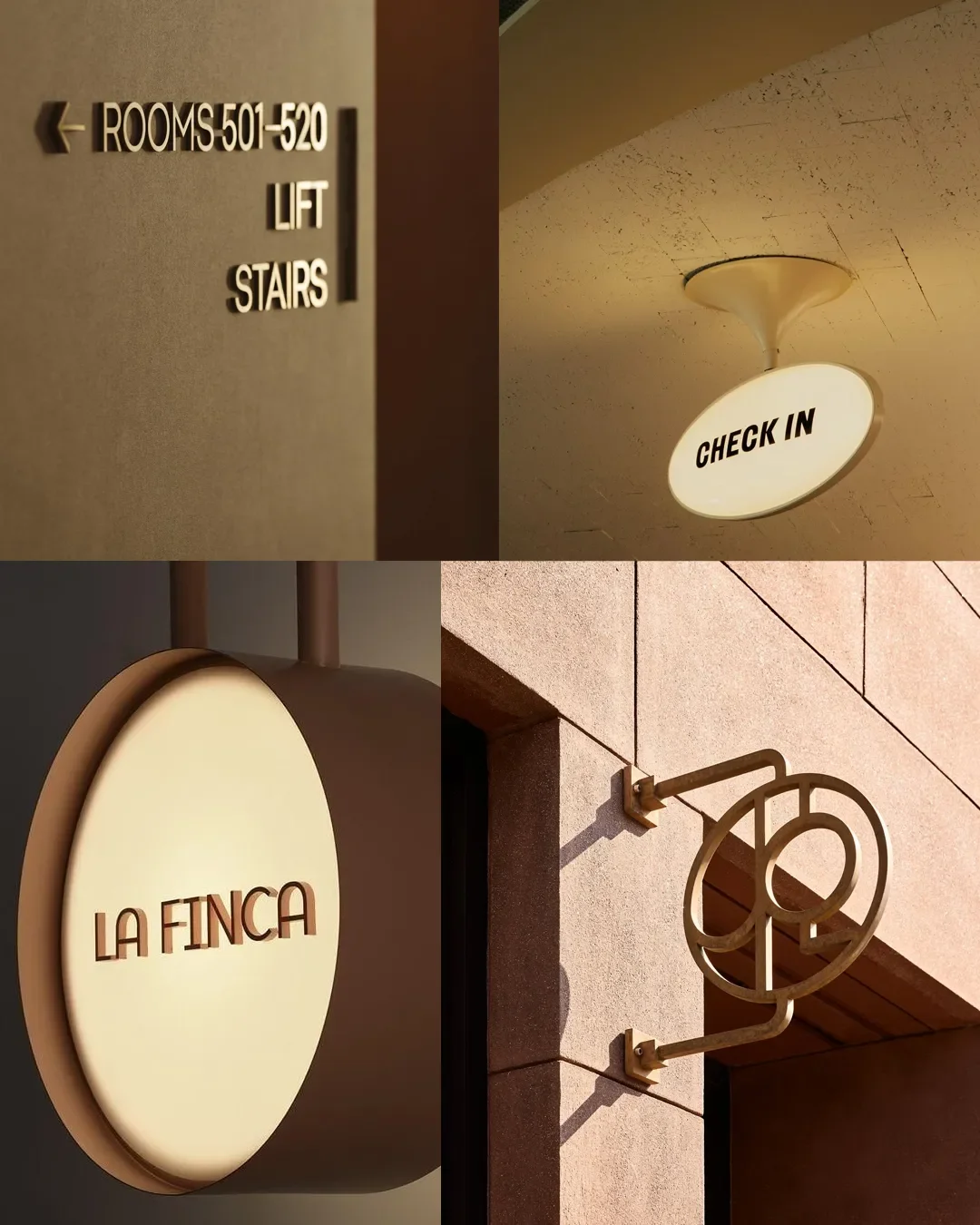
What Is Hotel Signage and Wayfinding?
Hotel signage is every fixed sign and graphic that identifies, directs, informs or regulates, inside and outside the building. Wayfinding is the system behind it: the order, placement and wording that let a guest decide where to go and confirm they are right. Environmental graphics are the branded surface treatments, such as wall graphics, window lettering and floor details, that give a space its character. Branded spatial information covers the names, numbers and short notices that tell guests what a space is called and how to use it.
Together they translate the identity into architecture. A logo on a website and a logo on a brass plate beside a door are the same brand, but the plate has to work at a different distance, in different light and under different rules.
Why Signage Should Be Included in Your Hotel Brand Identity
Signage is the part of the identity guests read when they are least certain: after a flight, with luggage, at night, looking for a room. Most hotel brand guidelines cover logos, colour and print, and stop before the building. The signs then get picked from a supplier catalogue, and the property looks considered online and generic on site. Including signage in the identity work gives the building the same decisions about type, tone and materials as the website. Viewing directional graphics as one critical layer within your broader map of hotel brand touchpoints ensures the guest experience feels seamless from the booking screen to the bedroom door.
How Does Wayfinding Affect Hotel Guest Experience?
Clear wayfinding lowers the effort of a stay. Guests who find the lift, their room and the restaurant without asking feel capable and relaxed. Confusing routes send them to the front desk, make them late for reservations and show up in reviews as comments about the layout. Staff time spent giving directions is also time away from welcoming guests.
How Should Hotel Signage Match the Brand?
Take typography, colour, voice and materials from the identity guidelines, then adapt them for distance, light and regulation. A fine display typeface may need a heavier weight on a corridor sign. A pale brand colour may need a darker panel to meet contrast rules. Keep the family intact: the same letterforms, the same finish language, the same voice. The section on reflecting your brand further down covers each element. Documenting these physical tolerances alongside your operational rules in a hotel brand launch checklist ensures future replacements or property expansions match the original specifications.
Types of Hotel Signage
Most hotels need the sign types below. The table gives the overview and the sections after it explain each one.
| Sign type | Purpose | Where it goes |
|---|---|---|
| Exterior | Identify the hotel from the street | Facade, canopy, entrance, car park |
| Arrival and directional | Guide guests to reception and beyond | Entrance, lobby, lifts, corridor junctions |
| Floor and room | Confirm location and room number | Lift lobbies, stairs, corridors, doors |
| Outlet and amenity | Name and explain restaurants, bars, spa, pool | Entrances and approach routes |
| Safety and regulatory | Meet fire, accessibility and legal rules | Exits, stairs, accessible routes |
| Branded graphics | Add atmosphere and local character | Walls, windows, lifts, floors |
Exterior Signs
The hotel name at street level, plus an entrance marker. Design for the approach: a guest in a taxi sees the sign at speed and at an angle. Illumination matters, and so does planning approval.
Arrival and Directional Signs
Reception should be recognisable from the entrance, either through a clear sign or through the desk itself. From there, directional signs go at every decision point: lift, stair, corridor junction and outdoor route. Boutique hotels without a traditional desk should still tell arriving guests where to check in.
Floor and Room Signs
Floor numbers at lifts and stair landings, room numbers on or beside every door, and range signs at corridor junctions, for example rooms 201 to 214 this way. Room numbers get read thousands of times, so clarity wins over decoration.
Outlet and Amenity Signs
Restaurants, bars, spa, pool, gym and meeting rooms each need a sign at the entrance and one on the route to it. Add opening hours and basic rules where guests need them.
Safety and Regulatory Signs
Fire exits, evacuation plans, stair identification, accessible route and facility signs, and capacity notices. These follow local codes and get checked by inspectors. Brand input covers layout, placement and finish within the approved format, while symbols and wording follow the code.
Branded Graphics
Murals, window lettering, floor inlays, lift interior graphics and similar details. They carry personality and local references, and they are the easiest layer to phase in after opening.
What Signage Does a Boutique Hotel Need?
A boutique hotel needs a sign wherever a guest has to make a decision, and little beyond that. In practice this means an exterior name and entrance marker, a reception sign, floor numbers, directional signs at junctions, room numbers, a sign for each food and drink outlet and the spa, required safety and accessibility signs, and a short house information plaque. Branded graphics are optional extras. A property with 20 rooms needs fewer directional signs than a large hotel, but every item on this list still applies.
Mapping the Guest Journey Before Designing the Signage
Walk the building as a first time guest before anyone designs a sign. Start at the street with no prior knowledge and mark every point where a guest has to choose a direction or confirm a place. Each marked point gets a sign, and spots without a decision usually need none.
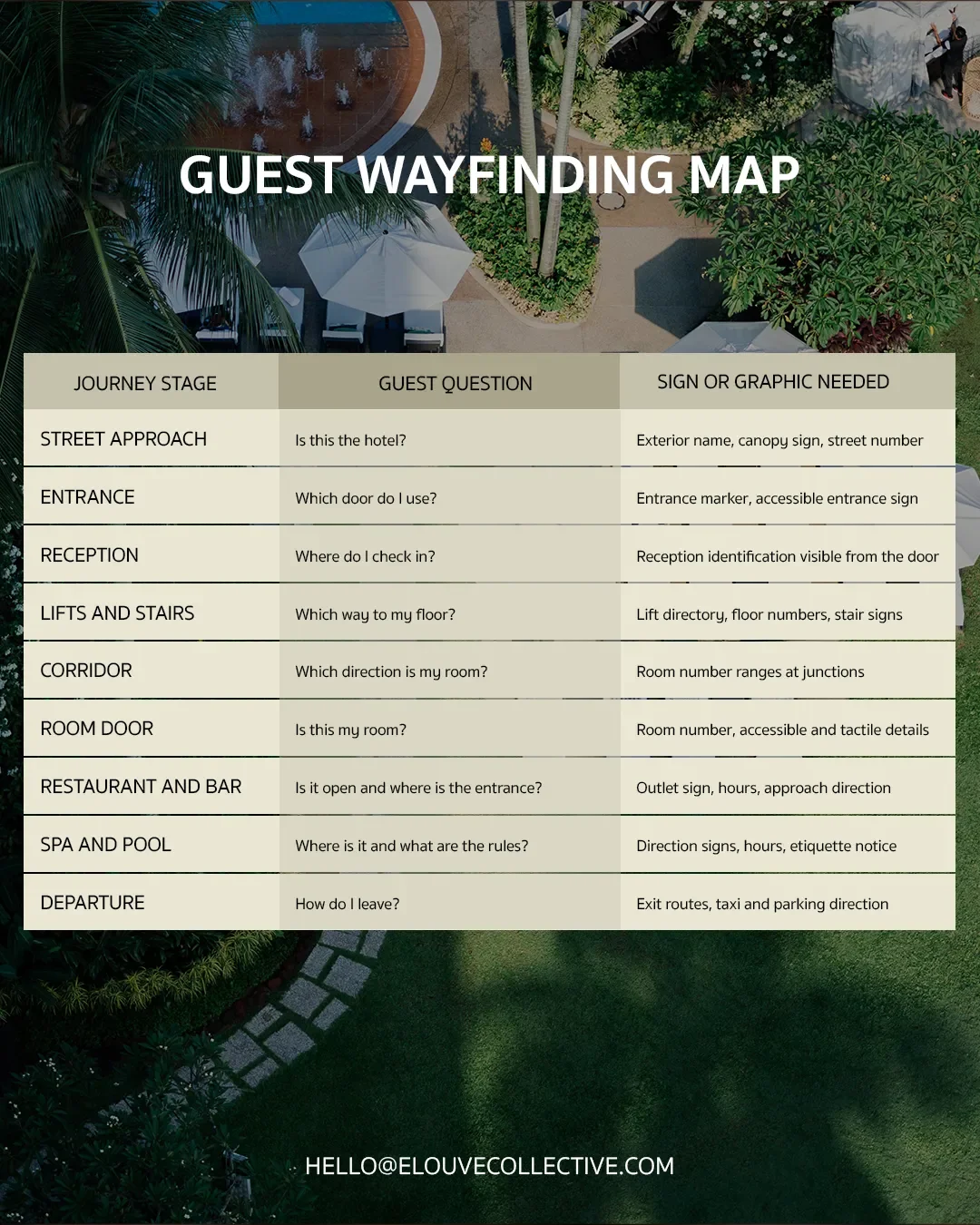
Test the route twice, once in daylight and once after dark, carrying luggage. Ask someone who has never visited to follow only the signs. The places where they hesitate are the places the system needs work. Mark each sign position on the plans, and the same map becomes the base for the signage schedule later.
How to Reflect Your Brand in Hotel Signage
Signs should read as part of the same hotel as the website and the rooms. These five areas carry the brand.
Typography and Lettering
Choose one primary typeface for functional signs and keep decorative lettering for the entrance and moments of display. Check numerals carefully: a 1 and a 7, or a 6 and a 9, should never be confusable at a glance. Letter spacing usually needs to open up at distance, and light weights may need thickening on small signs.
Tone of Voice and Sign Copy
Sign copy is brand voice in its shortest form. Keep it to the information guests need and write it the way the hotel speaks. "Spa, level two" and "The spa is on the second floor" are both clear, so pick the one that sounds like your property and use that pattern everywhere. Match names to the website and menus exactly, so a guest looking for The Library Bar finds a sign that says the same.
Colour and Contrast
Contrast between lettering and background controls legibility. Soft, pale brand palettes often fail against light walls, so signs may need a darker panel or a deeper tone than the brand uses elsewhere. Matte finishes reduce glare. Test samples in the actual lighting, in daylight and at night, before approving them.
Icons and Symbols
Use standard symbols for toilets, lifts, accessibility and exits, because guests recognise them instantly and codes may require them. Custom icons suit amenities such as the spa or pool, provided they share the stroke weight and corner treatment of the rest of the system.
Language Choices for International Guests
Decide which languages the signs carry based on your guest mix. Put the main language first and slightly larger, keep translations short, and use symbols to reduce the amount of text. Have a native speaker check every translation, and confirm the typeface supports the scripts you need, including right to left languages such as Arabic and characters for Chinese, Japanese or Korean.
Hotel Signage Materials, Lighting and Scale
Material choice shapes how a sign feels and how it ages. Brass develops a patina, powder coated aluminium holds colour and suits corridors, stone and timber suit entrances but need protection outdoors, and acrylic and glass suit contemporary interiors. Ask fabricators how each finish ages in your climate and how it gets cleaned.
Lighting changes how a sign reads. Backlit and halo lit lettering carries an entrance at night, while spotlights can cause glare on glossy panels. Check that illuminated signs match the interior colour temperature and still read well in daylight.
Scale follows viewing distance. Letters need to grow as guests see them from further away, so an entrance sign, a lobby directory and a room number plate are all sized differently. Ask the fabricator for letter height recommendations, and test full size mockups on site where you can.
Designing Signage for Existing and Heritage Buildings
Older buildings bring constraints that new builds rarely have. Exterior signs often need planning permission, and listed or protected buildings may need heritage consent before anything is fixed to a facade. Apply early, because approvals can take longer than fabrication. Inside, uneven walls, low ceilings and protected surfaces limit where and how signs can be fixed, so freestanding signs, projecting signs and fixings into mortar joints rather than stone are common solutions. Involve the architect and interior designer from the start, so sign positions work with lighting, door frames and joinery.
Accessibility and Safety Requirements
Rules differ by country and building type, so confirm requirements with your accessibility consultant and local authority. Common reference points include the ADA Standards in the US, BS 8300 in the UK and AS 1428 in Australia. Areas they commonly cover:
Contrast: lettering against background, with matte finishes to avoid glare
Character size and style: sized for viewing distance, in clear letterforms
Tactile and braille: raised characters on permanent room and space signs where required
Mounting: a consistent position, typically beside the door on the latch side, with a height range that many codes set at around 1.2 to 1.5 metres
Safety signs: fire exit and evacuation signs follow code formats and need sign off from the fire safety consultant
Use the same mounting height and side on every floor, so guests learn where to look once.
How to Name and Number Rooms, Floors and Spaces
Room numbers should follow the floor, so 305 sits on floor three. Run numbers in sequence along the corridor, avoid gaps, and check whether numbers carry meaning for your guest markets, since some hotels skip 13 or avoid 4 in certain regions. Named rooms suit small hotels where each room has a distinct character, but a name alone can confuse guests, staff and booking platforms, so pair every name with a number. Name wings, floors and public spaces once, then use the same names on signs, the website and menus.
Common Hotel Signage Mistakes
Mixed typefaces. Signs added by different suppliers over time make the property look unfinished.
Temporary paper notices. Notes taped to doors usually point to a permanent sign nobody planned.
Too many signs. Repeating the same message at every turn adds clutter and weakens the signs that matter.
Untested legibility. Contrast and letter size that look right on screen can fail in corridor light.
Signage decided last. Late decisions leave no time for approvals, samples or fabrication.
Inconsistent mounting. Heights and sides that change between floors make signs harder to find.
Mismatched names. A sign that says Restaurant while the menu and website say Brasserie sends mixed messages.
Hotel Signage Process and Timeline
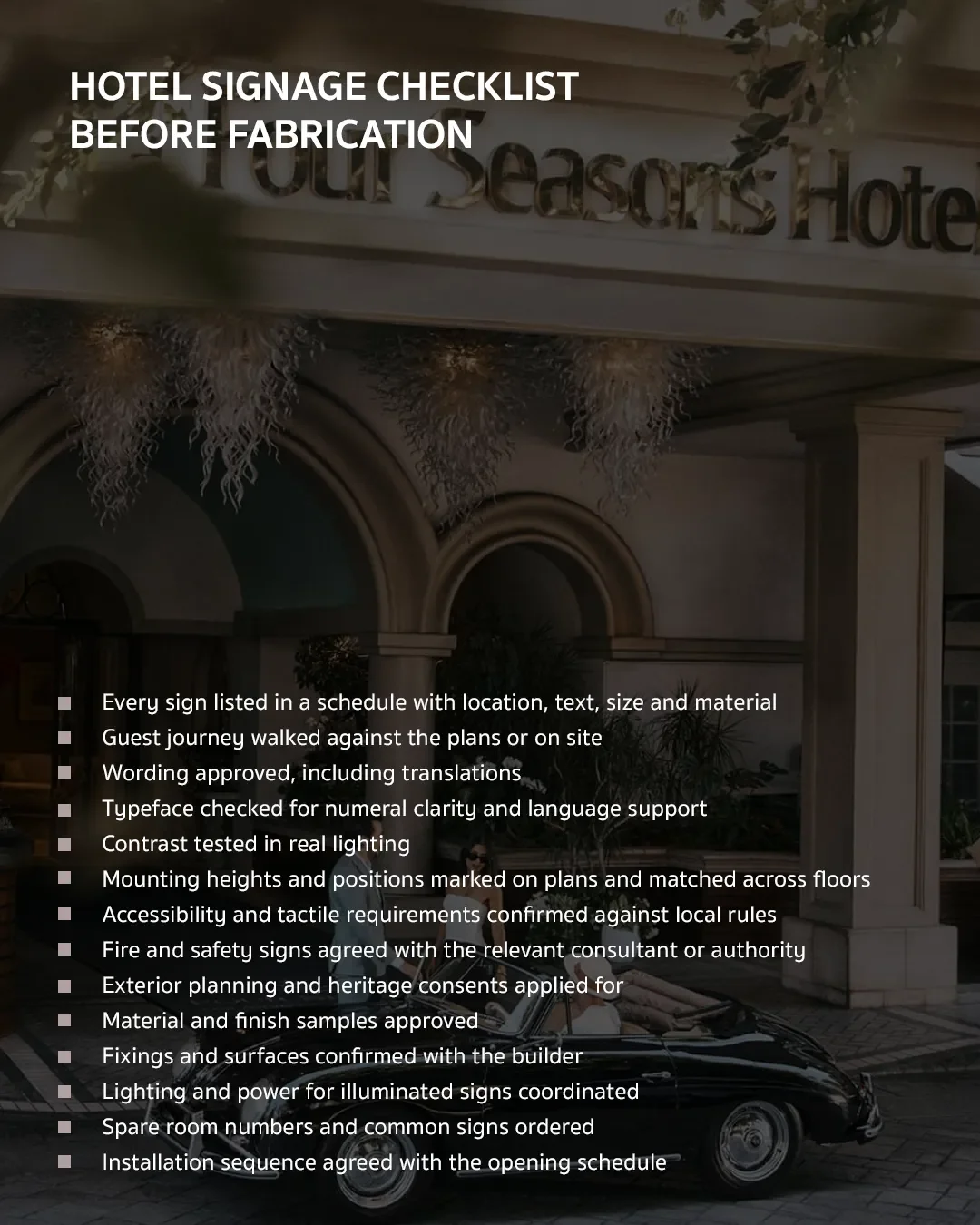
The process runs in a fixed order: audit and brief, guest journey map, signage schedule, design development, prototypes and approvals, fabrication handoff, fabrication, then installation and snagging. The signage schedule is the working document. It lists every sign with its location, text, size, material, finish, mounting height and quantity.
Fabrication handoff is where many projects slip. Give the fabricator dimensioned artwork files, approved material and finish samples, the fixing method and wall or surface type, final approved wording including translations, mounting positions marked on plans, and lighting and power details for illuminated signs. Incomplete drawings lead to fabricator assumptions, and assumptions show up on site.
The timings below are indicative for a new build. Refurbishments compress them, and approvals for exterior signs can extend them.
| Stage | Typical timing before opening | Output |
|---|---|---|
| Brief and audit | 9 to 12 months | Signage brief, plans reviewed |
| Guest journey map | 8 to 10 months | Decision points marked on plans |
| Signage schedule and design | 6 to 9 months | Full schedule, sign designs |
| Approvals and prototypes | 4 to 6 months | Consents, material samples |
| Fabrication handoff | About 4 months | Fabrication drawings, final copy |
| Fabrication | 2 to 4 months | Finished signs, lead times vary by material |
| Installation and snagging | 2 to 4 weeks | Signs fitted and checked day and night |
Hotel Signage Checklist Before Fabrication
How to Budget for Hotel Signage
Signage often falls between budgets: construction, furniture and fittings, and branding. Decide early who owns it. Put money first into the exterior and arrival signs, room and floor numbers, required safety signs and directional signs at junctions. Branded graphics, secondary outlet signs and seasonal pieces can phase in after opening. Required safety and accessibility signs should never be phased. Cost drivers include material, illumination, custom shapes, quantity, installation difficulty and approvals. Ask for quotes itemised by sign type so you can compare and adjust.
FAQs: Hotel Signage
What Is Hotel Wayfinding?
Hotel wayfinding is the system of signs, graphics and spatial cues that helps guests find their way around a property and confirm they are in the right place. It covers direction, identification and information from the street to the room.
How Much Does Hotel Signage Cost?
Cost depends on the number of signs, the materials, illumination, custom work and installation. A small property with simple finishes costs far less than a large hotel with illuminated metalwork. Request itemised quotes by sign type once the signage schedule is complete.
What Signs Does a Boutique Hotel Need?
An exterior name and entrance sign, reception identification, floor and room numbers, directional signs at junctions, outlet and spa signs, required safety and accessibility signs, and a house information plaque.
Who Designs Hotel Signage?
A brand or environmental graphics designer usually leads the design, working with the architect, interior designer and fabricator. Safety and accessibility signs also need input from the relevant consultants.
How Early Should Signage Be Planned?
Start during the identity and interior design stage, ideally 9 to 12 months before opening on a new build. Approvals and fabrication take time, and early planning lets sign positions work with the architecture.
Where to Start With Hotel Signage Design
Begin with three steps. Walk the building as a first time guest and mark every decision point. Check whether your brand guidelines cover signs, and add rules for typography, colour, wording and mounting if they do not. Then build the signage schedule so every sign has a place, a size and an owner.
If you are opening or refreshing a hotel and want signage that matches the identity, Elouvé Collective can help you create a coherent physical guest experience, from the journey map to the fabrication handoff.
