
A successful beauty rebrand changes the right touchpoints in a controlled sequence while preserving enough recognition for existing customers. The rollout needs clear transition rules across packaging, ecommerce, retail, inventory and customer communication.
A loyal customer reaches for her usual serum, picks up the bottle, and stops. The colour is different. The name sits somewhere new. She turns it over to check the ingredients, and for a few seconds she is unsure whether this is the product she trusted last month.
That pause is where rebrands lose money. Many beauty founders invest heavily in the new identity and very little in the weeks after it exists. This guide covers those weeks. If you are still deciding whether to rebrand, start with our skincare rebrand readiness guide. If the decision is made, here is how to move your customers, stock, website, and retailers across to the new brand without losing the people who already buy from you.

Treat Your Beauty Rebrand Launch as an Evolution
A rebrand feels like a clean break to the person who commissioned it. To a customer, it is a change to something they use every day. They have built habits around your product: where the bottle sits in the bathroom, the colour they look for when they reorder, the name they type into search.
Your existing customers carry most of the risk in a rebrand, because they are the ones who have to relearn you. New customers meet the new brand with no memory to contradict it. So the practical goal is simple. A returning customer should recognise the new version within a second or two, and should find a clear explanation why to resonate with an upgraded version of your brand experience
How do you launch a beauty rebrand?
Launch a beauty rebrand in phases. Decide which brand elements customers rely on to recognise you, plan how old and new stock will overlap, set up redirects before your website changes, email existing customers before the new look goes public, give retailers their assets early, publish a customer FAQ, and track repeat purchases for 90 days. The sections below cover each of these in the order you will need them.
Decide What Must Stay Consistent Before You Change Anything
Every brand has a small number of elements that carry its identity. Customers often cannot describe them, but they notice immediately when they disappear. These elements can be polished. They should rarely be replaced.
Nivea is a useful reference. The packaging has been refreshed many times over the years, and the blue tin with white lettering still reads as Nivea. The brand changed around that anchor instead of discarding it.
For a beauty brand, the founders have to identify the elements. a signature colour, a bottle silhouette, a cap or pump style, the position of the product name, a typeface, or a scent cue that customers associate with the first use. To find yours, cover the logo on your current product and ask what still makes it recognisable. Then read your reviews and customer messages for the details people mention without prompting. Once you lock in these updated visual anchors, document them in your beauty brand guidelines so internal teams, printers, and retail partners execute the transition consistently.
Pick one or two of these as bridge elements and carry them across to the new design. Apply the same thinking to your website, packaging, email, and social profiles, so a customer who sees any one of them gets the same recognition signal.
| Decision | What it covers | Example for a skincare brand |
|---|---|---|
| Keep | Elements customers use to find you | A deep green used on every product, the bottle shape, the name position |
| Evolve | Elements that can be refined | Typography, label layout, finish, photography style |
| Retire | Elements that add noise | Extra colours, old badges, outdated claims, inconsistent icons |
Write this table out for your own brand before your designer finalises anything. It becomes the reference for every later decision, from label proofs to retailer imagery.
Plan for Two Versions of Your Brand on the Same Shelf
Old and new stock will exist at the same time. Some sits in your warehouse, some at your fulfilment partner, some on retailer shelves, and some already in customers' homes. A packaging transition rebrand goes smoothly when you plan for this overlap and gets messy when you hope it passes quickly.
Should old and new packaging overlap?
Yes, for a short and managed period. A hard cutoff means writing off stock that is perfectly sellable and leaving gaps on shelf and in your online store. Overlap works when the two versions look close enough that customers read them as the same product, which is why the bridge elements from the previous section matter. As a guide, keep the overlap to roughly one reorder cycle for your product, plus the time your retailers need to sell down their existing stock.
How do I change skincare packaging without confusing customers?
Keep the product name, size, and key descriptors in the same positions on the new pack. Switch to new packaging at the start of a production batch, never partway through one. For the first batches, add a small insert or sticker that says the formula is the same and points to your FAQ. Photograph both versions and use the photos across your site, retailer materials, and support replies, so everyone who answers a customer question knows both versions are genuine.
Use this checklist to manage the overlap:
Count units of old packaging in your warehouse, at your fulfilment partner, and at each retailer
Set the date each product switches to new packaging, tied to a production batch
Confirm whether barcodes and SKU codes stay the same, and tell retailers if they change
Decide which channel sells old stock first, direct to consumer or retail
Print a limited run of inserts or stickers for the first new batches
Decide whether orders can ship with mixed versions, and tell customers on the product page if they can
Keep your website product photos matched to what actually ships
Set a stop date after which remaining old stock is removed from sale or moved to a clearance channel
Roll Out in Three Phases Across Several Weeks
A skincare rebrand rollout works best as three overlapping phases. Each phase has a trigger that tells you when to move to the next one, so the launch follows what you learn instead of a date on a calendar. A beauty brand refresh launch on this model reaches your most loyal customers first, then the wider audience, then the finish line.
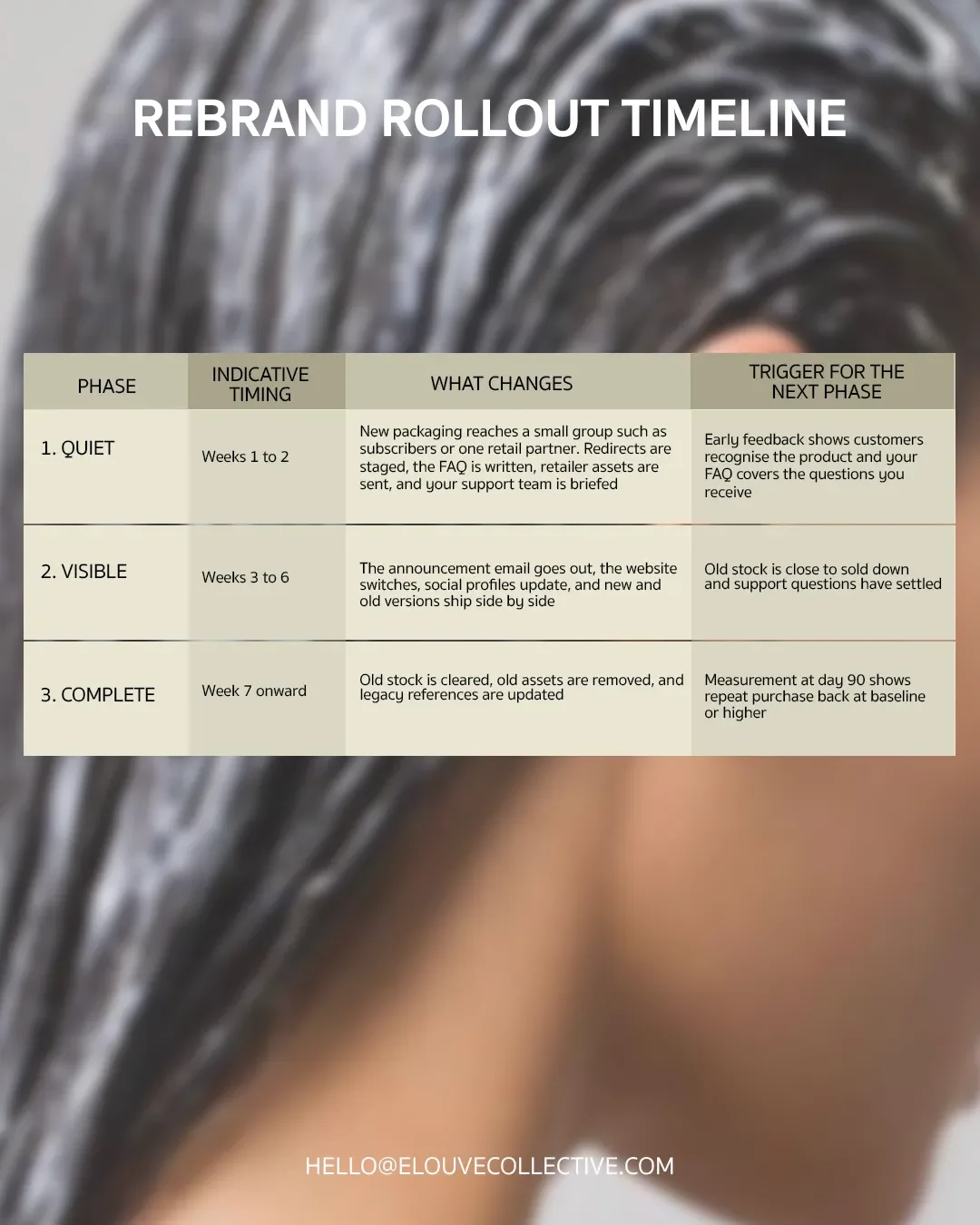
Timings depend on your stock levels and production schedule, so adjust them to match your own numbers.
Phase one is the one founders skip. A small, quiet release is the cheapest way to find out what confuses people. Every question that arrives during this phase goes into your FAQ before the wider audience sees the change.
Phase three covers the clean up that is easy to forget: marketplace listings, directory profiles, your Google Business profile, your press kit, influencer media kits, and any partner pages that still show the old brand.
Tell Existing Customers First, and Tell Them by Email
Your email list is the group most likely to notice and most likely to be bothered by a change. They should hear about it from you before they see it somewhere else.
How do you communicate a rebrand to customers?
Tell existing customers before the new look reaches the public. Send an email a few days ahead of launch that shows the change, says what stays the same, explains why you made it, and links to your FAQ. Then repeat the message in the places customers already look, including your website, product pages, order confirmations, and packing inserts. Strong rebrand communication for a beauty brand is plain, specific, and repeated across every touchpoint.
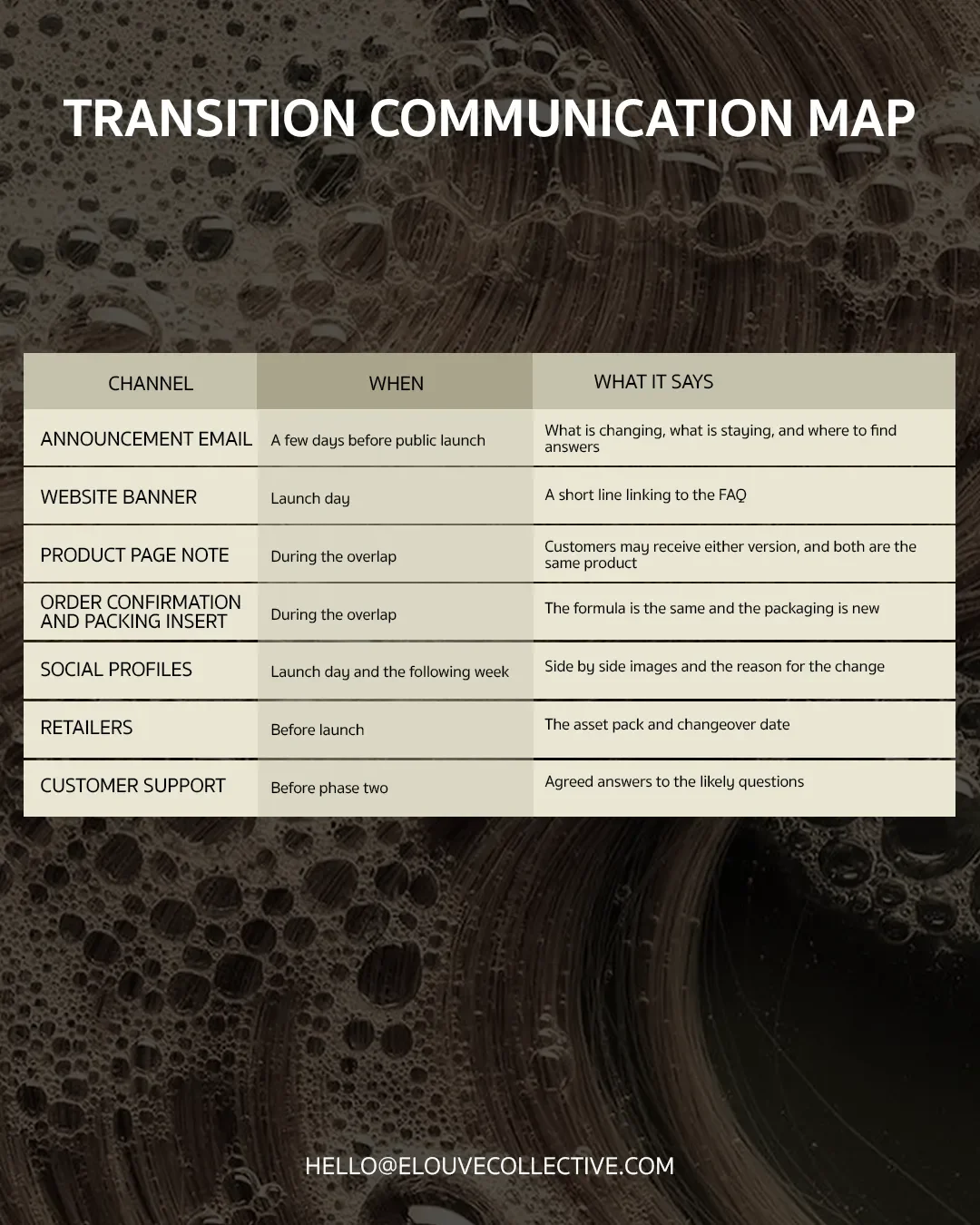
For the announcement email, use this structure:
Subject line. Say what is happening in plain words, for example a new look with the same formula.
Opening line. State the change and the date it takes effect.
Image. Show the old and new packaging side by side, with the bridge element clearly visible.
What stays the same. Formula, ingredients, sizes, and the team behind the brand, as long as each of these is true.
Why you changed it. One or two honest sentences.
What to expect. Customers may receive either version for a few weeks.
Where to get help. A link to the FAQ and a support contact.
Leave out the long brand story and abstract language about elevated or evolved identities. Also keep heavy discounts on old stock out of this email, since they can read as clearance and make customers question quality.
Keep Your Website and Search Visibility Intact with Redirects
If your product names, URLs, or domain change in the rebrand, every old address needs to point to its new equivalent. A redirect sends both visitors and Google from the old page to the new one. Without redirects, customers who click an old review link, press mention, or influencer post land on an error page, and the search rankings you built over the years start to slip.
Hand this list to your developer:
Map every old URL to the closest new page, product to product and collection to collection
Use permanent 301 redirects
Test the redirects before the changes go live
Update internal links, navigation, the sitemap, and canonical tags
Rename product images and update alt text and page titles
Update social handles, bios, and email signatures, and keep the old handle redirecting where the platform allows it
If your store runs on Shopify, add redirects through the URL redirects settings in the admin
Submit the new sitemap in Google Search Console and check for errors every week
Keep the redirects live for at least a year
Broken links also hit your email flows. Check abandoned cart emails, welcome sequences, and post purchase emails for old links and old branding before launch.
Give Retailers Their Assets Before Customers Start Asking Them Questions
Retail staff are the first people a customer asks when a product looks different. If they have no answer, the customer may assume something is wrong and choose another brand. Send retailers a complete asset pack during phase one, ahead of your customer email.
A useful retailer pack includes:
Updated product images on white backgrounds, plus lifestyle images
Product data sheets with new names, descriptions, and barcodes
A side by side image of old and new packaging, so staff can match them
A one page brief for sales staff covering what changed, what stayed the same, and what to say when a customer asks
Shelf talkers or tags for the overlap period, such as a note that the formula is the same
Retail experience guidelines for how the new brand appears on shelf, including colour, placement, display fixtures, and merchandising
A short training session or video for store staff
A clear changeover date and a process for returning or exchanging remaining old stock
The one page brief does the most work. Staff in a busy store rarely read more than that, and it gives them a confident answer to the first question they will hear.
Write the Customer FAQ Before Your Inbox Writes It for You
Publish the FAQ on your website and link to it from the announcement email, product pages, retailer brief, and packaging inserts. Short, direct answers also suit AI search tools, which often pull from FAQ content when people ask about a brand.
Use the questions below as a starting point and change any answer that is not true for your brand.
Is the formula the same? Yes. Only the packaging and labelling have changed. The formula, ingredients, and sizes are the same as before.
Why does my bottle look different? We updated our packaging design. The product inside is the same one you already use, and the old and new versions are both genuine.
Can I still use the product I bought in the old packaging? Yes. It is the same product. Check the batch code and expiry date on the pack as you normally would.
Which version will I receive when I reorder? During the transition you may receive either version. Both are the same product.
Is my usual product being discontinued or renamed? No. The product name stays the same. Only the look has changed.
How do I know the new packaging is genuine? Buy from our website or from the retailers listed on our stockists page. Products from other sellers cannot be guaranteed.
After launch, add every new question that reaches your support inbox. The FAQ should grow for the first 90 days.
Measure Recognition and Repeat Purchase After Launch
Launch day attention tells you very little. What matters is whether the customers you already had keep buying. Record your baseline for each metric in the 60 days before launch, then compare at 30, 60, and 90 days.
| Metric | Day 30 | Day 60 | Day 90 |
|---|---|---|---|
| Repeat purchase rate | Compare to baseline and expect a small dip at most | Back near baseline | At or above baseline |
| Support tickets about the change | Expect a rise and log the common questions | Falling, with new questions added to the FAQ | Close to normal volume |
| Email clicks and replies | Check clicks on the announcement and FAQ links | Regular campaigns performing as before | Stable |
| Branded search | Watch searches that include the old name | Old name searches gradually falling | New name searches at or above previous levels |
| Retailer reorders | Early orders show confidence in the new look | Review sell through at each stockist | Reorders arriving at the usual rhythm |
If repeat purchase falls and stays down, look at recognition first. Check whether the bridge elements are visible enough on shelf and on screen, and whether customers can find the FAQ. Small fixes to labelling, inserts, or email follow ups usually recover most of the loss.
What a Successful Rebrand Looks Like, and Where to Start
A successful rebrand is one your existing customers barely register as a problem. They recognise the product, they find answers when they look for them, and they keep reordering. That outcome comes from deciding what stays consistent, managing the overlap in stock, rolling out in phases, telling your customers first, protecting your website with redirects, equipping your retailers, answering questions in advance, and measuring what happens afterwards.
As a specialized skincare branding agency, Elouvé Collective plans the rollout alongside the identity and packaging design, so launch decisions are made while the brand is still being built. If your rebrand is approved and you want a clear plan for the weeks that follow, we can map it with you.
