
A beauty brand is retail-ready when its positioning is clear, packaging works at shelf distance, product information is consistent and stockists can understand and sell the range. The checklist should identify gaps before outreach or retail expansion begins.
This guide is for established DTC beauty brands preparing for wholesale. It covers what changes between DTC and retail, how to adjust your packaging, what to prepare before you pitch, and how to score your own readiness. If you need professional support handling this transition, working with a skincare branding agency can streamline the entire process. If you want a skincare wholesale checklist you can work through in order, start here and finish with the scorecard.
What Changes When a DTC Beauty Brand Moves Into Retail
Moving from DTC to retail changes who explains your product, how fast a decision happens and how much of the brand you control. Packaging, imagery and documents that worked for your own channel now have to work for people you will never meet.
| Area | DTC | Retail |
|---|---|---|
| Who explains the product | Your website, content and customer service | The pack, the shelf and a store team who may know little about you |
| Time to decide | Minutes of browsing | A few seconds at the shelf |
| Job of the packaging | Feel good on opening and survive a parcel | Be understood from a distance, survive stocking and handling, and scan at the till |
| What shoppers see of your range | The whole range on your site | A few units, with the rest somewhere else in the store |
| Imagery | Lifestyle content, social posts, your own site | White background packshots, retailer templates and portal specifications |
| Brand control | Complete | Shared with the retailer, their layout and their copy |
| Margin | Full retail price | A wholesale price, lower than the retail price |
Every row in this table is a job to finish before the first buyer meeting. The rest of this guide takes them one at a time.
The Shelf Distance Test: What a Shopper Sees From Six Feet Away
Most beauty packaging is designed to be viewed at arm's length, on a screen or in the hand. A shelf works at a different distance. A shopper's first look happens from around six feet away, and in that moment your pack needs to answer three questions: what is this brand, what is this product, and why would I pick it up.
Try it before paying for any redesign. Print a full size mockup of your hero product, place it on a shelf in a store next to the brands you want to sit beside, and walk back six feet. Photograph it from standing height. Then check:
Can you read the brand name?
Can you tell the product type, such as serum, cleanser or moisturiser?
Is the hero benefit or variant visible, such as hydrating, brightening or SPF?
Does the pack hold its own against the colour and contrast of the products beside it?
Luxury beauty packaging often fails this test for understandable reasons. Tonal palettes, small type and subtle foil look refined in the hand and in photography. Under bright store lighting, glossy finishes reflect, tonal text disappears and the pack reads as a blank block. You can keep the restrained look and still fix this by increasing the size of the product name, raising contrast on one key line of type, and choosing finishes that hold up under strong light.
SKU Recognition: Make Every Product in the Range Easy to Tell Apart
On your website, navigation does the sorting. In a store, the packs do it. A shopper or a sales assistant has to tell your cleanser from your toner and your night cream from your day cream without opening anything.
Line up every unit in your range and squint. If two products look the same at a glance, wrong picks and returns follow. Building a cohesive skincare packaging system for multiple SKUs resolves this visual confusion before your range hits retail. A clear system fixes this:
Name position: place the product name in the same spot on every pack, large enough to read at distance.
Colour coding: give each product type or skin concern its own colour or tint, and keep it consistent across sizes.
Size cues: make minis, full sizes and refills visibly different.
Variant clarity: show shade, scent or strength on the front, so nobody has to read the back to find out.
Retailers often start with a limited selection from a new brand. Decide which three to six products lead, make sure their packaging carries the logic of the whole range, and hold the rest for later.
How Should Packaging Change for Wholesale? Cartons, Shippers and Barcodes
DTC packaging is built to look good when opened and to survive a parcel. Wholesale packaging also has to survive being unpacked, stocked, handled by strangers and scanned at a till. Check each layer.
Cartons
The carton is the part of your pack that shoppers handle most. For retail it needs a front panel that passes the shelf test, and a back panel that carries what the store and the law require: ingredients, directions, warnings, a batch or lot code, size, and a barcode in a scannable position. If your DTC cartons are minimal and leave the detail to your website, this is the biggest change.
Look at finishes too. Soft touch laminate marks easily, foil can rub and embossed edges crush under handling. Rub a finished carton against another one, stack a dozen, and drop a boxed case. If it scuffs on your desk, it will look worse after transit and a month on a shelf.
Outer cases and shippers
Retailers receive product in cases with a set quantity, such as 6, 12 or 24. Each case needs a label showing the product name, SKU, quantity and barcode, and the dimensions and weight should be recorded for the retailer's logistics team. The case should protect the units without extra void fill. Ask your packaging manufacturer for a drop and compression test before the first order.
Barcodes, labelling and shelf extras
Every SKU needs its own barcode, usually registered through GS1, printed clearly with enough clear space around it. Rules for ingredients, claims and warnings differ by country, so check each market you plan to sell in with someone who handles cosmetic regulation. Then ask which shelf extras the retailer will take, such as testers, shelf strips or small display units, and brief them early because they carry lead times.
Pack cost at wholesale prices
A wholesale price is typically around half of your retail price. A rigid box or a multi finish carton that was affordable in DTC can take a much larger share of your margin. Recalculate unit cost at wholesale and at retail order volumes, and simplify finishes where the shelf will not show the difference.
What Should a Skincare Brand Prepare Before Pitching Retailers?
A buyer wants to know three things: who buys this, why it will sell in their store, and what you will do to bring customers to it. Your pitch materials should answer all three quickly.
The wholesale deck
Keep the deck to between eight and twelve slides. Cover:
Brand story and the customer you serve, on a single slide
Hero products and how the range fits together
Proof of demand: DTC sales trends, repeat purchase rate, reviews and press
Pricing: wholesale price, recommended retail price and the retailer's margin
Marketing support: what you will do to bring customers in, across social, email and launch activity
Logistics: minimum order, lead times, case sizes and the reorder process
What you need from the retailer: placement, testers and promotion calendar
The line sheet
One clean page or grid with an image, product name, size, SKU, barcode, wholesale price, retail price and case quantity for every product. Keep it consistent with the deck, because buyers compare the two.
Product Imagery Retailers Can Actually Use
Lifestyle photography built your DTC brand. Retailers need images they can drop into their own site and materials without editing. Prepare:
White background packshots of every SKU, front on and at an angle, at high resolution
Back of pack and carton images that show ingredients clearly
Texture and swatch shots that show consistency and shade
Lifestyle images with usage rights, for the retailer's campaigns
Short videos of the product in use
Files named by SKU or barcode, so they match the retailer's system
Keep lighting, shadow and crop the same across the range, so a page of your products looks like one brand.
Retail Brand Guidelines: Protecting Your Brand When Others Control the Shelf
Once you are in retail, other people will describe your products, position your packs and use your logo. Without guidelines, they will guess. A retail guidelines document of ten to twenty pages is enough. Reviewing comprehensive beauty brand guidelines can help you structure these rules clearly. Cover:
Logo use, clear space and minimum sizes
Colour values and typography
Image and layout rules, including how to crop and place packshots
How to describe the products, with approved claims and wording
Display guidance: product order, facings, testers and signage
Rules for co branding and promotions
Who to contact for approval and assets
Write it in plain language. Store teams, regional marketers and agencies will use it, and most of them are not designers.
What Branding Assets Do Retailers Need?
Gather everything into one shared folder, organised by SKU, so you can answer a buyer's request within a day.
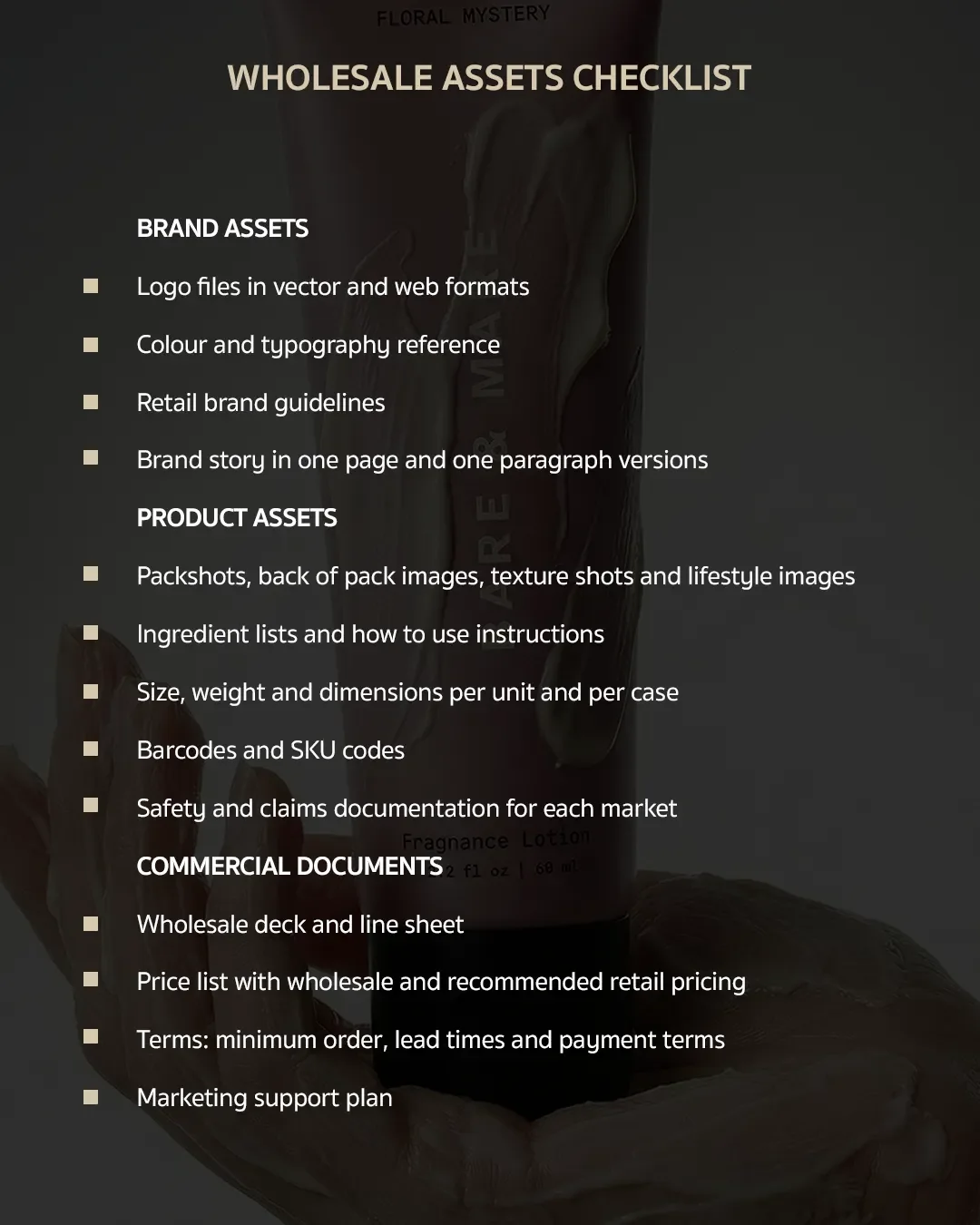
Brand assets
Logo files in vector and web formats
Colour and typography reference
Retail brand guidelines
Brand story in one page and one paragraph versions
Product assets
Packshots, back of pack images, texture shots and lifestyle images
Ingredient lists and how to use instructions
Size, weight and dimensions per unit and per case
Barcodes and SKU codes
Safety and claims documentation for each market
Commercial documents
Wholesale deck and line sheet
Price list with wholesale and recommended retail pricing
Terms: minimum order, lead times and payment terms
Marketing support plan
Retailer portal assets
Many retailers ask you to upload product information to a supplier portal or template. Expect fields for the product title in the retailer's format, short and long descriptions with character limits, ingredients, claims, size, weight, barcode, images and sometimes video. Prepare standard copy for every SKU in several lengths, so you can paste it in and adjust, and avoid rewriting it for each retailer.
Retail Readiness Scorecard: How Do I Know If My Beauty Brand Is Ready for Retail?
Score each line: 0 for no, 1 for partly, 2 for yes.
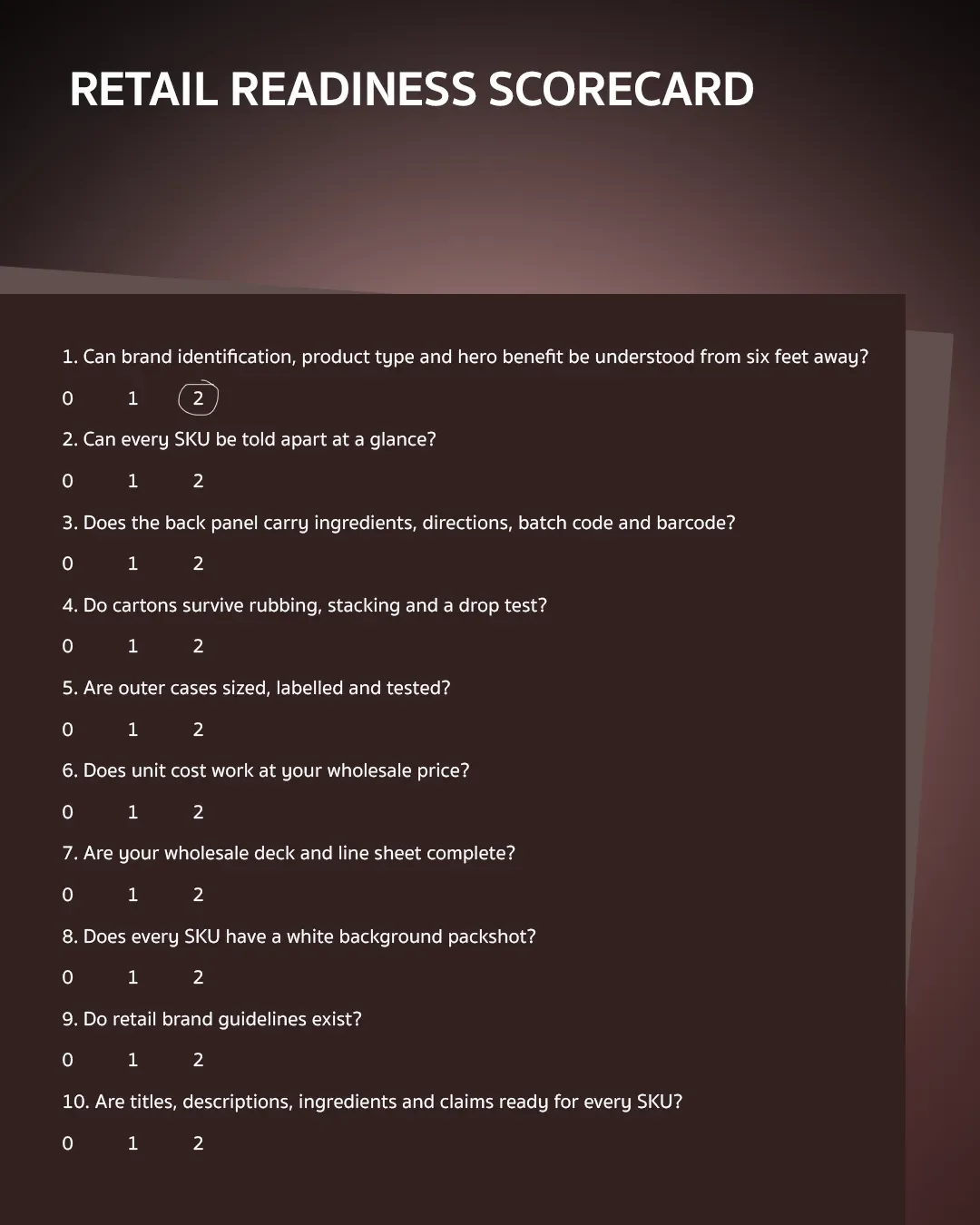
16 to 20: you are ready to pitch.
10 to 15: you are close. Fix the lowest scoring lines before you approach buyers. Most take weeks, not months.
Under 10: a small pilot with one independent retailer or a pop up will teach you more at lower risk while you build the missing pieces.
Retail Readiness FAQs
How do I know if my beauty brand is ready for retail?
Your brand is ready when a stranger can understand your product from the shelf, your packaging survives handling, and your pitch materials answer a buyer's questions. Use the scorecard above. A score of 16 or more is a good sign.
What branding assets do retailers need?
Logo files, brand guidelines, white background packshots, ingredient and product data, barcodes, a wholesale deck, a line sheet and a price list. Portal copy for each SKU saves time once buyers start asking.
How should packaging change for wholesale?
Add full information to the back panel, test finishes for scuffing, prepare labelled outer cases, print barcodes and recheck pack cost against your wholesale margin.
What should a skincare brand prepare before pitching retailers?
A wholesale deck, a line sheet, product imagery, brand guidelines and proof of demand from your DTC sales.
Do I need to redesign my packaging before approaching retailers?
Often you do not. Run the shelf distance test and the scuff test first. Many brands need changes to hierarchy, back panel detail and finishes, which is a smaller job than a full redesign.
How many products should I launch with in retail?
Retailers often start with a limited selection, commonly a few hero products. Choose the ones with the best repeat rate and the clearest packaging.
Prepare Your Beauty Brand for Retail
A retail buyer gives you a short window to make a clear case. Elouvé Collective reviews your range, packaging and retail materials, and gives you a clear list of what to fix before your first buyer meeting.
Prepare your beauty brand for retail.
