
Moving from DTC to retail changes how quickly beauty packaging must communicate and how consistently the range must work together. Brands need clearer shelf hierarchy, robust information systems, retail-ready assets and stockist tools without losing existing recognition.
A beauty brand that sells well online can look quiet on a stockist shelf. Online, the website explains the ingredients, the founder story and the routine. On a shelf, the brand gets a few seconds, some distance and a row of competitors asking for the same attention.
DTC beauty to retail is the process of adapting an established online brand for wholesale. That means packaging that reads quickly on a shelf, practical details such as barcodes and case packs, and a set of assets that stockists can use without chasing you for more. This guide covers each one in the order a buyer will meet them.
Reviewing a comprehensive packaging design guide before making these structural adjustments will help you protect your visual assets while updating your technical layouts. It is written for beauty founders who already have customers. If you are still deciding whether the business is ready for wholesale, start with our beauty retail readiness checklist. This article picks up once the decision is made and looks at what to change.
What Changes When a Beauty Brand Moves From DTC to Retail
Online, you control the whole experience. A customer reads the product page, checks the reviews and opens a box designed for unboxing. The packaging is the last chapter of a story they already know.
In retail, the packaging is the first chapter and sometimes the only one. A shopper meets the product beside five or ten others, with no page to scroll and nobody to explain it. A stockist buyer looks at it from another angle: will it sell, will it survive shipping, will it fit the fixture, and will the brand support it properly.
The table below compares the two environments.
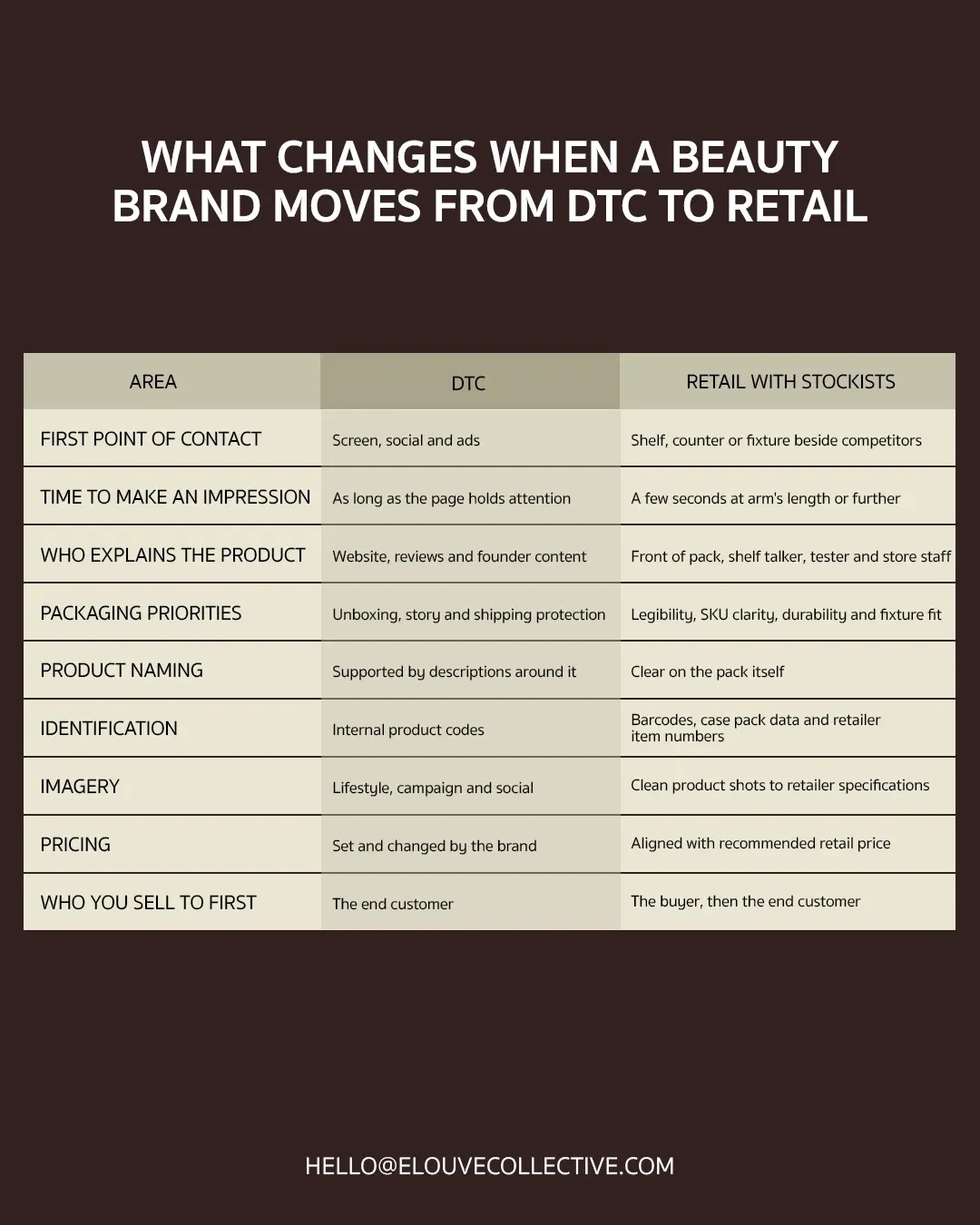
The identity can stay the same. The packaging has to carry more of the explanation than it did online.
How Should Beauty Packaging Change for Retail?
Beauty packaging should change in three ways for retail. It needs to read from shelf distance, each product needs to be easy to tell apart from the rest of the range, and the pack has to meet stockist requirements. The brand identity usually stays intact.
Design for Shelf Distance
Shelf distance is the gap between a shopper and a product when they first notice it. In store, that is often an arm's length or more, and the shopper is usually moving. Small type, pale tints on white and fine line illustration look refined on a screen and tend to disappear at that range.
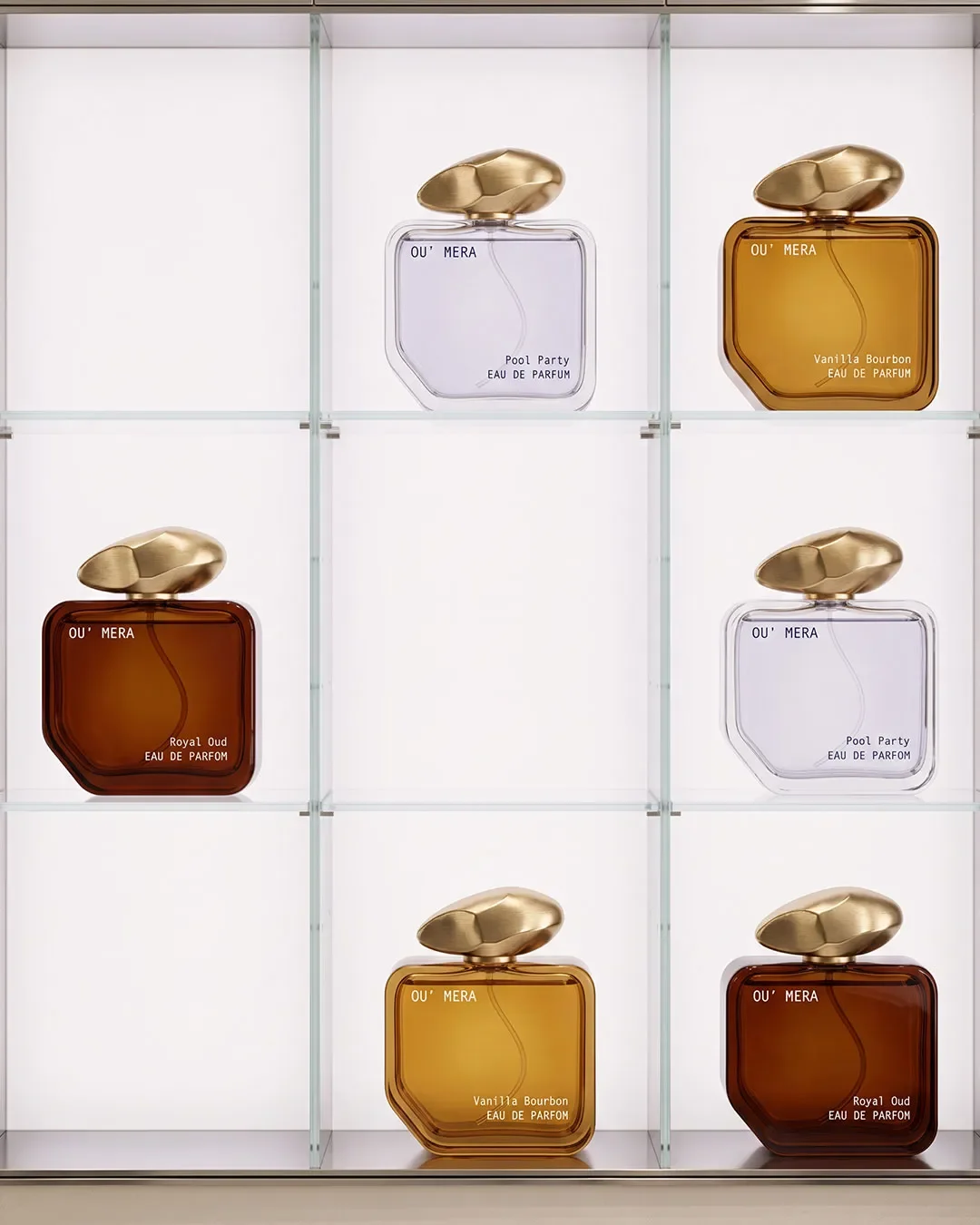
Check three things. The brand name should be readable from a few steps away. The product type, such as serum, cleanser or moisturiser, should be clear at a glance. The colour or shape of the pack should be distinctive enough that a returning customer finds it without reading anything.
Print a pack at actual size, place it on a table and step back. If you cannot tell what it is, a shopper will not be able to either.
Make SKUs Easy to Navigate
SKU navigation is how easily a shopper finds the right product within your range. Online, filters and product pages do that job. On a shelf, the pack does it. Implementing a systematic skincare packaging system for multiple SKUs resolves this layout challenge, giving your collection automatic visual organization.
Give every product a consistent position for the product name, a clear marker for the variant or skin concern, and a visible size. Colour coding by product type or concern works well when the colours are different enough to separate at distance. If three products look almost identical and differ only in a line of small text, shoppers pick up the wrong one and store teams restock the wrong one.
Line up the full range in a row before you finalise anything. Each product should be identifiable on its own, and together they should still look like one brand.
Keep the Parts Customers Already Recognise
An established DTC brand has recognition worth protecting. Keep the logo, primary colour, typeface and any signature pack shape. Adjust hierarchy, scale and the amount of copy. A customer who found you online should spot you in store without a second look. Formalizing these rules in your corporate beauty brand guidelines guarantees that retail partners, distributors, and designers don't dilute your identity when executing shelf rollouts.
Barcodes, Case Packs and Other Retail Packaging Requirements
Stockists run on systems. A beautiful product that cannot be scanned, counted or shipped in the right quantities creates work for the retailer, and that tends to end the conversation.
Barcodes: every retail unit needs a scannable barcode, with a separate number for each size and variant. They are issued through GS1, as a UPC in the US and Canada and an EAN in the UK, Europe and Australia. Place the barcode on a flat area, away from curves, seams and foil, and leave clear space around it. For boxed products, it belongs on the carton.
Case packs: a case pack is the group of units a stockist orders and receives together, often 6, 12 or 24. Decide the quantity early, then check that the shipping carton protects the product and carries a label with the product name, quantity and barcode.
Durability: retail packaging is handled far more than DTC packaging. Cartons are stacked, picked up, put back and sometimes opened. Test that foil, soft touch coatings and closures survive scuffing, because a marked pack loses shelf appeal before it is sold.
Label information: ingredient lists, batch codes, period after opening symbols and claims vary by market. Confirm the requirements for each territory with your compliance advisor before artwork is final, and give this information a planned place on the pack.
Fixture fit: ask each stockist for shelf depth and height limits. A tall carton that does not fit a standard bay will not be stocked.
How Can Packaging Stand Out on a Retail Shelf?
Skincare shelf appeal comes from being easy to notice, easy to understand and easy to remember, and the packaging is judged against the products next to it.
Start with the category. Visit stores that could stock you and photograph the section. Note the dominant colours, type styles and finishes. If every pack nearby is white with pale green type, a calm white pack disappears. You do not need to be loud. You need one clear reason to be noticed, such as a distinct colour, a confident typeface, an unusual shape or a finish that catches the light.
Think about facings. A facing is one unit visible at the front of the shelf, and most brands get one or two. The front of the pack carries most of the work, so repeat the brand name on the sides and top for products that sit at an angle or in a stack.
Think in blocks. When your products sit side by side, they form a block of colour and shape. A consistent system across the range makes that block easy to spot from the end of an aisle. Then give the hero product, the one that drives discovery, the clearest packaging and the strongest position.
Displays and Testers: What Stockists Expect
Many beauty retailers expect support in store beyond the stock itself. Displays and testers are the two most common requests.
Displays
A display can be a countertop unit, a shelf strip, a header card or a shelf talker. Each one is a small piece of brand environment that has to work inside the stockist's fixtures, so ask for dimensions before designing. Keep the message short: product name, one benefit and a price if the retailer allows it. Use the same visual system as the packaging so the two read as one unit, and keep assembly simple because store teams rarely have time for complicated builds.
Testers
Shoppers buy beauty by trying it. A tester should be clearly marked, hygienic to use and sturdy enough for repeated handling. Decide which products need one, how testers are labelled and whether the stockist expects them free or at a reduced cost. For skincare, pumps and spatulas are easier to keep clean than open jars. Tester packaging that looks cheap lowers the perceived value of the whole range, so give it the same care as the retail unit.
Before committing to either, ask the stockist what has worked for similar brands in their store.
What Assets Do Beauty Retailers Need From Brands?
Retailers list, merchandise and promote your products across several teams. The easier you make that, the faster the product moves.
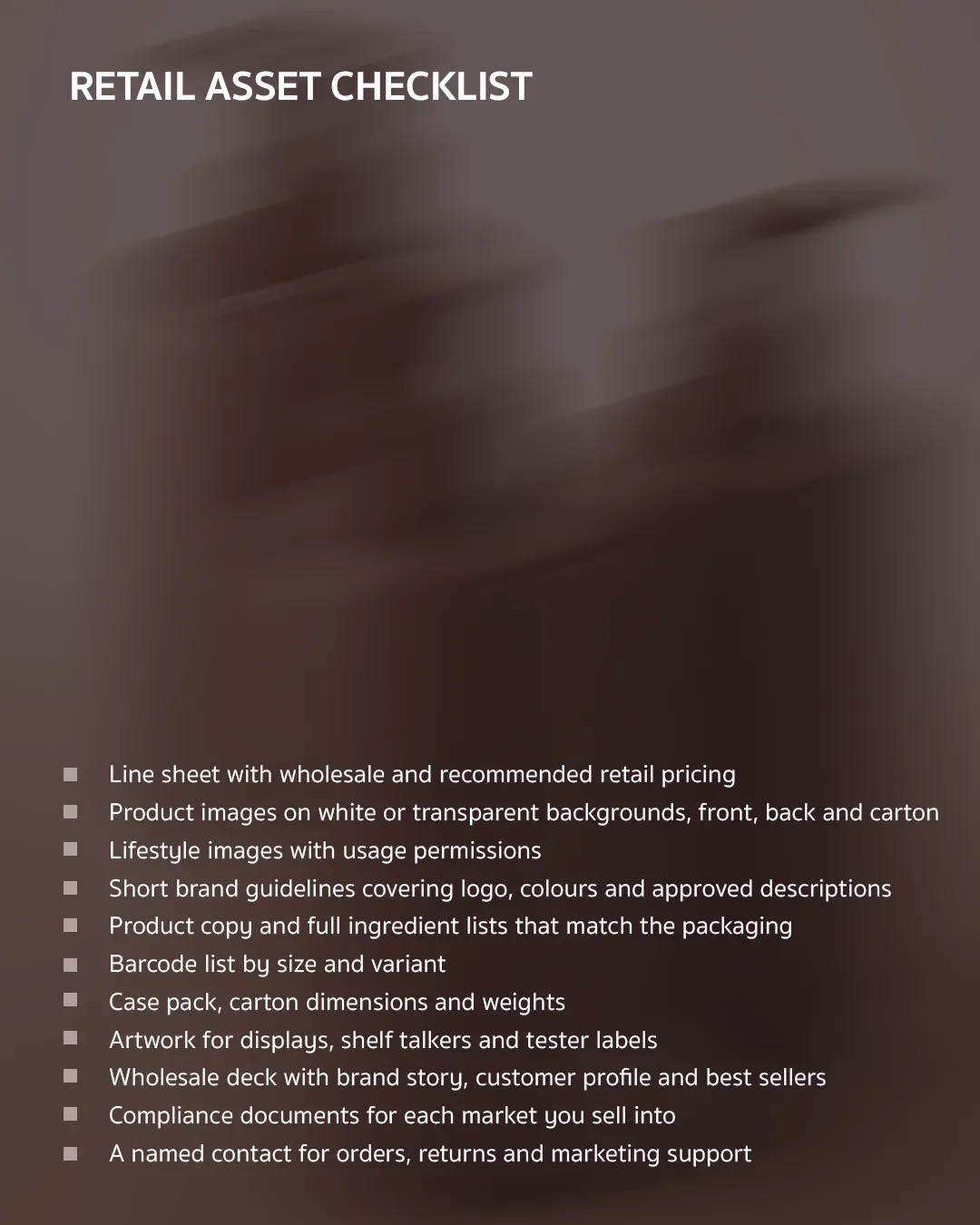
The line sheet comes first. It is a one or two page document with product names, sizes, barcode numbers, wholesale price, recommended retail price, case pack and minimum order. Buyers keep it open while they decide, so it should be clean, accurate and consistent with the packaging.
Retailer imagery is next. Provide clean product shots on white or transparent backgrounds at the sizes the retailer specifies, showing the front, back and carton. Add a small set of lifestyle images they can use for their own marketing. Update these whenever the packaging changes, because old images on a stockist's site create confusion fast.
How to Keep Your Brand Consistent Across DTC and Retail Channels
Channel consistency means a customer meets the same brand whether they buy from your website, a department store or a boutique. It also protects the relationship with stockists, who pay attention to how you behave online.
Names and descriptions: use the same product names and descriptions on the pack, your website and every retailer listing.
Packaging and imagery: if a retail pack differs from the DTC version, update your website images and explain the difference so customers are not confused.
Pricing: align your DTC price with the recommended retail price. Permanent discounts on your own site that undercut stockists strain the relationship quickly.
Communication: tell DTC customers where they can find you in store, and give stockists notice before online launches or promotions.
Good skincare wholesale branding makes the brand feel like one business across every channel, with the details adjusted to suit each one.
Shelf Audit: How to Test Your Packaging Before You Pitch Stockists
A shelf audit is a structured check of how your packaging performs beside real competitors. It takes an afternoon and finds problems that are cheap to fix now and expensive to fix after production.
Choose three to five stockists you want to approach, then visit their beauty sections or collect clear photos of them.
Photograph the category from standing distance and again from arm's length.
Place your range in that setting, using printed packs or accurate digital mockups, beside the competitors.
Score each product from 1 to 5 on readability at distance, clarity of product type, ease of finding it within the range, distinctiveness and quality feel.
Ask someone who does not know your brand to find a specific product within a few seconds.
Fix the lowest scoring areas before artwork goes to print.
Repeat the audit with each new stockist type, since a department store counter and an independent boutique shelf test a pack in different ways.
FAQs: DTC Beauty Brands Moving Into Retail
How should beauty packaging change for retail?
Make the brand name and product type readable from shelf distance, give each SKU a clear and consistent system, and meet stockist requirements such as barcodes, case packs and fixture sizes. Keep the logo, colours and typeface customers already recognise.
What assets do beauty retailers need from brands?
A line sheet, clean product images, lifestyle images, short brand guidelines, product copy with ingredients, a barcode list, case pack details and artwork for displays and testers.
How do DTC skincare brands prepare for wholesale?
Start with a shelf audit to see how the packaging performs beside competitors. Then adjust the packs, set up barcodes and case packs, build the line sheet and imagery, and align pricing and product names across your website and stockists. Working in that order lets you fix design issues before they reach production.
How can packaging stand out on a retail shelf?
Study the products around yours and choose a clear point of difference, such as colour, shape or finish. Make the front of the pack readable from a distance, build a consistent system so your range forms a recognisable block, and give the hero product the strongest position.
Do beauty products need barcodes for retail?
Yes. Most stockists require a scannable barcode on every unit, with a separate number for each size and variant. Barcodes are issued through GS1.
Should DTC and retail packaging be identical?
The identity should match. The details often differ, because retail packs need barcodes, a tighter hierarchy and sturdier finishes. Keep names, colours and pack shapes consistent so customers recognise the product in either channel.
Prepare Your Beauty Brand for Retail
Moving from DTC to stockists is a design project as much as a sales one. Elouvé Collective works with beauty founders on packaging, brand assets and identity systems built to perform on a shelf, from shelf audits through to line sheets and display artwork. If your brand is preparing for retail and you want the packaging to hold up beside the competition, get in touch to prepare your beauty brand for retail.
