
A useful packaging manufacturer brief gives suppliers enough information to quote the same scope and flag production risks early. It should cover structure, dimensions, materials, finishes, quantities, artwork status, testing needs, delivery and approval stages.
A founder sends the same email to five manufacturers: “We need 5,000 airless pumps, luxury feel.” Five quotes come back. One is built around a PP pump, one around an aluminium collar, and two assume stock components. The fifth costs double the rest and nobody can say why. The quotes cannot be compared, so the founder picks the cheapest and finds the real cost three months later.
A quote reflects the brief it was written from. A thin brief gets a guess, and a guess gets padded. This checklist covers what to gather before you contact a supplier, so the quotes you receive can be read side by side and the samples you approve match the product you pictured.
Why Most Packaging Quotes Are Useless (and the Brief Is Usually the Reason)
When a manufacturer receives a vague request, there are three things they can do. They assume what you probably mean, they add margin for everything they could not confirm, or they quote the cheapest specification that fits your words. Each one gives you a number that does not describe your product.
A good brief turns quotes into a comparison tool. Every supplier prices the same pump, the same finish and the same quantity, so the differences you see are real differences in price, lead time and terms.
What information does a packaging manufacturer need for a quote?
A supplier needs enough detail to price one specific pack. At minimum:
Formula type and anything in it that affects materials
Fill volume, capacity and format
Neck finish, closure and every component
Materials, colours, print and finish
Quantities, including a first order and a forecast
Shipping destination and delivery terms
Target price and launch date
Tooling expectations and ownership
The sections below take each one in turn.
Start With the Product Inside the Pack
The formula decides the packaging before any design choice does. Tell the supplier what goes into the pack, because it determines which materials will survive it.
Share the product type (serum, cream, oil, mist, balm, shampoo), the viscosity (water thin, gel, thick cream), the target fill volume, and the pH. Flag anything aggressive: high alcohol content, essential oils, fragrance load, acids, retinol or vitamin C. These can soften plastics, attack gaskets and lift decoration. You rarely need to hand over the full formula. The category, viscosity, pH and a list of known risk ingredients give a supplier enough to recommend suitable materials.
Suppliers can advise, and the brand stays responsible for confirming the pack works with the formula. Ask your lab for stability and compatibility results, and mention in the brief whether testing has been done or is still to come.
Define What the Pack Must Be and Do
Start with capacity. State the fill volume in ml and the vessel capacity separately, because they differ. A 30 ml fill usually needs a vessel with more internal volume to leave headspace.
Then set the dispensing method: pump, airless pump, dropper, spray, jar or tube. Add the neck finish, which is the thread size and style on the bottle, written as numbers such as 18/415 or 24/410. Bottle and closure must share it. If you do not know yours, send a photo of a pack you like or ask the supplier to recommend one. Understanding the commercial trade-offs between custom vs stock packaging at this stage will help you decide if standard components fit your vision or if custom tooling is required.
List every component on its own line: bottle, pump or dropper, collar, cap, outer cap, label, carton and insert. Each has its own material, colour and price, and each is a place a quote can go wrong.
Finish with the environment and your non negotiables. Say where the pack will live (bathroom shelf, handbag, courier box) and name the one or two things that cannot change, such as glass, a certain weight, or refillability.
Specify Materials and Finishes Without Guessing
You do not need technical vocabulary to brief materials well. You need clear references. Send images of packs you admire, name the brands, and describe the feel: heavy, cool to the touch, soft matte, high gloss. A line such as “frosted glass, matte black pump, one colour white print” gives a supplier more to work with than “premium.”
Name the material options you are open to: glass, PET, PETG, PP, aluminium, FSC board. If recycled content or recyclability matters to your claims, say so now, because it changes what the supplier can offer.
For colours, give Pantone references and send a physical swatch where you have one. Colour reads differently on glass, plastic and board, so ask how each supplier matches and approves colour.
For print and finish, state the method you want (hot foil, screen print, pad print, soft touch coating, embossing or a printed label), the placement and the number of colours. Once these visual parameters are set, you must align them to the manufacturer's exact template by preparing flawless packaging dielines and print ready artwork to prevent production errors.
Put Real Numbers on Quantity and Timing
Give two figures: your first order and your forecast for year one. “3,000 units now, 20,000 across the year” lets a supplier price the first run and show where the price drops. Ask for pricing at three quantity tiers so you can see how volume changes the unit cost.
Minimum order quantities vary by component, material and decoration, so ask for each one in writing. If you can tolerate a quantity slightly under or over the minimum, say so. Phased deliveries are also worth raising, since some suppliers will split one order into several shipments.
Work your launch date backwards: sample approval, production, shipping, then filling. Put the date you need packaging at your filler in the brief.
State your shipping destination too: country, city, and whether goods go to a filler, warehouse or fulfilment partner. Freight cost and import duties depend on it, and so does whether the receiving site can accept pallets.
Set a Budget Range Before You Ask for a Price
Decide your target cost per complete unit, meaning every component added together, and the ceiling you cannot pass. Share a range. Founders often worry that revealing a budget invites a price at the top of it. Asking for itemised quotes by component, from at least three suppliers, keeps that in check.
Confirm what each price includes: tooling, decoration, cartons, packing, samples and freight.
One caution on shipping terms. Incoterms such as ex works (EXW), free on board (FOB) and delivered duty paid (DDP) decide who pays for freight, insurance and duties, and who carries the risk at each stage. An EXW price looks lower than a DDP price for identical goods because it covers less. Name the Incoterm you want every supplier to quote, and check the choice with your freight forwarder before you compare totals.
Gather Your Artwork and Technical Files
At quote stage, send your logo in vector format (AI, EPS or PDF), brand colour references, a simple layout showing where print sits, reference images and any dimensions you have.
At sampling stage, you will need finished dielines and print artwork. For the brief, you only need to confirm that a dieline exists and say who is supplying it, yours or the manufacturer’s template.
Put everything in one folder with clear file names and a one page spec sheet on top. Suppliers answer faster when the first thing they open explains the rest.
Compliance, Testing and Claims to Flag Early
Name the markets you sell into, because labelling and material requirements differ between the UK, EU, US and Australia. Ask suppliers for the material declarations and compliance documents your market needs.
List the tests you expect: leak, drop, pump dose, closure torque and transit. Allow label space for mandatory information such as ingredients, batch code and volume, since it affects the size of print areas.
If you plan to claim recyclable, refillable or recycled content, ask the supplier for evidence behind it. Raising these points early keeps them from changing your materials and costs late in the process.
Ask for Samples and Quotes in a Format You Can Compare
Send every supplier the same document and ask for replies in the same layout.
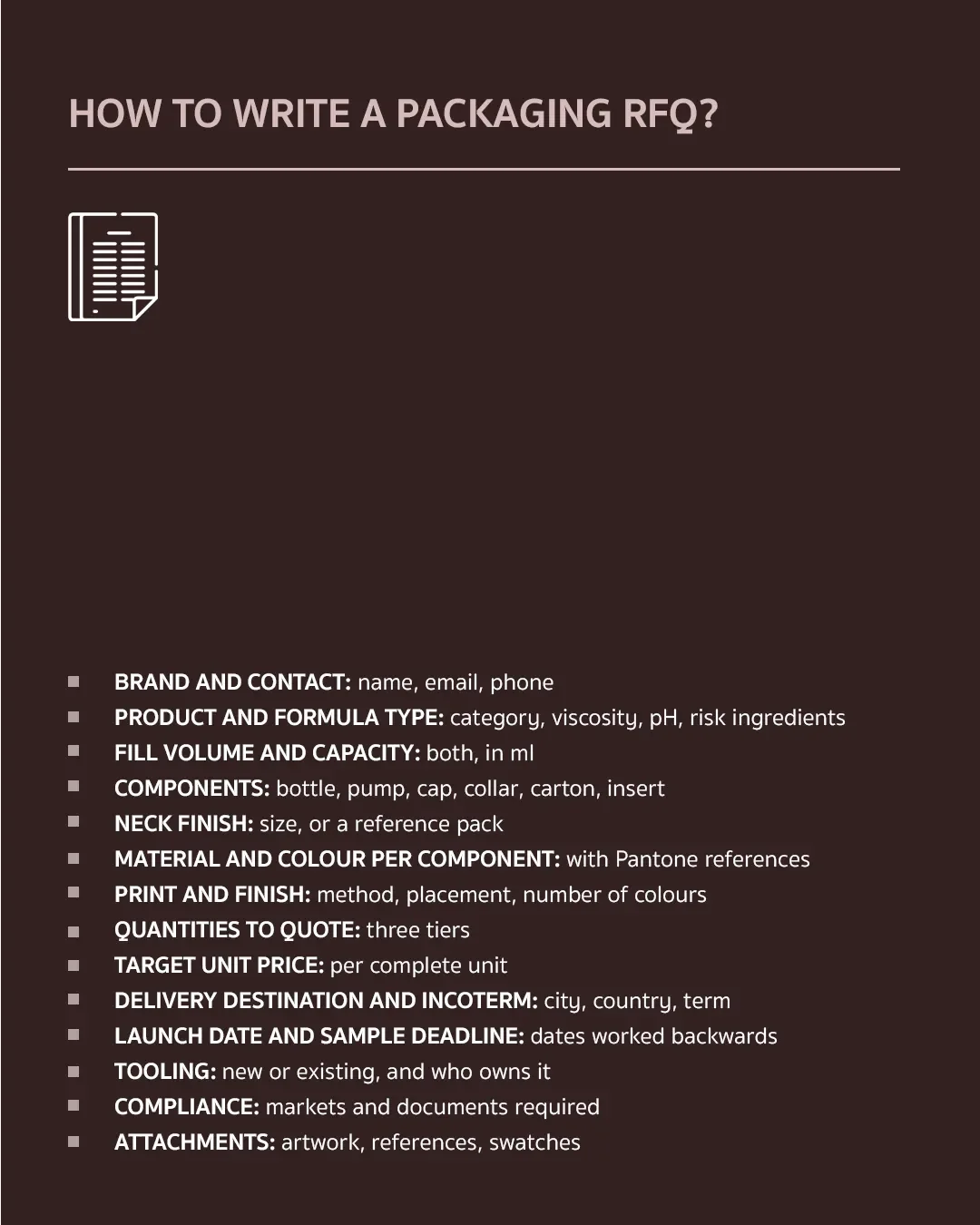
How do I write a packaging RFQ?
A request for quotation (RFQ) is one or two pages that tell a supplier exactly what to price. Copy this and fill it in:
How do I compare packaging supplier quotes?
Copy this into a spreadsheet and fill one column per supplier.
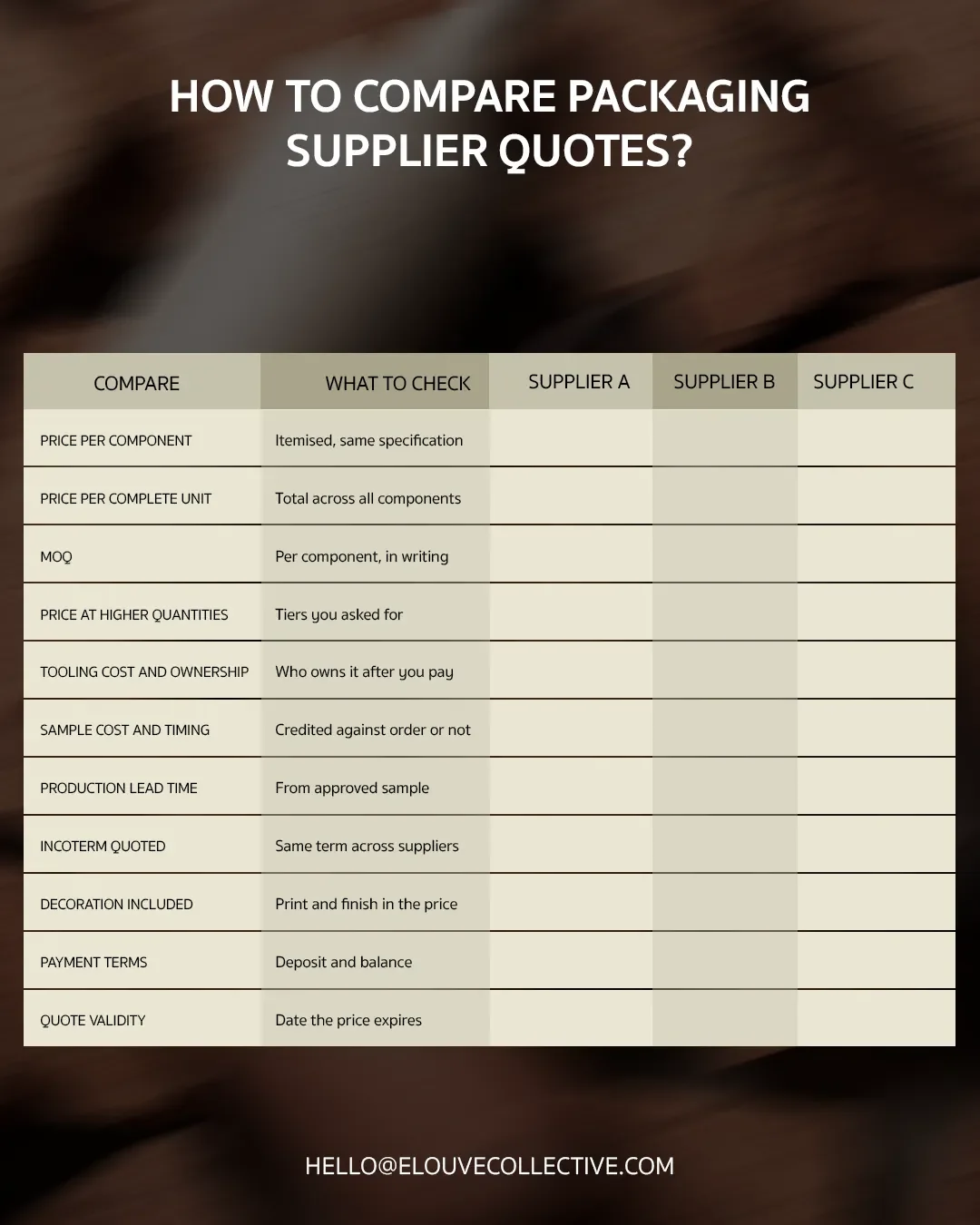
Compare prices only after the specification and the Incoterm match across suppliers.
Questions to Ask Every Manufacturer Before You Choose One
What should I ask a cosmetic packaging supplier?
Have you made packs for beauty brands at my quantity, and can I speak to a client?
What are your MOQs for each component, and how do they change with decoration?
Who owns the tooling once I have paid for it, where is it stored, and will you release it if I move supplier?
How long does the tooling last, and who pays for maintenance?
What quality checks run before shipping, and what defect rate do you accept?
How do you match colour and keep it consistent between batches?
Who is my day to day contact, and how quickly do you reply?
What happens if a batch arrives faulty?
Tooling ownership deserves a written answer. Founders regularly pay for a mould and later learn the supplier holds it. Get ownership, storage and release terms into the quote itself.
Watch for vague answers on tooling, no questions about your formula, no sample policy, and pressure to pay a deposit before the specification is agreed.
Sampling and Testing Expectations Before You Commit to Production
Ask which sample stages each supplier offers and what each costs. A typical path runs from a stock sample to judge shape and weight, to a decorated sample of your real components, to an approved sample that becomes the standard production is measured against. To avoid confusion with your supplier, learn the specific differences between a packaging prototype vs mockup vs production sample so you know exactly what you are paying for at each evaluation gate.
Fill the decorated sample with your actual formula and test it. Check pump dose, leaks, closure fit, and how decoration holds up over a few weeks of use. Keep the signed sample, and ask the supplier to keep an identical one.
Allow several weeks for decorated samples and longer where new tooling is involved. Ask for the timeline in writing, and ask whether sample costs are credited against your first order.
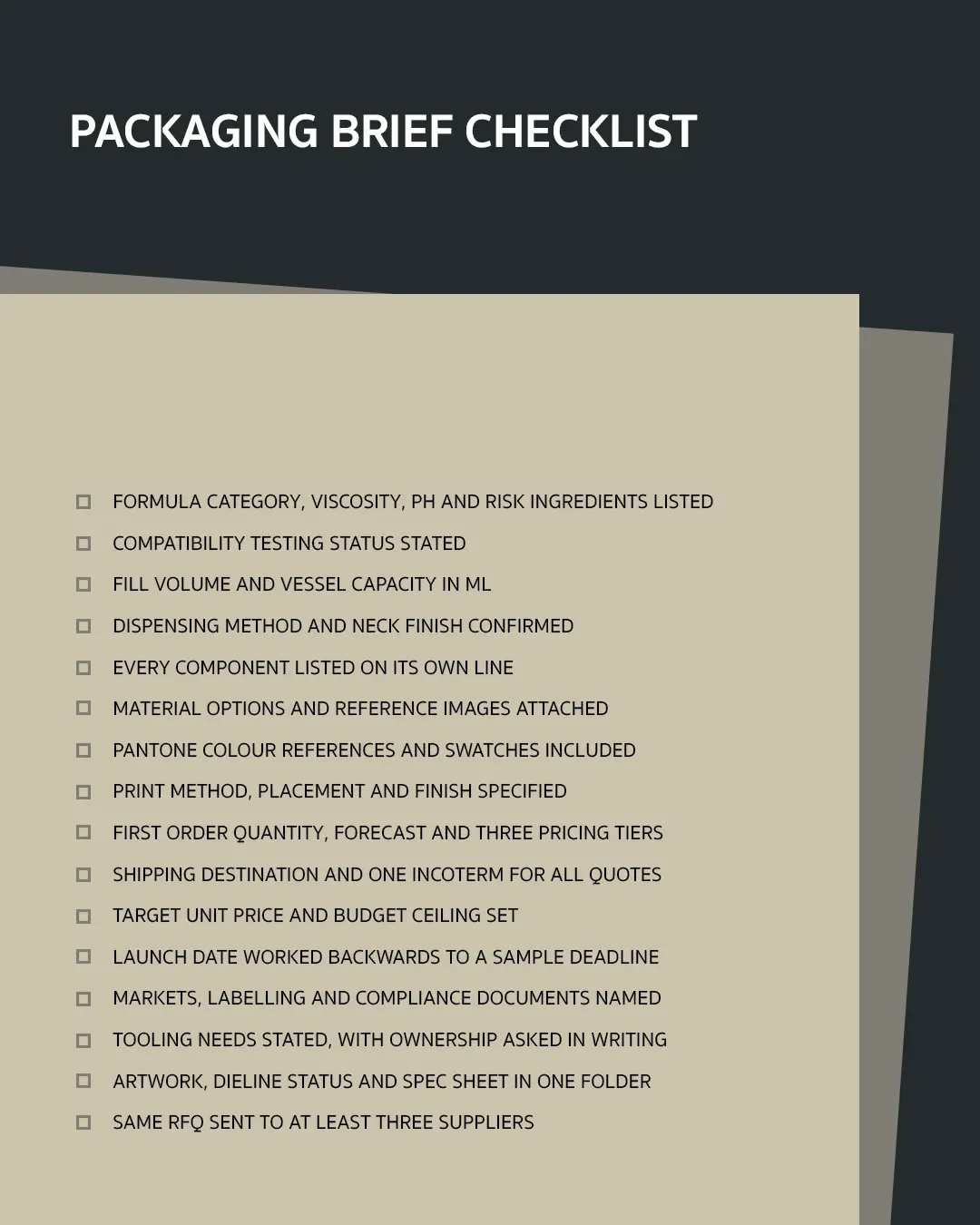
Your Packaging Brief Checklist
FAQs: How to Brief Packaging Manufacturer
What should I include in a packaging brief?
Include the formula type, fill volume, components, neck finish, materials, colours, print and finish, quantities, shipping destination, budget, launch date and tooling expectations. The checklist above lists each one.
How many manufacturers should I request quotes from?
Three to five is a workable range. Fewer leaves you with little to compare, and more creates a lot of follow up for little extra insight.
What MOQ should a new beauty brand expect?
It depends on the component, material and decoration. Stock components generally carry lower minimums than custom parts, and glass and custom moulds sit higher. Ask each supplier for MOQs per component in writing.
How long do packaging samples take?
Decorated samples commonly take several weeks, and new tooling adds more. Ask the supplier for a written timeline before you plan your launch date.
Who should own the packaging tooling?
If you paid for it, ask for ownership to be written into the quote, along with where it is stored and how it can be released to another supplier.
Where to Start
A strong brief takes a few focused days to assemble, and the effort carries through every quote, sample and production run. If you would like a second pair of eyes on your specification, or packaging designed so suppliers can price it accurately, Elouvé’s packaging design service covers it.
Prepare your packaging project, Book a discovery call or email us directly at hello@elouvecollective.com
